
It happens in the quietest moment: a delicate glass bauble teeters on the edge of the mantel, then—*clink-crash*—shatters on the hardwood. Or your heirloom ceramic bird tumbles from its shelf just as you walk into the room. You sigh, sweep up the pieces, and wonder—not for the first time—why does my cat do this? It’s rarely malice. More often, it’s instinct, curiosity, boredom, or unmet needs wearing the guise of chaos. Understanding the root causes is the first step toward a peaceful coexistence with both your cat and your cherished decorations.
The Instinctive Roots: Why Knocking Things Over Makes Biological Sense
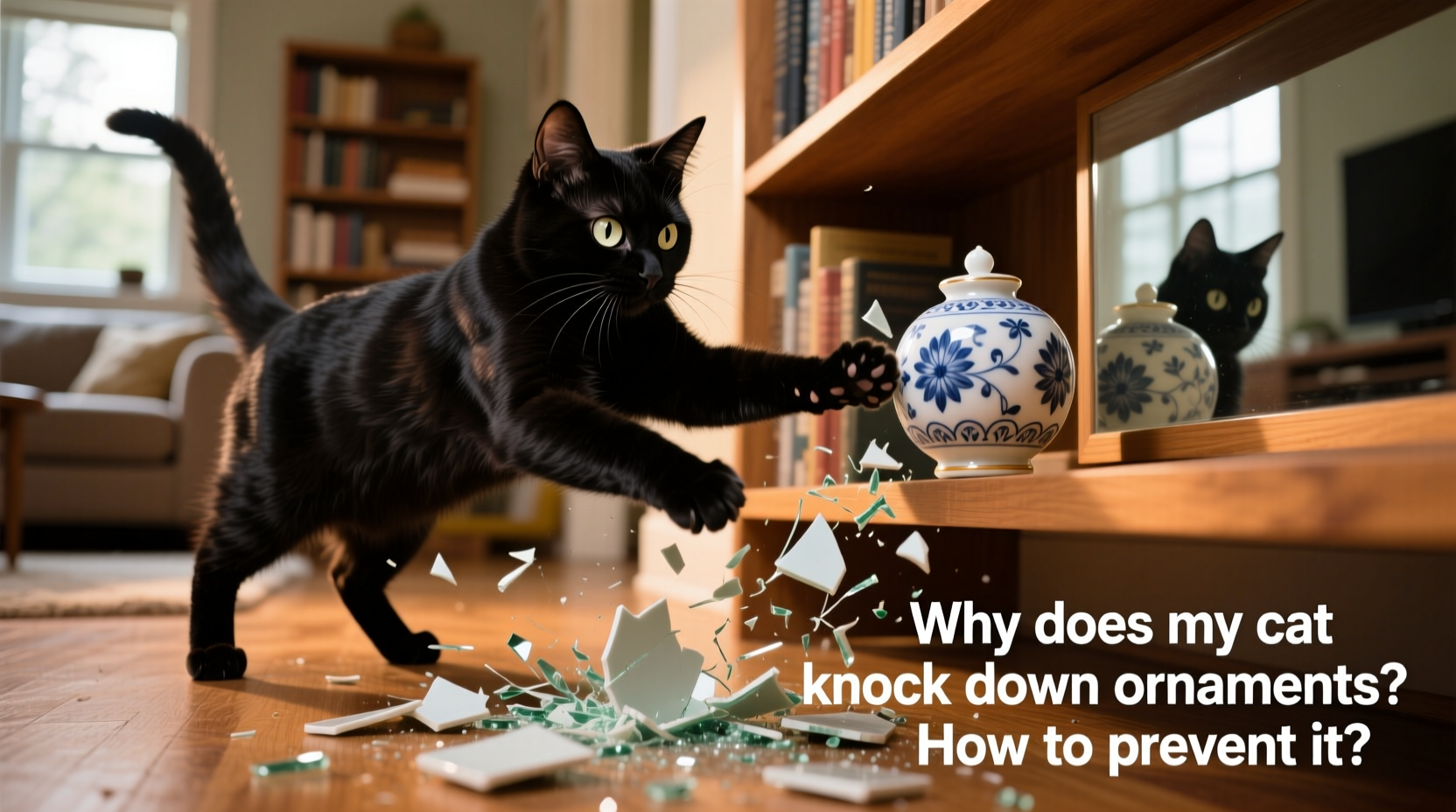
Cats don’t perceive shelves, mantels, or tabletops as “off-limits display zones.” They see elevated surfaces as vantage points—territorial landmarks that offer surveillance over their domain. When your cat bats at an ornament, they’re not targeting your holiday decor; they’re engaging in behaviors honed over 60 million years of evolution.
Three core instincts drive this behavior:
- Hunting rehearsal: A dangling ornament swaying in a draft mimics prey movement. Even indoor cats retain strong predatory drive—pouncing, batting, and “killing” moving objects is neurologically reinforcing.
- Sensory exploration: Cats learn about the world through touch, sound, and cause-and-effect. The sharp *tink* of glass, the wobble before the fall, the sudden motion—it all provides rich sensory feedback that satisfies innate curiosity.
- Attention-seeking (secondary reinforcement): If knocking something down reliably earns your voice, your movement, or even your frustrated glance—even negative attention—the behavior becomes reinforced. Your reaction, however brief, tells your cat: This action makes something happen.
This isn’t misbehavior. It’s communication—often in a language we’ve forgotten how to read.
Environmental Triggers: What’s Really Inviting the Chaos?
Not all cats knock things over equally—and not all homes invite the same level of ornament-toppling. Environmental factors significantly increase the likelihood of incidents. Consider these common triggers:
| Trigger | Why It Encourages Knocking | Real-World Example |
|---|---|---|
| Unstable placement | Ornaments balanced on narrow ledges, uneven surfaces, or wobbly stands activate a cat’s instinct to test stability—like nudging a branch before climbing. | A crystal ball perched precariously on a curved marble shelf invites repeated gentle taps until gravity wins. |
| Reflective or shiny surfaces | Light glinting off glass or metal creates unpredictable visual stimuli—flashes that mimic insect wings or darting prey. | A mirrored ornament catching afternoon sun becomes a flickering target during quiet hours. |
| Lack of vertical enrichment | When cats lack appropriate climbing structures (cat trees, wall-mounted shelves), they repurpose furniture and decor as impromptu perches—and launchpads. | A bookshelf lined with knick-knacks becomes the only tall, stable surface available for surveying the room. |
| Understimulation during peak activity windows | Cats are crepuscular—most active at dawn and dusk. Without scheduled play, pent-up energy manifests as object manipulation. | At 5:47 a.m., your cat circles the Christmas tree, then deliberately bats a pinecone ornament off its hook—repeatedly. |
These aren’t excuses—they’re diagnostic clues. Spotting the pattern helps you intervene precisely, not punitively.
Evidence-Based Prevention Strategies (That Actually Work)
Scolding, spraying water, or yelling may stop the behavior momentarily—but they damage trust, increase anxiety, and fail to address the underlying need. Effective prevention works with feline nature, not against it. Here’s what veterinary behaviorists and certified cat behavior consultants consistently recommend:
- Redirect the hunting impulse daily: Schedule two 15-minute interactive play sessions using wand toys (e.g., Da Bird or FroliCat) that mimic erratic prey movement. End each session with a small meal or treat—this completes the “hunt-eat-groom-sleep” sequence, satisfying the predatory drive.
- Stabilize the environment: Use museum putty, non-slip shelf liners, or removable adhesive pads under bases. Anchor lightweight shelves to walls. Place fragile items behind sturdier, immovable objects (e.g., books or decorative boxes).
- Create designated “knock zones”: Set up a low shelf or platform with safe, noisy, knockable items—wooden blocks, stainless steel bowls filled with dried beans, or weighted plush toys. Reward your cat lavishly when they interact with these instead of your decor.
- Modify access strategically: Close doors to high-risk rooms during unsupervised hours. Use baby gates that allow airflow but block passage. Install motion-activated deterrents (like the PetSafe SSSCAT spray) *only* on surfaces where ornaments sit—not near your cat’s bed or food bowl.
- Enrich scent and texture: Cats prefer surfaces with varied textures and familiar scents. Rubbing a cloth on your cat’s cheeks (where facial pheromones are released) and then dabbing it on stable furniture edges can make those areas more appealing than shiny ornaments.
A Real-Life Shift: How Maya Transformed Her Home in Three Weeks
Maya lived in a historic row house with floor-to-ceiling built-in bookshelves displaying her late grandmother’s porcelain collection. Within weeks of adopting Luna—a playful 2-year-old domestic shorthair—three figurines had shattered. Frustrated and grieving, Maya consulted a certified feline behaviorist.
They observed Luna’s routine: she’d patrol the shelves at 6 a.m., bat gently at items for 3–4 minutes, then retreat to nap—until the next cycle. No signs of anxiety or aggression. Just persistent, rhythmic interaction.
The behaviorist recommended three changes: First, Maya installed a wall-mounted cat highway along the top of the bookshelves—giving Luna a dedicated, stable path to survey the room. Second, she placed a rotating “knock station” on a lower shelf: a wooden tray holding smooth river stones, a bell-filled jingle ball, and a felt mouse—all secured with museum putty. Third, she began daily dawn play sessions using a feather wand, ending each with Luna’s favorite freeze-dried chicken.
By day 12, Luna stopped approaching the porcelain entirely. By day 21, she’d chosen the river stones as her preferred tactile toy—and the bell-filled ball became her go-to “prey” for solo play. The porcelain remained intact. More importantly, Luna slept more deeply, groomed less obsessively, and greeted Maya with chirps instead of silent stares. The change wasn’t about controlling the cat—it was about meeting her needs so thoroughly that the ornaments lost their appeal.
Expert Insight: What Veterinary Behaviorists Emphasize
“Cats don’t ‘misbehave’—they behave. Every action serves a function: to explore, to hunt, to communicate, or to cope. When we respond with punishment instead of inquiry, we miss the opportunity to deepen our bond and solve the real problem. The most effective interventions are those that satisfy the instinct, not suppress the symptom.” — Dr. Sarah Wooten, DVM, CVJ, Veterinary Behavior Consultant and author of Feline Focus: Understanding the Mind Behind the Meow
Dr. Wooten’s perspective underscores a critical shift: This isn’t about training your cat to obey. It’s about designing an environment where their natural behaviors have healthy outlets—and where your treasured objects coexist peacefully with their evolutionary imperatives.
Practical Prevention Checklist
Use this actionable checklist to audit and adjust your space—no professional help required:
- ✅ Assess stability: Gently nudge every ornament on display. If it shifts, wobbles, or tilts easily, secure it or relocate it.
- ✅ Map peak activity times: Note when your cat is most alert and energetic (usually dawn/dusk). Schedule interactive play 15 minutes before those windows open.
- ✅ Install vertical alternatives: Ensure at least one sturdy cat tree or wall-mounted perch exists within 6 feet of any high-risk surface.
- ✅ Create a “safe knock zone”: Dedicate one low, accessible shelf to textured, noisy, non-fragile items—and reward interaction there with treats or praise.
- ✅ Remove reflective temptation: Relocate or cover highly reflective ornaments during your cat’s most active hours—or replace them with matte-finish alternatives.
- ✅ Check for stress signals: Excessive grooming, hiding, or changes in litter box habits may indicate environmental anxiety—address that first, as stress amplifies displacement behaviors like object-knocking.
FAQ: Addressing Common Concerns
Will my cat ever stop knocking things over completely?
Most cats significantly reduce the behavior once their physical, sensory, and emotional needs are consistently met—but occasional knocking may persist, especially during growth spurts (kittens), seasonal shifts (increased daylight in spring), or after periods of reduced stimulation. The goal isn’t perfection; it’s predictable, manageable interaction that protects both your belongings and your relationship.
Is it okay to use citrus sprays or vinegar near ornaments to deter my cat?
No. Citrus oils and vinegar are irritants that can harm cats’ respiratory tracts and sensitive skin. More critically, they create aversion to the *area*, not the *object*—so your cat may avoid the shelf entirely, losing valuable vertical space, or simply shift the behavior elsewhere. Positive redirection is safer and more effective long-term.
My older cat started knocking things over recently—is this normal?
Sudden onset in senior cats warrants a veterinary visit. Cognitive decline (feline cognitive dysfunction), arthritis pain (causing frustration with mobility), or vision/hearing loss (leading to increased tactile exploration) can all manifest as new object-knocking. Rule out medical causes before assuming behavioral ones.
Conclusion: Harmony Is a Design Choice, Not Luck
Your cat isn’t sabotaging your home. They’re navigating it with senses, instincts, and needs far older—and far more urgent—than your decorating choices. Every ornament knocked over is data: a clue about unmet play needs, insufficient vertical territory, or an environment that doesn’t speak their language. Prevention isn’t about barricading your belongings behind invisible walls. It’s about building bridges—between species, between instinct and intention, between your love for beauty and your cat’s need for purpose.
Start small. Secure one shelf today. Play for fifteen focused minutes tomorrow. Watch where your cat lingers, what they sniff, how they move—and let those observations guide your next step. You won’t eliminate every tumble, but you’ll transform chaos into connection. And in that space—where curiosity is honored, not punished, and where your cat feels deeply understood—you’ll find something far more enduring than unbroken glass: mutual respect, quiet joy, and a home that truly belongs to both of you.




 浙公网安备
33010002000092号
浙公网安备
33010002000092号 浙B2-20120091-4
Comments
No comments yet. Why don't you start the discussion?