
Cats and Christmas trees share a complicated relationship. One moment, your cat is curled up beneath the twinkling lights like a scene from a holiday card. The next, a glass ornament lies shattered on the floor, and your tree leans precariously to one side. If you’ve ever found yourself asking, “Why does my cat do this?” you’re not alone. Millions of cat owners face the same seasonal challenge each year. Understanding the behavior behind the batting paws and leaping attacks is the first step toward preserving both your decorations and your peace of mind.
Cats are natural predators with instincts honed over thousands of years. A Christmas tree—with its dangling objects, rustling branches, and flickering lights—activates their hunting drive. What looks like mischief is often curiosity, play, or territorial exploration. Rather than punishing your cat, the solution lies in redirection, prevention, and thoughtful preparation. This guide explores the science behind feline behavior, offers proven protection strategies, and helps you maintain a joyful, cat-friendly holiday season.
The Science Behind the Swat: Why Cats Attack Ornaments
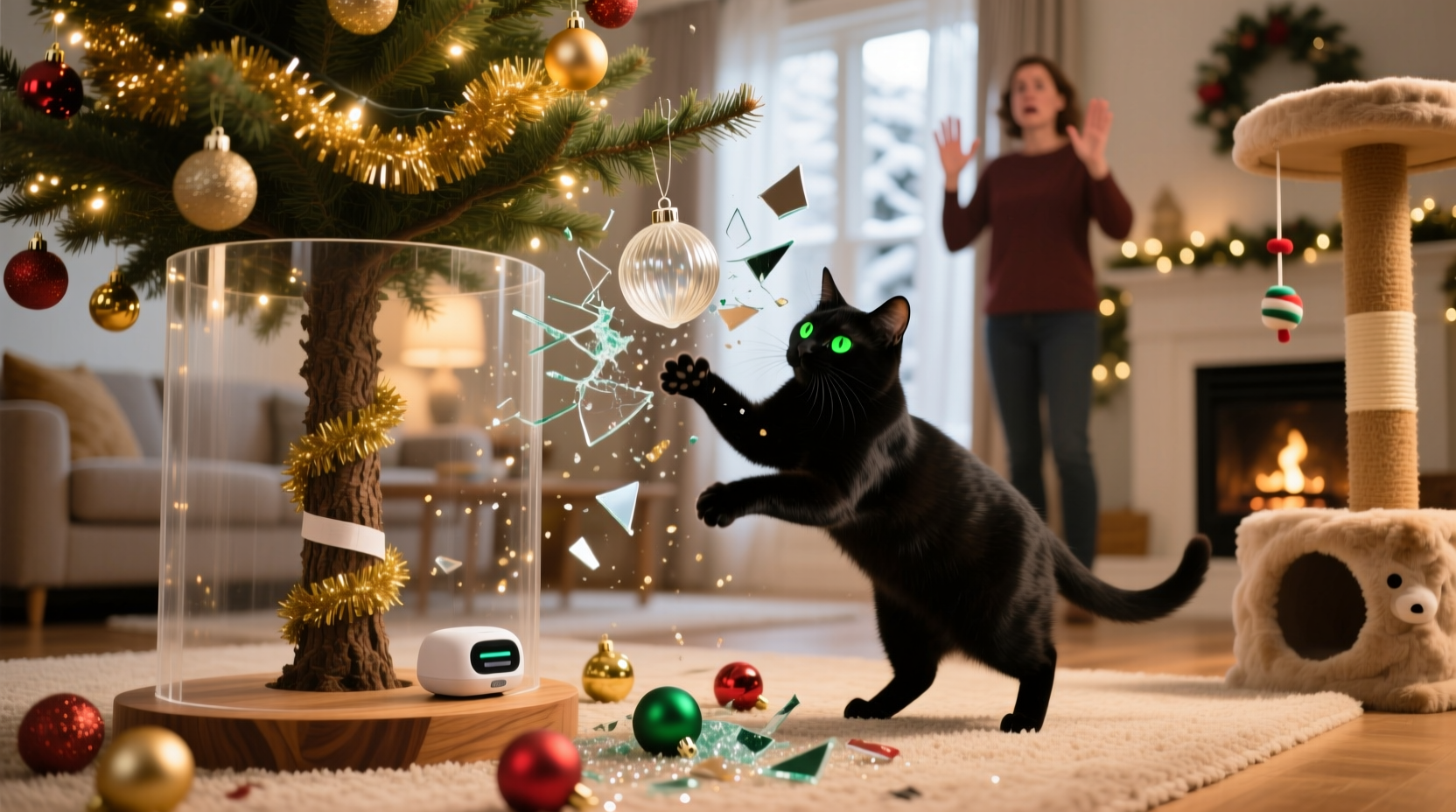
Cats don’t knock things over to annoy their owners. Their actions stem from deeply ingrained behaviors rooted in survival. When a cat bats at an ornament, it’s engaging in instinctual play that mimics hunting. Small, moving, or reflective objects trigger predatory sequences: stalk, pounce, bat, and capture. Ornaments hanging from a tree resemble prey—especially those that sway in air currents or reflect light.
Additionally, cats use their paws to investigate the world. They lack opposable thumbs but have highly sensitive nerve endings in their paw pads. Bumping or swiping at an object provides tactile feedback, helping them assess texture, weight, and movement. A dangling ornament is essentially a puzzle box with unpredictable motion—irresistible to a curious cat.
Some experts also suggest that cats may knock things down for attention. If an ornament hits the floor and results in interaction—even scolding—the cat learns that the behavior produces a response. Over time, this can reinforce the habit, turning occasional curiosity into a regular performance.
“Cats aren’t being destructive out of malice. They’re responding to environmental stimuli that trigger natural instincts. Our job is to manage the environment, not the emotion.” — Dr. Lena Torres, Feline Behavior Specialist, American Veterinary Society of Animal Behavior
Effective Strategies to Protect Your Christmas Tree
Preventing damage doesn’t mean excluding your cat from the holiday experience. With thoughtful planning, you can create a space where both your tree and your pet coexist safely. Start early—ideally before the tree goes up—and implement multiple layers of protection.
Secure the Tree Physically
The most effective way to prevent toppling is to anchor your tree. Whether real or artificial, an unstable base invites disaster. Use a sturdy stand with a wide footprint and consider securing the trunk to a wall or ceiling hook using soft nylon cord or a discreet tree tether kit.
Control Access with Barriers
Physical barriers can deter climbing and batting without confining your cat. Options include:
- Fencing or baby gates: Create a low corral around the tree using mesh playpens or freestanding panels.
- Terrain deterrents: Place aluminum foil, double-sided tape, or plastic mats with nubby surfaces around the base. Most cats dislike the texture underfoot.
- Natural repellents: Citrus peels or sprays (non-toxic) placed nearby can discourage approach, as cats typically avoid citrus scents.
Modify the Tree Itself
Not all ornaments are cat-proof. Reconsider what goes on the lower two-thirds of the tree:
- Avoid glass, metal, or breakable materials near the bottom.
- Use lightweight, unbreakable ornaments made of felt, wood, or fabric.
- Hang fragile items at least six feet off the ground—out of jumping reach.
- Limit tinsel and ribbon, which pose ingestion hazards if chewed.
Step-by-Step Guide: Cat-Proofing Your Tree in 7 Days
Begin preparing one week before setup to ensure a smooth transition. Follow this timeline to minimize stress for both you and your cat.
- Day 1–2: Assess your cat’s behavior. Note past interactions with trees or similar objects. Is your cat a climber? A bather? Does it respond to noise or motion?
- Day 3: Choose a safe location. Place the tree away from furniture your cat uses to jump onto countertops or shelves. Avoid high-traffic zones where play chases might occur.
- Day 4: Set up anchoring system. Assemble the tree stand and test stability. Attach support wires if needed, ensuring they’re out of reach.
- Day 5: Introduce the tree (unadorned). Let your cat investigate the bare tree for 24 hours. Supervise and redirect if climbing occurs. Use treats or toys to associate the area with positive experiences.
- Day 6: Decorate strategically. Start with lights, then add non-breakable ornaments on lower branches. Save fragile and sentimental pieces for the top.
- Day 7: Activate deterrents. Lay down foil or textured mats around the base. Plug in motion-activated air sprayers (like SSScat) if needed—they release a harmless puff of air when triggered.
- Ongoing: Monitor and reinforce. Spend extra time near the tree during peak activity hours (dawn and dusk). Redirect pouncing with wand toys or puzzle feeders.
Do’s and Don’ts of Cat-Safe Holiday Decorating
| Do’s | Don’ts |
|---|---|
| Use LED lights (cooler and safer) | Leave electrical cords exposed or within reach |
| Anchor the tree to a wall or ceiling | Rely solely on a heavy base for stability |
| Offer alternative climbing structures (cat trees, shelves) | Punish your cat for interacting with the tree |
| Provide daily interactive play sessions | Use tinsel, string, or small ingestible decorations |
| Inspect the tree daily for loose branches or hazards | Leave the tree unattended with unsupervised pets |
Real Example: How the Reynolds Family Saved Their Heirloom Tree
The Reynolds family in Portland had a tradition of displaying a delicate 1920s glass ornament passed down through three generations. Each year, their Bengal cat, Milo, managed to bring it crashing down—until they changed their approach. Instead of removing the tree entirely, they implemented a multi-pronged strategy.
They chose a corner location away from Milo’s favorite leap points, secured the tree with nearly invisible fishing line attached to a ceiling hook, and wrapped the bottom three feet in burlap adorned with homemade felt ornaments. The heirloom pieces went only on the uppermost branches. Around the base, they placed a low mesh playpen, camouflaged with pinecones and fake snow.
They also introduced a new routine: 10 minutes of laser pointer play every evening near the tree. Within days, Milo began treating the tree as part of his play zone rather than a target. That year, the heirloom survived intact—and Milo even earned a “Tree Guardian” stocking tag.
FAQ: Common Questions About Cats and Christmas Trees
Can I train my cat not to touch the tree?
Direct training is limited, but you can shape behavior through environmental management and positive reinforcement. Reward your cat for staying near the tree without touching it, and redirect unwanted behavior with toys. Consistency over several seasons often leads to habituation.
Are fake trees safer than real ones?
Artificial trees eliminate risks like sap and needle ingestion, but both types require anchoring. Real trees may attract cats due to residual sap scent or litter-box confusion (some cats mistake mulch for soil). Always use a tight-fitting collar with a bell if your cat climbs, so you can hear its movements.
What should I do if my cat eats tinsel or ornament fragments?
Seek veterinary care immediately. Ingested linear objects like tinsel can cause intestinal blockages, a life-threatening condition. Do not induce vomiting unless instructed by a professional.
Conclusion: Harmony Over Hazard
Your Christmas tree doesn’t have to be a battleground. By understanding your cat’s instincts and applying smart, compassionate solutions, you can enjoy a festive home without sacrificing safety or tradition. The goal isn’t to suppress your cat’s nature—it’s to guide it toward appropriate outlets. A well-placed toy, a securely anchored trunk, and a little patience can make all the difference.
This holiday season, let your tree stand tall—not as a target, but as a symbol of coexistence. With preparation and empathy, you can protect your decorations, keep your cat engaged and healthy, and preserve the magic of the season for everyone in your household.




 浙公网安备
33010002000092号
浙公网安备
33010002000092号 浙B2-20120091-4
Comments
No comments yet. Why don't you start the discussion?