
Every holiday season, it happens again. You carefully place the delicate glass angel on the mantel, step back to admire the festive arrangement—and by morning, it’s in pieces on the floor. The culprit? Your otherwise sweet-natured cat, sitting nearby with wide, unbothered eyes. This isn’t random mischief. If your cat targets the same ornament—year after year—it’s not just coincidence. It’s a pattern rooted in instinct, memory, and environmental cues. Understanding why your cat repeats this behavior is the first step toward managing it without sacrificing tradition or your peace of mind.
The Seasonal Trigger: Why Timing Matters
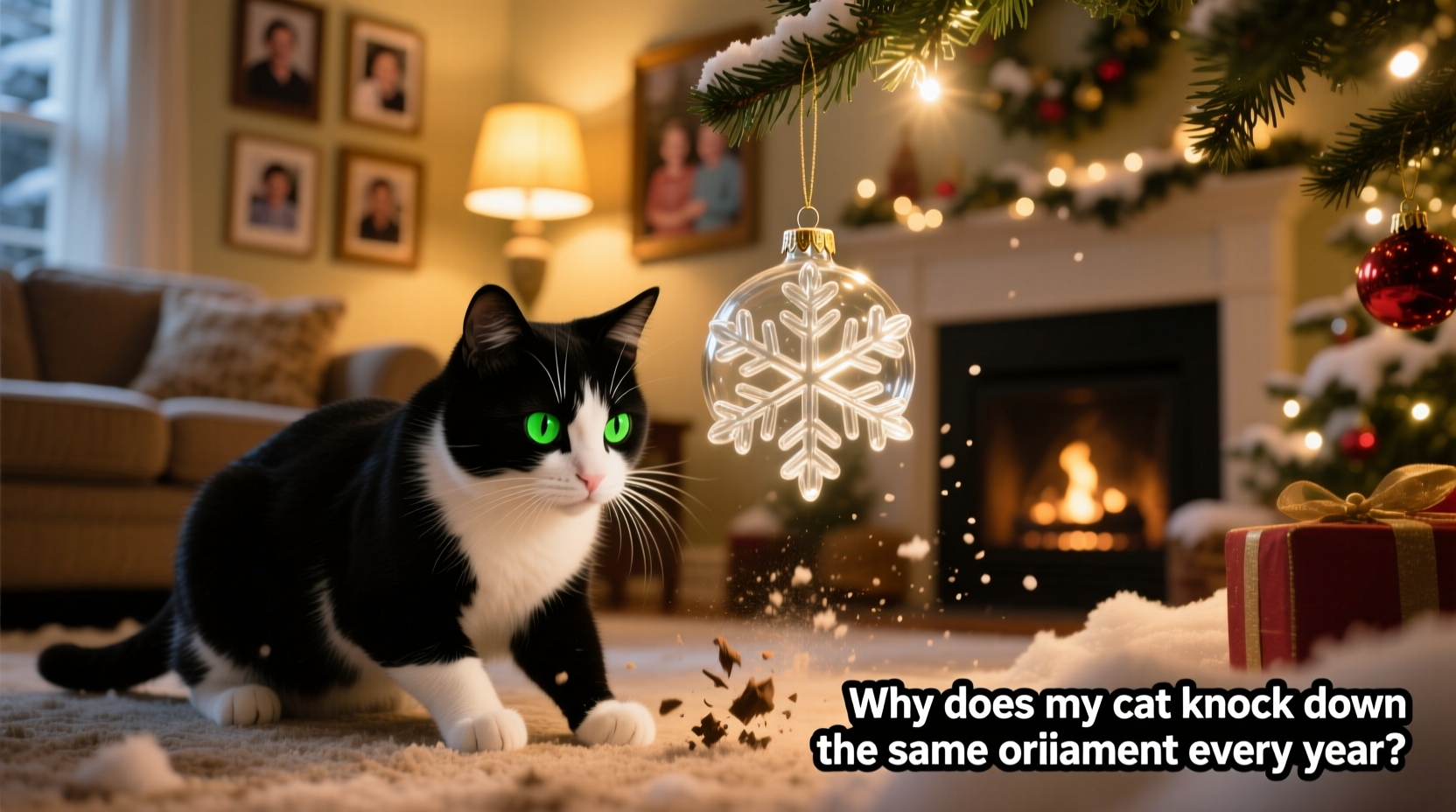
Cats are creatures of routine, but they’re also highly attuned to changes in their environment. The return of holiday decorations marks a significant shift in sensory input: new scents from pine garlands, flickering lights, rearranged furniture, and unfamiliar objects placed within reach. These changes can trigger curiosity, anxiety, or predatory instincts.
When the same ornament reappears annually in a similar location, your cat may associate its presence with the start of a “new season” in the household. For some cats, knocking it down becomes part of a ritual—a way to assert control over shifting territory. Others may remember the sound it makes when it falls, the way it moves when batted, or the attention they receive afterward. All of these factors reinforce the behavior, turning it into a predictable annual event.
Feline Instincts at Play
To understand your cat’s actions, consider the evolutionary lens. Domestic cats retain many behaviors of their wild ancestors, including hunting, territorial marking, and object manipulation. Knocking things over isn’t mere destruction—it’s exploration, practice, and sometimes, communication.
- Hunting simulation: Moving objects mimic prey. A dangling ornament swaying in an air current triggers a pounce-and-bat response.
- Spatial testing: Cats use their paws to test stability, texture, and movement. An unstable ornament is an irresistible challenge.
- Attention-seeking: If knocking something down results in human reaction—even scolding—it reinforces the act as a way to engage.
- Memory recall: Cats have excellent long-term memory, especially for events tied to rewards (play, attention) or novelty.
When combined with seasonal repetition, these instincts create a perfect storm. The ornament isn’t just an object; it’s a recurring puzzle that your cat has learned to solve—with dramatic results.
“Cats don’t forget meaningful interactions with objects, especially those tied to sensory feedback or social responses. Repeated destruction often signals learned behavior reinforced by environment or emotion.” — Dr. Lena Patel, Feline Behavior Specialist
Environmental and Emotional Factors
Beyond instinct, emotional states influence feline behavior. The holidays, while joyful for humans, can be stressful for pets. Increased visitors, loud noises, altered routines, and confined spaces heighten anxiety. Some cats respond by engaging in displacement behaviors—actions like over-grooming, scratching, or knocking things over to cope with tension.
If your cat consistently targets one ornament each year, consider whether it’s located near a high-traffic area, close to a window (potential wildlife viewing), or adjacent to a favorite perch. The placement may make it both accessible and symbolically significant in your cat’s mental map of the home.
Additionally, scent plays a role. If the ornament is stored in a closet with lingering pheromones or dust, reintroducing it might trigger a reaction. Cats rely heavily on smell, and an object carrying unfamiliar or aged odors may be perceived as intruding on their space.
Real Example: Bella and the Silver Bell
Maria noticed that every December, her 5-year-old tabby Bella would leap onto the bookshelf and bat a small silver bell off its hook. The bell had belonged to Maria’s grandmother and was traditionally hung during Christmas. Despite securing it with tape and later replacing it with a lighter version, Bella struck again each year—always within 48 hours of the bell’s return.
A consultation with a veterinary behaviorist revealed that Bella associated the bell’s metallic jingle with the arrival of guests. As a kitten, she’d been startled by sudden laughter and noise shortly after hearing the bell ring. Over time, she began knocking it down preemptively—possibly to remove a perceived threat. By switching to a silent ornament and using calming diffusers during setup, Maria reduced Bella’s stress and stopped the cycle.
How to Prevent the Annual Ornament Incident
You don’t need to abandon traditions to coexist peacefully with your cat. Instead, adopt a proactive strategy that respects both your feline’s nature and your holiday spirit.
Step-by-Step Guide: Managing Seasonal Cat Behavior
- Assess Placement: Keep fragile or sentimental ornaments out of jumping range—at least six feet off the ground or behind barriers.
- Use Anchoring Methods: Secure items with museum putty, clear fishing line, or adhesive hooks designed for light objects.
- Introduce Decor Early: Bring out decorations a few weeks before peak season to allow your cat time to investigate under supervision.
- Provide Alternatives: Place interactive toys, hanging puzzles, or feather wands nearby to redirect attention.
- Monitor Initial Exposure: Watch your cat’s reaction when you set up the ornament. Note signs of fixation, such as staring, tail twitching, or slow approach.
- Reinforce Calm Behavior: Reward your cat with treats or affection when they ignore the ornament or choose a toy instead.
- Rotate Ornaments: Consider retiring the targeted piece for a few years and replacing it with a cat-safe version.
Do’s and Don’ts: Holiday Decor and Cats
| Do | Don’t |
|---|---|
| Use lightweight, unbreakable ornaments made of felt or foam | Hang glass or heavy ornaments within paw reach |
| Anchor trees securely to walls to prevent tipping | Leave tinsel or string-like decorations accessible—these are choking hazards |
| Offer distraction with scheduled play sessions during decor setup | Yell or punish your cat after the fact—this increases anxiety and doesn’t stop recurrence |
| Use pet-safe storage to preserve ornaments between seasons | Store ornaments in places your cat can access—residual scents may attract future interest |
Building a Cat-Friendly Holiday Environment
Instead of viewing your cat as a threat to your décor, reframe the season as an opportunity to enrich their environment. Boredom and lack of stimulation are major contributors to destructive behavior. When cats have limited outlets for natural behaviors like climbing, stalking, and batting, they’ll find their own entertainment—often at your expense.
Create designated play zones with vertical space, puzzle feeders, and seasonal-themed toys. Rotate these regularly to maintain novelty. Consider a “cat tree” decorated with safe, edible garlands (like popcorn strings or dried fish) to give them their own festive focal point.
Additionally, maintain consistency in daily routines. Feed, play, and groom at the same times each day to provide stability amid seasonal chaos. This reduces stress and diminishes the likelihood of attention-seeking destruction.
FAQ: Common Questions About Recurring Cat Behavior
Why does my cat only knock down one specific ornament and ignore others?
Your cat likely associates that particular ornament with a memorable experience—its movement, sound, texture, or the reaction it provokes. Unlike generic decorations, this item stands out due to past interaction, making it a repeated target.
Can I train my cat to leave the ornament alone?
Yes, but through redirection rather than punishment. Use positive reinforcement when your cat engages with appropriate toys. Pair this with physical barriers and environmental enrichment to reduce temptation. Consistency over multiple seasons is key.
Is this behavior a sign of aggression or anxiety?
Not necessarily aggression, but it can stem from mild anxiety or overstimulation. If your cat exhibits other stress signs—hiding, excessive grooming, or litter box avoidance—consider consulting a vet or behaviorist to address underlying emotional needs.
Conclusion: Coexisting with Tradition and Curiosity
Your cat knocking down the same ornament every year isn’t defiance—it’s communication. Whether driven by instinct, memory, or environmental stress, the act reveals how deeply your pet engages with the rhythms of your home. Rather than resisting this behavior, work with it. Adapt your traditions slightly, enrich your cat’s world meaningfully, and protect what matters most—both your heirlooms and your bond.
Change won’t happen overnight, especially if the habit spans several seasons. But with patience, observation, and consistent effort, you can break the cycle. Start this year by setting up smarter, playing more, and watching closely. You might just enjoy a peaceful holiday—one where the only thing that rings is the doorbell.




 浙公网安备
33010002000092号
浙公网安备
33010002000092号 浙B2-20120091-4
Comments
No comments yet. Why don't you start the discussion?