
If you've ever been jolted awake at 3 a.m. by the sound of a ceramic mug shattering on the kitchen floor—only to find your cat sitting calmly beside the wreckage—you're not alone. This peculiar habit is both baffling and frustrating for pet owners. Why would a seemingly affectionate animal deliberately sabotage household peace in the dead of night? The answer lies in a combination of instinct, environment, and feline psychology. Cats don’t act out of malice; their behaviors are deeply rooted in survival mechanisms, curiosity, and communication. Understanding what drives your cat’s midnight knock-off sessions can help you respond effectively without resorting to punishment or frustration.
The Evolutionary Roots of Object Knocking
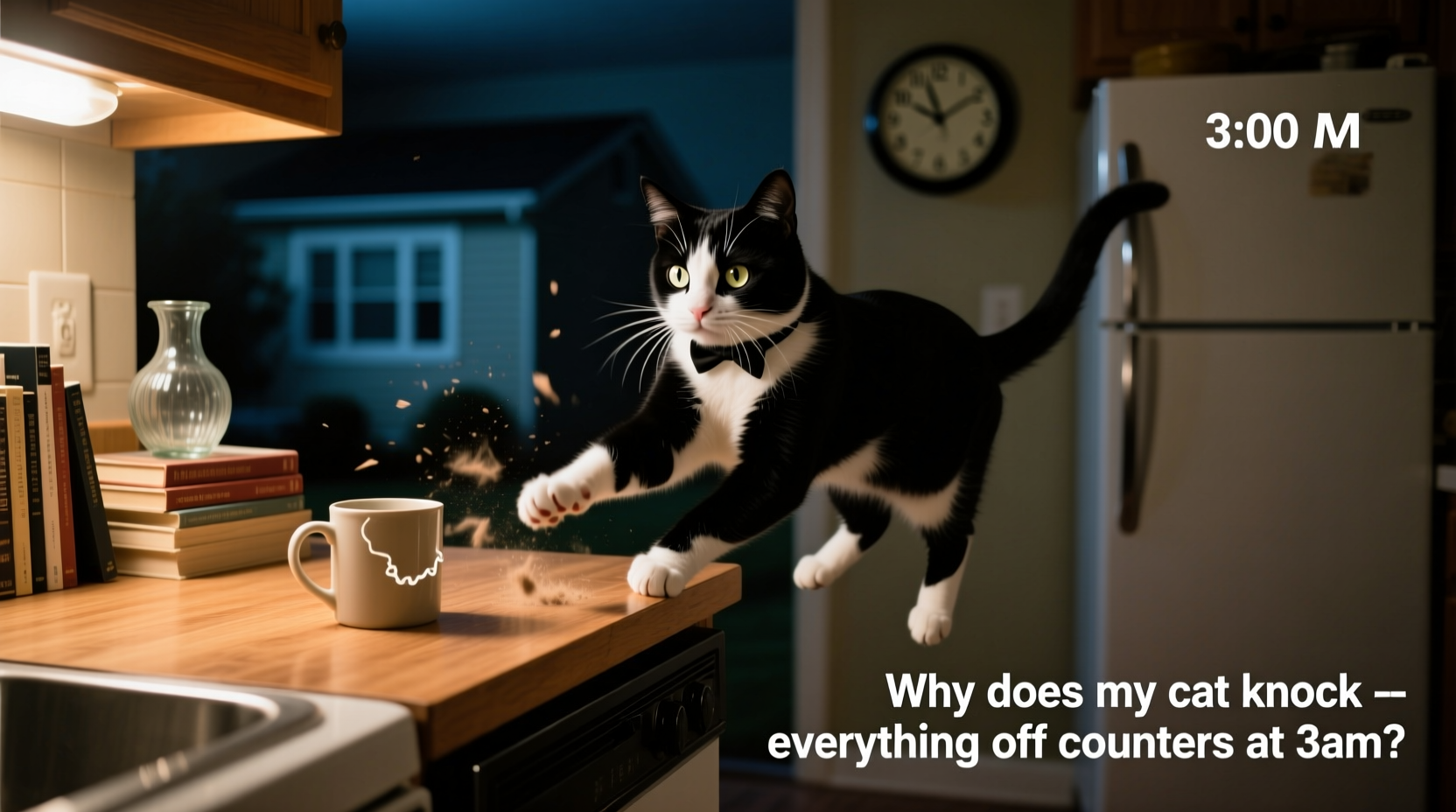
Cats are natural predators, evolved from solitary hunters who relied on stealth, precision, and environmental awareness to survive. In the wild, animals test objects to determine if they’re prey, threat, or resource. Your cat knocking something off the counter isn't just random mischief—it's an investigative behavior. By nudging or batting an item, your cat gathers sensory information: Is it moving? Does it make noise? Can it be eaten?
This tactile exploration mimics how young kittens learn about their world. A study published in *Applied Animal Behaviour Science* found that cats use paw manipulation as a primary method of object assessment, especially when visual cues are limited. At night, when lighting is poor, touch becomes even more critical. So when your cat pushes your phone off the table, it’s not trying to ruin your morning—it’s conducting a scientific experiment using its paws as tools.
“Cats don’t see furniture or countertops as human spaces—they see them as part of their territory to investigate and interact with.” — Dr. Sarah Ellis, Feline Behavior Researcher, University of Lincoln
Nocturnal Instincts and the 3 a.m. Energy Surge
Domestic cats are crepuscular, meaning they’re most active during dawn and dusk. However, many adapt to a nocturnal rhythm, especially if left alone during the day. By 3 a.m., your cat may be fully alert, primed with energy, and searching for stimulation. If there’s no toy, prey, or interaction available, your countertop items become targets.
Think of it like a bored office worker tapping a pen incessantly—the behavior isn’t malicious, but a manifestation of excess energy. For cats, physical engagement is a way to stay mentally sharp. When enrichment is lacking, they create their own entertainment, often involving gravity-defying stunts with household objects.
Communication Through Chaos
Sometimes, object-knocking is a deliberate form of communication. If your cat has learned that knocking things down gets your attention—even negative attention like yelling—it will repeat the behavior. From a feline perspective, any reaction confirms success. Silence might mean invisibility, but a startled shout means connection.
This pattern often develops unintentionally through inconsistent responses. One night you ignore the behavior; the next, you leap out of bed shouting. To your cat, the second response is highly rewarding. Over time, this reinforces the action as a reliable way to initiate interaction, especially during quiet hours when human attention is otherwise unavailable.
How Reinforcement Works in Practice
| Night | Behavior | Owner Response | Cat’s Interpretation |
|---|---|---|---|
| 1 | Knocks glass off counter | Ignores | \"No result. Try again.\" |
| 2 | Knocks same glass off | Yells \"Stop!\" | \"Success! Noise = Attention.\" |
| 3 | Knocks louder object off | Turns on light, cleans up | \"Even better! Light + movement!\" |
| 4+ | Targets new objects | Variable responses | \"Unpredictable, but worth trying.\" |
The inconsistency in human reactions makes the behavior harder to extinguish. Predictable consequences are key to modifying animal behavior, but most owners react only when damage occurs—effectively training the cat that loud crashes are the best way to get noticed.
Environmental Triggers and Prevention Strategies
Not all cats engage in counter-clearing equally. Certain factors increase the likelihood of this behavior:
- Lack of vertical space: Cats feel secure at height. Without cat trees or shelves, counters become default perches.
- Unsecured items: Objects hanging slightly over edges invite paw-testing.
- Boredom: Indoor-only cats with limited playtime are more prone to destructive exploration.
- Diet schedule: Feeding exclusively during the day may leave cats hungry and restless at night.
Addressing these elements reduces opportunities for chaos. The goal isn’t to punish your cat but to redesign the environment so that knocking things over becomes less appealing—and less rewarding.
Step-by-Step Guide to Reducing Midnight Knockdowns
- Conduct a nighttime audit: Walk through your home at night with the lights off. Identify which surfaces have accessible objects and remove anything breakable or valuable after dinner.
- Install motion-activated deterrents: Use devices that emit a harmless burst of air or sound when triggered. These teach cats to avoid certain zones without direct confrontation.
- Establish a pre-bed routine: Engage your cat in 10–15 minutes of vigorous play before bedtime using wand toys or laser pointers to simulate hunting.
- Introduce automatic toys: Set timers on motorized toys to activate at 2–3 a.m., redirecting your cat’s energy toward appropriate outlets.
- Adjust feeding times: Use a timed feeder to dispense a small meal around 4 a.m., aligning with natural hunger peaks and reducing restlessness.
Mini Case Study: Luna and the Midnight Mug Toss
Sarah, a graphic designer from Portland, adopted a 1-year-old tabby named Luna. Within weeks, she began waking up to shattered mugs and displaced remotes. Initially, she tried scolding Luna, but the behavior worsened. After consulting a veterinary behaviorist, Sarah realized her work-from-home schedule meant Luna spent 10+ hours alone each day with minimal stimulation.
She implemented several changes: installed a cat tree near the kitchen window, introduced a timed feeder, and started playing with Luna for 15 minutes every evening using a feather wand. She also removed all non-essential items from counters and placed crinkly toys on the floor nearby.
Within three weeks, the incidents dropped from nightly to once every few weeks. “I used to think she was being spiteful,” Sarah said. “But now I see it was just boredom and instinct. Once I gave her better options, she stopped needing to make her own fun.”
Do’s and Don’ts of Managing Counter-Knocking Behavior
| Do | Don’t |
|---|---|
| Provide vertical climbing structures and scratching posts | Punish your cat after the fact—cats don’t connect delayed consequences with actions |
| Use positive reinforcement when your cat plays appropriately | Leave tempting objects within paw’s reach |
| Offer food puzzles or treat-dispensing toys at night | Yell or chase your cat—it reinforces attention-seeking behavior |
| Keep essential items secured in drawers or cabinets | Assume the behavior will disappear on its own |
Frequently Asked Questions
Is my cat knocking things over because it’s angry at me?
No. Cats don’t act out of revenge or spite. While they can feel stress or anxiety, object-knocking is typically driven by curiosity, hunting instinct, or a desire for interaction—not emotional retaliation. Attributing human emotions like anger oversimplifies complex feline motivations.
Will declawing stop this behavior?
Declawing is not only ineffective for stopping object-knocking but is also widely considered inhumane. It involves amputating the last bone of each toe and can lead to chronic pain, behavioral issues, and litter box avoidance. Instead, focus on environmental enrichment and redirection techniques.
Could this be a sign of a medical problem?
In rare cases, sudden changes in behavior—including increased activity at night—can indicate underlying conditions like hyperthyroidism, cognitive dysfunction (especially in older cats), or vision loss. If your cat exhibits other symptoms such as weight loss, excessive vocalization, or disorientation, consult your veterinarian.
Expert Insight: What Veterinarians Say
“The biggest mistake owners make is reacting emotionally. Yelling or startling the cat only strengthens the association between knocking and attention. Consistency, enrichment, and patience are far more effective than discipline.” — Dr. Karen Overall, Veterinary Behavioral Medicine Specialist
Dr. Overall emphasizes that feline behavior problems are rarely about defiance. They’re about unmet needs. When a cat feels physically and mentally fulfilled, disruptive behaviors naturally decline. This shift requires understanding rather than correction.
Creating a Cat-Friendly Home Environment
Preventing 3 a.m. knock-offs isn’t about restricting your cat—it’s about enriching its world. A well-designed environment satisfies natural instincts without compromising household peace. Consider the following checklist to assess your home’s feline compatibility:
Cat Enrichment Checklist
- ✅ At least one tall cat tree or wall-mounted shelves
- ✅ Daily interactive play sessions (minimum 10 minutes)
- ✅ Nighttime toys with auditory or motion feedback (e.g., bell balls)
- ✅ Timed feeder set for early morning meals
- ✅ Safe access to windows with bird feeders outside
- ✅ Rotating toy selection to prevent habituation
- ✅ Designated off-counter resting spots with soft bedding
By meeting your cat’s biological needs, you reduce the incentive to improvise. A tired, engaged cat is far less likely to seek out midnight adventures.
Conclusion: Turning Chaos Into Connection
Your cat isn’t trying to ruin your sleep or test your patience. The 3 a.m. counter-clearing ritual is a symptom of deeper needs—curiosity, stimulation, and connection. Rather than viewing this behavior as a nuisance, see it as an invitation to better understand your feline companion. With thoughtful adjustments to routine, environment, and interaction, you can transform these disruptive moments into opportunities for bonding and enrichment.




 浙公网安备
33010002000092号
浙公网安备
33010002000092号 浙B2-20120091-4
Comments
No comments yet. Why don't you start the discussion?