
Every holiday season, families gather around the glowing lights of their Christmas tree—except when that tree suddenly crashes to the floor, ornaments shattering, thanks to a furry four-legged acrobat. If your cat has made toppling the Christmas tree an annual tradition, you’re not alone. This behavior, while frustrating, is deeply rooted in feline instincts and environmental triggers. Understanding the \"why\" behind this mischievous habit is the first step toward preventing it—without compromising your cat’s well-being or your holiday spirit.
Cats don’t knock over trees out of spite. They act based on curiosity, play drive, territorial instincts, and sometimes boredom. The good news? With thoughtful planning, environmental enrichment, and a few strategic modifications, you can enjoy a stable, festive centerpiece all December long—even with a curious cat in the house.
The Feline Mind Behind the Mischief
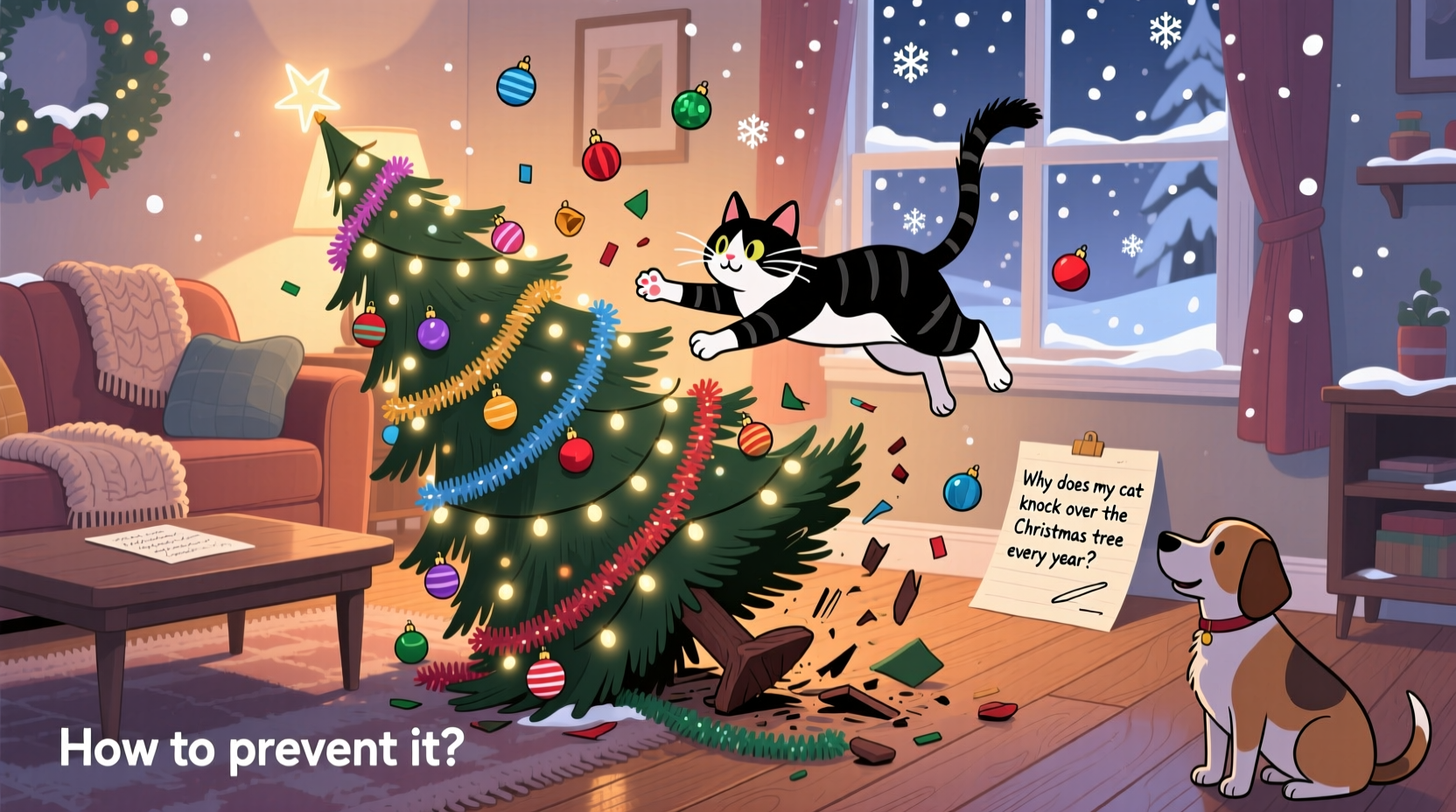
To stop the tipping, you must first understand what motivates your cat. Unlike dogs, who may knock things over for attention, cats are driven by instinctual behaviors shaped by thousands of years of evolution. A Christmas tree presents a unique sensory experience: dangling objects, rustling branches, unfamiliar scents, and elevated perches—all of which trigger natural feline responses.
One primary reason cats interact with the tree is **prey simulation**. Ornaments that swing or reflect light mimic the movement of small animals. A cat’s hunting instinct kicks in, prompting batting, pouncing, and climbing. Even motionless ornaments can become targets after a slight breeze or tail flick sets them swaying.
Another factor is **territorial investigation**. Cats rely heavily on scent and spatial awareness. A new object like a Christmas tree disrupts their established environment. Your cat may rub against it, sniff it, or paw at it to gather information and leave its own scent. In some cases, this exploration leads to instability—especially if the tree base isn’t secured.
Additionally, **vertical space** is crucial for cats. Trees offer height, which equates to safety and vantage points in feline psychology. Climbing provides exercise, mental stimulation, and a sense of control. When your cat sees a tall structure covered in interesting textures and objects, it becomes irresistible—not as decoration, but as a jungle gym.
“Cats aren’t being destructive—they’re being cats. Their actions are logical from their perspective. The key is managing the environment, not the emotion.” — Dr. Sarah Thompson, Veterinary Behaviorist
Effective Prevention Strategies: A Step-by-Step Guide
Preventing tree-toppling isn’t about restricting your cat entirely—it’s about redirecting their energy and modifying risks. Below is a practical, step-by-step approach to safeguard your tree while supporting your cat’s needs.
- Secure the Tree Base
Start with physical stability. Use a heavy, weighted stand designed for real or artificial trees. For extra security, anchor the tree to a wall using fishing line or soft straps attached near the top and fastened to a wall hook. This keeps the tree upright even under climbing pressure. - Elevate Ornaments Strategically
Keep breakable or enticing decorations above 3 feet from the ground. Cats typically won’t jump higher than necessary unless motivated. Use lightweight, non-toxic ornaments on lower branches—avoid glass, metal, or anything small enough to be swallowed. - Trim Lower Branches
If safe and aesthetically acceptable, prune the bottom 12–18 inches of branches. This eliminates stepping stones for climbing and creates a visual barrier, making the trunk less accessible. - Use Cat-Deterrent Materials
Place aluminum foil, double-sided tape, or textured plastic mats around the tree base. Most cats dislike the feel of these surfaces underfoot and will avoid the area. Reapply as needed, especially if the deterrent loses effectiveness over time. - Provide Alternative Climbing Structures
Set up a cat tree or shelving system nearby, ideally within sight of the Christmas tree. Outfit it with toys, perches, and hiding spots to draw your cat’s attention away from the decorated tree.
Enrichment Over Restriction: Meeting Your Cat’s Needs
Attempting to keep a cat away from the tree through punishment or exclusion often backfires. Stress increases, trust diminishes, and the allure of the forbidden grows. Instead, focus on enrichment—giving your cat better options than the tree.
During the holidays, cats often face routine disruptions: guests, noise, new smells, and restricted access to favorite spaces. These changes can increase anxiety and lead to attention-seeking behaviors, including tree interaction. Providing consistent enrichment helps maintain emotional balance.
- Daily play sessions: Engage your cat in 10–15 minutes of active play twice a day using wand toys or laser pointers. This satisfies their hunting drive and reduces idle curiosity toward the tree.
- Food puzzles and treat dispensers: These encourage mental stimulation and slow down feeding, mimicking natural foraging behavior.
- Scent rotation: Introduce familiar scents near the cat’s resting areas (e.g., a blanket with your scent) to counteract the novelty of pine or tinsel.
Consider creating a “holiday zone” for your cat—a quiet room equipped with food, water, litter, toys, and a comfortable bed. Rotate their access throughout the day, especially during high-traffic events, to reduce stress without complete isolation.
Do’s and Don’ts: Holiday Tree Safety Checklist
| Do’s | Don’ts |
|---|---|
| Use a sturdy, weighted tree stand | Place the tree on a flimsy or unsecured base |
| Anchor the tree to a wall or ceiling | Rely solely on the stand for stability |
| Hang cat-safe toys on alternative structures | Use tinsel, ribbons, or stringed garlands (choking hazard) |
| Keep electrical cords hidden or protected | Leave cords exposed where cats can chew them |
| Supervise initial interactions with the tree | Leave the tree unattended with unsupervised cats |
| Offer daily interactive play | Ignore signs of stress or hyperactivity |
A Real-Life Example: The Miller Family’s Solution
The Millers had struggled with their Bengal cat, Luna, for three consecutive Christmases. Each year, Luna scaled the tree within hours of setup, knocking it over by dinner. One year, she pulled down a strand of lights and chewed the cord, requiring a vet visit for mild burns.
Determined to change the pattern, they consulted a certified cat behavior consultant. The solution wasn’t punishment—it was redirection. They installed a tall cat tree beside the living room window, added a hammock and feather teaser toy, and began a structured play routine each evening. They also used a tension rod anchored to the wall to stabilize the tree and wrapped the base in crinkly foil.
The result? Luna showed interest in the tree for the first two days but gradually shifted her focus to the new climbing tower. By Christmas Eve, she hadn’t approached the tree in over a week. The family still monitors her, but the chaos has ended.
Their success wasn’t instant. It required consistency, observation, and a willingness to adapt. But by addressing Luna’s needs rather than just the symptom, they created lasting change.
Frequently Asked Questions
Can I use citrus peels or sprays to keep my cat away from the tree?
Citrus scents are generally unpleasant to cats and can act as a deterrent. However, essential oils and concentrated citrus extracts can be toxic if ingested or absorbed through the skin. Use only diluted, pet-safe products sparingly, and never spray directly on the tree or near water bowls. Safer alternatives include commercial cat repellent sprays labeled non-toxic.
Is it safe to leave the tree up if I have a kitten?
Kittens are especially prone to climbing and chewing due to their developmental stage. Extra precautions are necessary: secure all cords, avoid small ornaments, and consider delaying tree setup until closer to Christmas. Supervision is critical, and providing ample kitten-safe toys can help divert attention.
What if my cat still knocks the tree over despite precautions?
If multiple strategies fail, reassess your cat’s environment. Is there enough vertical space? Are play sessions frequent enough? Consider relocating the tree to a less accessible room or using a pre-lit artificial tree with built-in stabilizers. In extreme cases, a temporary baby gate can restrict access during unsupervised hours.
Expert Insight: The Role of Environmental Design
Dr. Elena Ruiz, a feline environmental designer and author of *Happy Homes for Cats*, emphasizes that most behavioral issues stem from mismatched environments. “Cats aren’t flawed—they’re responding to poorly designed spaces,” she says.
“A Christmas tree isn’t inherently dangerous. But when placed in a home without adequate feline alternatives, it becomes the only source of stimulation. The solution isn’t to remove the tree—it’s to add more opportunities.” — Dr. Elena Ruiz, Feline Environmental Designer
She recommends treating holiday prep like any other home modification: assess your cat’s typical routes, preferences, and pain points. If your cat loves high vantage points, place a shelf across the room. If they’re drawn to shiny objects, provide reflective toys elsewhere. Proactive design prevents conflict.
Final Tips and Action Plan
Protecting your Christmas tree doesn’t mean excluding your cat from the festivities. It means integrating their needs into your holiday planning. Here’s a concise checklist to follow before setting up your tree:
Pre-Tree Setup Checklist
- Choose a stable location away from furniture your cat can leap from
- Inspect and reinforce the tree stand
- Plan anchoring method (wall strap, ceiling support, etc.)
- Install or refresh your cat’s climbing structure nearby
- Stock up on interactive toys and puzzle feeders
- Hide or protect electrical cords with conduit covers
- Remove hazardous materials (tinsel, loose wires, toxic plants)
Ongoing Maintenance During the Season
- Monitor your cat’s behavior daily
- Engage in scheduled play before peak activity times (dawn/dusk)
- Rotate toys weekly to maintain interest
- Check tree stability regularly, especially after visits or storms
- Reapply deterrents as needed
Conclusion: Peaceful Holidays with Your Feline Companion
Your cat’s annual tree-tipping habit isn’t a flaw in their character—it’s a signal that their environment isn’t fully meeting their needs. By combining physical safeguards with behavioral understanding, you can preserve both your holiday decor and your bond with your pet.
This year, instead of dreading the inevitable crash, take proactive steps to create a balanced, enriching space. Anchor the tree, enrich your cat’s world, and embrace the reality that coexistence is possible—and even joyful. After all, the holidays are about warmth, connection, and shared moments. With a little planning, your cat can be part of the celebration, not the chaos.




 浙公网安备
33010002000092号
浙公网安备
33010002000092号 浙B2-20120091-4
Comments
No comments yet. Why don't you start the discussion?