
Cats are creatures of habit, mystery, and occasional absurdity. One moment they’re sprinting through the house like tiny, furry rockets; the next, they’re curled up in a cardboard box barely big enough to hold their tail. But what about when the box is far too large? Why would a cat choose to sit in a container that dwarfs its body, leaving acres of unused space around it? This seemingly illogical behavior is not random—it’s rooted in deep-seated feline instincts, environmental psychology, and evolutionary survival mechanisms. Understanding this quirk offers insight into how cats perceive safety, comfort, and control in their surroundings.
The Instinct for Enclosed Spaces
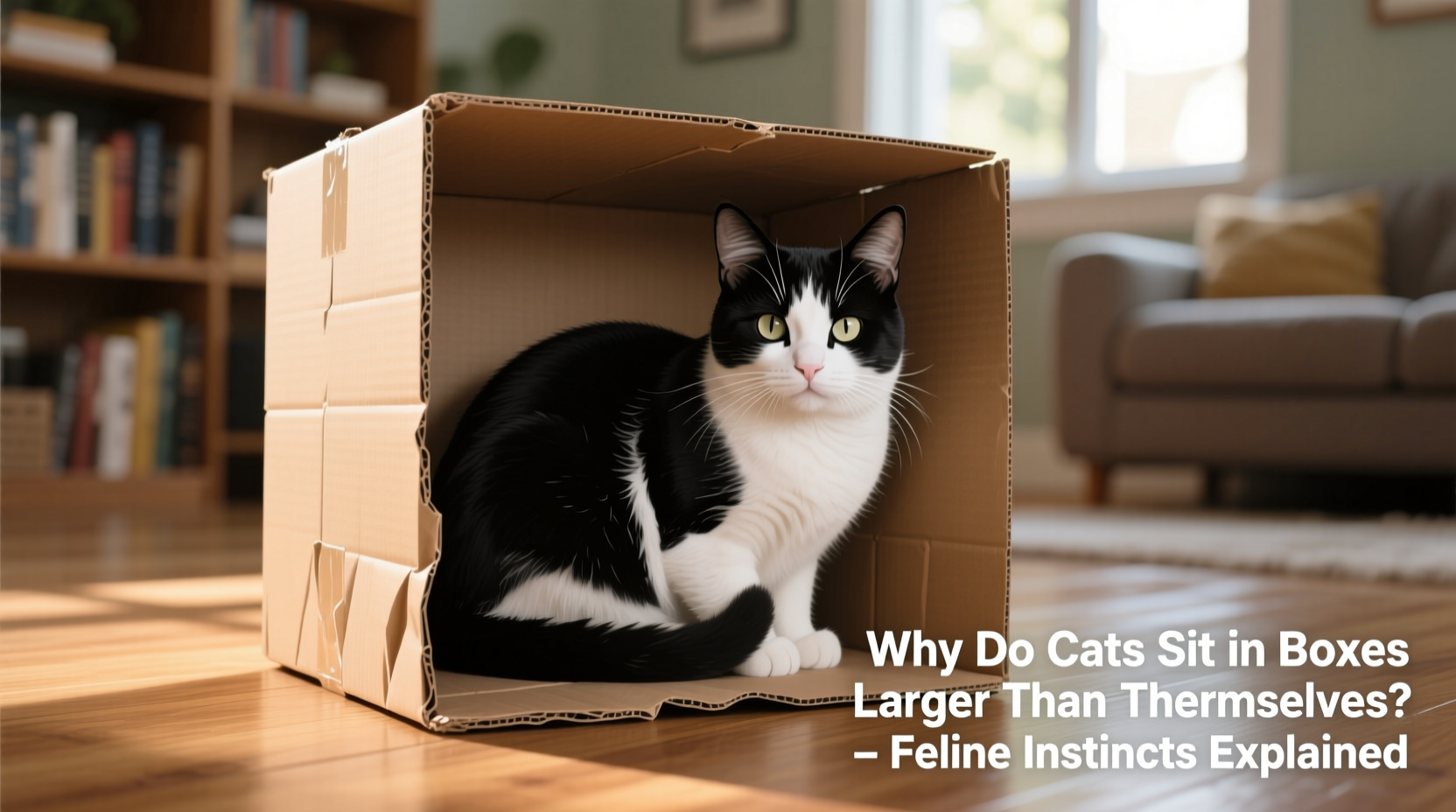
At first glance, a box—regardless of size—provides an enclosed environment. For cats, enclosure equates to security. In the wild, felines avoid open spaces where predators can approach unseen. Instead, they seek sheltered spots: under bushes, inside hollow logs, or beneath rocky overhangs. These spaces offer protection from above and on the sides, reducing vulnerability.
Domestic cats retain these instincts, even when they’ve never faced a predator. A cardboard box, no matter its dimensions, mimics the den-like conditions their ancestors relied on. The walls, however flimsy, create psychological boundaries. Even if the box is oversized, the mere presence of defined edges signals “safe zone.” The cat doesn’t need to fill the space completely—the act of being *within* it is enough to trigger a sense of refuge.
“Cats don’t assess space by efficiency. They assess it by perceived safety. A box, regardless of fit, represents a controllable territory.” — Dr. Sarah Thompson, Feline Behavior Specialist, Cornell University College of Veterinary Medicine
Thermoregulation and Comfort
Another critical factor is temperature. Cats maintain a higher body temperature than humans—around 101–102.5°F (38.3–39.2°C). To conserve heat, they naturally gravitate toward insulated environments. Cardboard is a surprisingly effective thermal insulator. When a cat enters a box, especially one with intact flaps, the material traps body heat, creating a warm microclimate.
This explains why cats often prefer boxes over plush beds. A soft cushion may feel comfortable, but it doesn’t retain heat as effectively as the air pocket formed within a box. Even in a large box, the cat will typically curl tightly into a ball, minimizing surface area and maximizing warmth retention. The excess space isn’t wasted—it allows airflow regulation. If the box becomes too warm, the cat can shift position or partially exit while still maintaining access to shelter.
Sensory Control and Environmental Mastery
Cats are highly sensitive to sensory input. Sudden noises, bright lights, or unfamiliar scents can cause stress. A box acts as a sensory buffer. Its walls dampen sound, block peripheral movement, and limit visual stimuli. This reduction in environmental noise allows the cat to relax more deeply.
Interestingly, larger boxes can enhance this effect. A bigger interior gives the cat room to reposition without exiting the protected zone. It can turn, stretch, or lie flat—all while remaining within the psychological boundary of “den.” This flexibility increases the box’s utility as a multi-purpose retreat: nap spot, observation post, or emergency hideout.
Moreover, cats are territorial animals. By occupying a large box, they assert dominance over that space. The act of sitting inside—even if they use only a fraction of it—marks the object as theirs. Other pets or household members learn to avoid it, reinforcing the cat’s sense of control.
Stress Reduction and Healing Behavior
Research has shown that access to hiding places significantly reduces stress in cats, especially in new or chaotic environments. A landmark study conducted at Utrecht University found that shelter cats given cardboard boxes adapted to their surroundings faster and exhibited fewer signs of anxiety than those without shelters.
This principle applies at home, too. If your household experiences frequent changes—a new roommate, construction noise, or even rearranged furniture—a large box can serve as a stable anchor. The cat returns to it repeatedly, not because it fits perfectly, but because it represents consistency in an unpredictable world.
In veterinary settings, cats recovering from illness or surgery often seek out oversized enclosures. The added space allows them to move slightly without fully exposing themselves, supporting both physical recovery and emotional security.
Case Study: Luna Adjusts to Apartment Life
Luna, a three-year-old domestic shorthair, moved with her owner from a quiet suburban home to a bustling city apartment. Initially, she hid under the bed for days, refusing food and avoiding interaction. Her owner placed several cardboard boxes of varying sizes near windows and quiet corners. Within 48 hours, Luna began using a large moving box—nearly twice her length—as a daytime perch. She didn’t fill it, but she positioned herself at one end, facing outward.
Over two weeks, Luna’s confidence grew. She started napping in the center of the box, then eventually ventured out for play sessions. The box became her transitional safe zone. Her owner noted, “She didn’t need it to be small. She just needed to know she could go back to it anytime.”
Do’s and Don’ts of Cat Box Provision
| Do’s | Don’ts |
|---|---|
| Provide multiple boxes in different rooms for choice and rotation | Use boxes with staples, tape, or toxic ink markings |
| Leave flaps intact to enhance enclosure feeling | Force your cat into a box—they must choose it voluntarily |
| Replace damp or soiled boxes promptly | Assume all cats like boxes—some prefer fabric tunnels or covered beds |
| Add soft bedding if your cat prefers comfort over raw cardboard | Place boxes in high-traffic or noisy areas where privacy is compromised |
Why Size Doesn’t Matter (to the Cat)
Human logic assumes efficiency: why use a king-sized bed when a twin will do? But cats operate differently. Their decision-making isn’t based on spatial economy but on risk assessment and environmental control. A larger box may seem inefficient to us, but to a cat, it offers strategic advantages:
- Escape routes: More space means easier maneuverability if startled.
- Observation angles: A cat can shift position to monitor different parts of the room without exposing itself.
- Thermal zoning: Warm air rises and collects in certain areas. A large box allows the cat to find the optimal heat pocket.
- Play potential: Kittens and active adults may use oversized boxes for partial concealment during stalking games.
In essence, the box isn’t just a seat—it’s a dynamic environment. The cat isn’t “sitting in” it so much as “inhabiting” it. The extra space isn’t wasted; it’s part of the habitat’s functionality.
Step-by-Step: Creating the Ideal Box Environment
- Select the right box: Choose one made of sturdy corrugated cardboard with all four sides and flaps intact.
- Remove hazards: Cut away any plastic tape, staples, or labels with sharp edges. Wipe down if dirty.
- Position strategically: Place the box in a quiet corner, near a window, or beside a favorite resting spot.
- Enhance comfort (optional): Line with a removable fleece mat or old towel for added warmth.
- Rotate regularly: Introduce a fresh box every few weeks to maintain novelty and hygiene.
- Observe behavior: Note how your cat uses it—does she face inward or outward? Curl up or stretch? Adjust placement accordingly.
Frequently Asked Questions
Is it normal for my cat to sit in boxes much larger than her?
Yes, it’s completely normal. Cats value the sense of enclosure and control more than precise fit. As long as she feels secure, size is irrelevant.
Should I be concerned if my cat hides in boxes frequently?
Occasional use is healthy. However, if your cat spends excessive time hidden, avoids social interaction, or shows other signs of stress (over-grooming, appetite loss), consult a veterinarian or feline behaviorist.
Can I use plastic storage bins instead of cardboard?
Some cats accept plastic bins, especially if they have lids or cut-out entrances. However, cardboard is generally preferred due to its breathability, insulation, and chewable texture—which some cats find soothing.
Final Thoughts: Embracing the Quirks of Feline Nature
The sight of a cat dwarfed by a massive box may inspire laughter, but it’s also a window into their complex inner world. What looks like whimsy is actually instinct in action—driven by millennia of evolution, finely tuned sensory perception, and a relentless pursuit of safety. Rather than questioning why your cat chooses such impractical real estate, consider celebrating it. That box is more than packaging waste; it’s a sanctuary, a fortress, and a throne all at once.
By honoring these behaviors, we deepen our understanding of feline psychology and improve the quality of life for our pets. So the next time a delivery arrives, don’t rush to recycle the box. Leave it out. Watch. You might just witness a ritual as old as cat domestication itself.




 浙公网安备
33010002000092号
浙公网安备
33010002000092号 浙B2-20120091-4
Comments
No comments yet. Why don't you start the discussion?