
It’s a familiar scene: you’re halfway through your dinner, savoring each bite, when you look up to find your cat locked onto you with unblinking eyes. No blinking. No looking away. Just steady, focused attention. You might chuckle, feel flattered, or even slightly unnerved. But what is your cat actually thinking? Is it love? Hunger? A silent demand for a bite of your salmon? The truth is, feline staring is layered with meaning—some benign, some instinctual, and occasionally, a sign of something deeper.
Cats don’t stare without reason. Unlike humans, who use prolonged eye contact as a form of emotional connection or dominance, cats rely on subtle body language, and staring plays a role in both communication and survival. Understanding why your cat watches you eat isn't just about curiosity—it can reveal insights into their emotional state, relationship with you, and even their health.
The Evolutionary Roots of Feline Observation
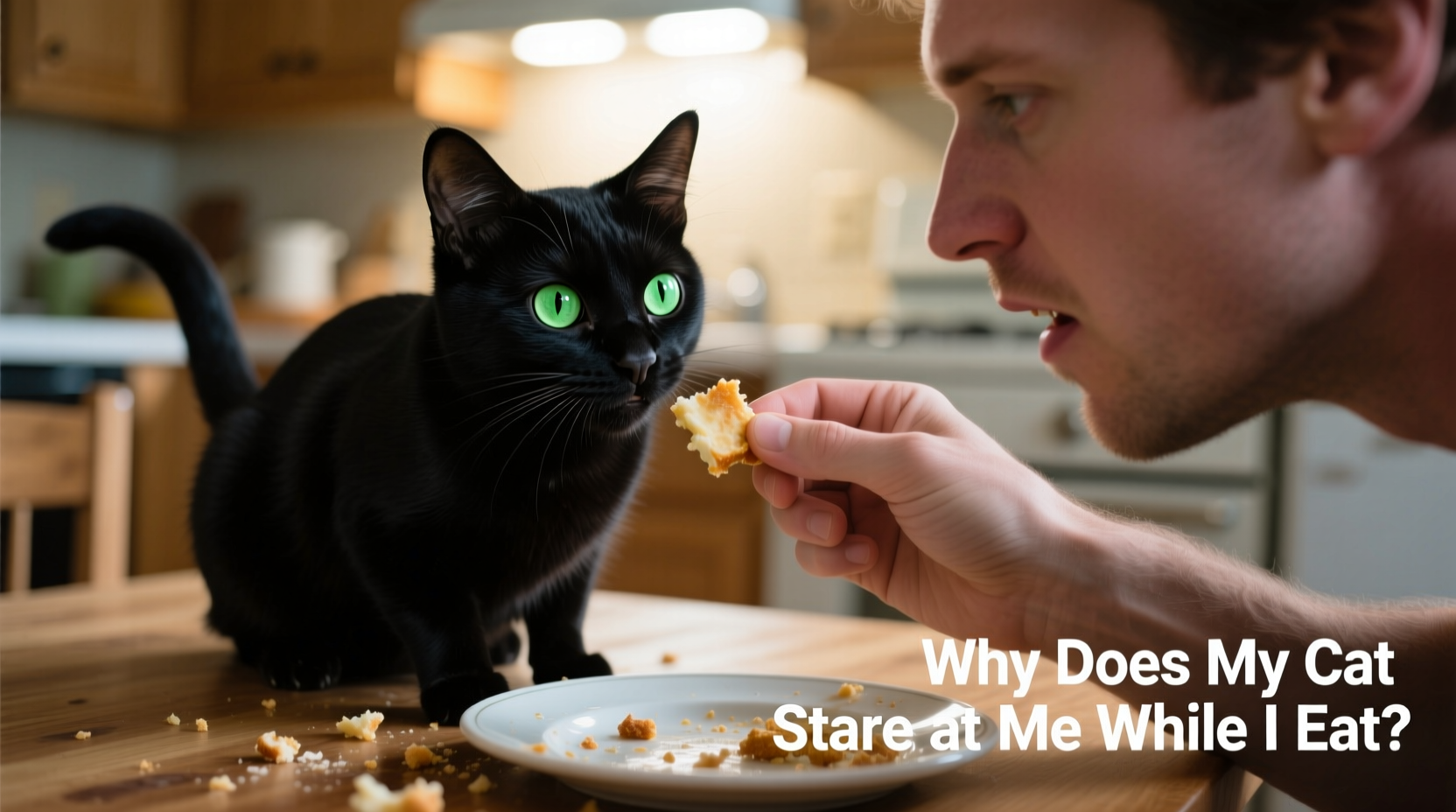
To understand your cat’s gaze, we must first consider their ancestry. Domestic cats evolved from solitary hunters who relied on stealth, patience, and acute observation. In the wild, watching movement—even something as mundane as a human lifting a fork—is part of assessing the environment for potential threats or opportunities. Your cat sees you eating not just as a routine activity but as a behavioral event worth monitoring.
When food is involved, instincts kick in. In multi-cat households or in feral colonies, access to food is often competitive. Even well-fed domestic cats retain this hardwired awareness: if someone is eating, there may be a chance to scavenge. Your cat isn’t plotting theft—they’re simply tuned into the rhythm of resource availability.
“Cats are opportunistic by nature. Staring during meals is an inherited vigilance strategy. It’s not personal—it’s biological.” — Dr. Lena Torres, Feline Behavior Specialist, University of Edinburgh
This doesn’t mean your cat views you as prey or competitor. Rather, they see you as part of their social group, and your actions directly affect their world. If you eat, they expect inclusion—or at least an explanation.
Common Reasons Your Cat Stares at You While Eating
Not all staring is created equal. The context, body language, and frequency matter. Here are the most common explanations:
- Hunger or food anticipation: This is the most obvious reason. Your cat associates your mealtime with the possibility of scraps, dropped morsels, or even their own feeding time.
- Bonding and social inclusion: Cats that view their humans as companions may watch closely to feel involved. To them, sharing space during meals is a social ritual.
- Curiosity about smells and textures: Human food emits strong aromas. Your cat may be intrigued by the unfamiliar scents and want to investigate visually before possibly begging for a taste.
- Learned behavior: If your cat has ever received food from you during a meal—even once—they’ll remember and repeat the staring in hopes of reinforcement.
- Attention-seeking: Some cats have mastered the art of the “innocent stare” as a way to prompt interaction, petting, or play after your meal ends.
Body Language Cues: What the Stare Really Means
A stare isn’t just a stare. How your cat holds their body, moves their tail, and blinks (or doesn’t) tells you everything. Here’s how to decode the message behind the gaze:
| Stare Type | Body Language | Likely Meaning |
|---|---|---|
| Soft, slow-blinking stare | Ears forward, relaxed posture, tail loosely curled | Trust and affection. Your cat feels safe and bonded. |
| Intense, unblinking focus | Tail twitching, pupils dilated, low crouch | Anticipation or mild anxiety. They want food or are overstimulated. |
| Distant, passive watching | Sitting upright, minimal movement, ears neutral | Curiosity or environmental monitoring. Not necessarily seeking interaction. |
| Staring with meowing or pawing | Vocalizing, rubbing against legs, persistent presence | Direct request for food or attention. Learned begging behavior. |
Pay special attention to the blink. A slow blink from your cat is often called a “cat kiss”—a sign of comfort and trust. If your cat stares and then slowly closes their eyes, they’re telling you they feel secure. Try returning the gesture: slowly blink back. Many cats respond positively, deepening the bond.
When Staring Becomes a Concern: Red Flags to Watch For
Occasional staring is normal. But certain patterns may signal underlying issues—medical, behavioral, or emotional. Be alert to these warning signs:
- Obsessive or prolonged staring without engagement: If your cat fixates on you for extended periods, especially without responding to calls or stimuli, it could indicate cognitive dysfunction, particularly in older cats.
- Aggressive body language during staring: Hissing, flattened ears, or swatting while staring suggests stress, fear, or territorial discomfort.
- Staring accompanied by excessive vocalization: Constant meowing during meals may point to hyperthyroidism, anxiety, or hunger due to medical conditions like diabetes.
- New or sudden change in behavior: A cat that never stared before but now does so persistently may be reacting to changes in routine, diet, or household dynamics.
- Loss of appetite in the cat despite fixation on your food: Watching intently but refusing their own meals could indicate dental pain, nausea, or gastrointestinal issues.
“If a previously indifferent cat suddenly becomes a constant mealtime observer, especially with weight loss or restlessness, consult your vet. Behavioral shifts are often early disease indicators.” — Dr. Arjun Patel, DVM, Feline Internal Medicine
In senior cats, staring into space or appearing “zoned out” during meals may be linked to feline cognitive dysfunction syndrome (CDS), similar to dementia in humans. Symptoms include disorientation, altered sleep cycles, and reduced grooming. Early veterinary intervention can improve quality of life.
Mini Case Study: Luna and the Midnight Pasta Ritual
Luna, a 7-year-old tabby, began sitting silently at the edge of the dining table every time her owner, Mark, ate pasta. At first, it seemed harmless—just curiosity. But over time, Luna started showing up 15 minutes before dinner, pacing and meowing. She stopped eating her evening meal and would only settle after Mark gave her a small bite of plain pasta.
Concerned, Mark consulted a veterinary behaviorist. After ruling out medical causes, the diagnosis was clear: learned food association reinforced by inconsistent boundaries. Mark had occasionally shared pasta out of guilt, unknowingly training Luna to expect it. With guidance, he implemented a new routine: feeding Luna her dinner 30 minutes before his own, offering a puzzle toy during his meals, and ignoring the staring. Within three weeks, Luna stopped attending meals altogether and resumed eating her own food reliably.
This case highlights how quickly cats learn—and how small actions shape long-term behavior.
How to Respond: Healthy Boundaries and Positive Alternatives
You don’t need to stop your cat from watching entirely—nor should you. But guiding their behavior ensures peace at mealtime and reinforces a balanced relationship. Follow this step-by-step approach:
- Establish a consistent feeding schedule: Feed your cat shortly before or after your meals so they’re less likely to feel excluded.
- Create a distraction zone: Designate a comfortable area away from the dining space with a window perch, toy, or food puzzle to occupy them.
- Avoid eye contact and feeding during meals: Do not reward staring with food or attention. Wait until after you’ve finished to interact.
- Reinforce calm behavior: When your cat chooses to stay elsewhere during meals, reward them with praise or a treat afterward. <5> Use positive redirection: If they approach, gently guide them to their bed or toy without scolding.
Checklist: Managing Mealtime Staring
- ✅ Feed your cat on a predictable schedule aligned with yours
- ✅ Remove yourself from the dining area if the cat becomes pushy
- ✅ Never give table scraps, even once
- ✅ Provide mental stimulation during your meals (puzzle toys, window views)
- ✅ Monitor for sudden changes in staring habits or appetite
- ✅ Consult a vet if staring is paired with lethargy, vocalization, or aggression
Frequently Asked Questions
Is it bad to let my cat watch me eat?
No, it’s not inherently bad. Many cats find comfort in observing their owners. However, if it leads to begging, anxiety, or disruption, setting boundaries is important for both your peace and their well-being.
Why does my cat stare but not meow?
Silent staring often indicates patience or calculated observation. Some cats learn that silence gets more attention than noise. Others may simply be waiting to see if you’ll offer food without demanding it.
Can I train my cat to stop staring at me while I eat?
You can’t eliminate the behavior completely—cats are naturally observant—but you can redirect it. Consistent routines, environmental enrichment, and avoiding reinforcement of the stare will reduce its frequency over time.
Conclusion: Understanding Builds Connection
Your cat’s stare isn’t manipulation or mischief—it’s communication. Whether rooted in instinct, affection, or hunger, that quiet gaze is a window into their inner world. By learning to interpret it, you deepen your understanding of their needs and strengthen the trust between you.
Respect their intelligence. Set gentle boundaries. And remember: every blink, twitch, and silent watchfulness is part of the intricate language of cats. The next time your feline companion locks eyes with you over your dinner, pause. Look back—not with suspicion, but with appreciation. You’re being included in their world, one silent moment at a time.




 浙公网安备
33010002000092号
浙公网安备
33010002000092号 浙B2-20120091-4
Comments
No comments yet. Why don't you start the discussion?