
A healthy Christmas cactus (Schlumbergera bridgesii) is a marvel of botanical timing—its vivid magenta, white, or salmon blooms appear like clockwork in late November through January, often lasting six to eight weeks. Yet many gardeners report the same quiet disappointment year after year: lush, glossy green stems, vigorous growth, and zero flowers. This isn’t a sign of neglect—it’s usually a sign of *misaligned environmental cues*. Unlike typical houseplants, the Christmas cactus is a photoperiodic epiphyte native to Brazil’s coastal rainforest understory, where it grows on moss-draped tree branches in dappled light, high humidity, and distinct seasonal shifts. Its flowering response hinges on precise, subtle signals—not fertilizer strength or pot size. When those signals go missing, the plant stays vegetative. The good news? With targeted adjustments, most non-blooming cases resolve within one full cycle—often just 8–10 weeks.
1. The Core Issue: Missing Photoperiodic Triggers
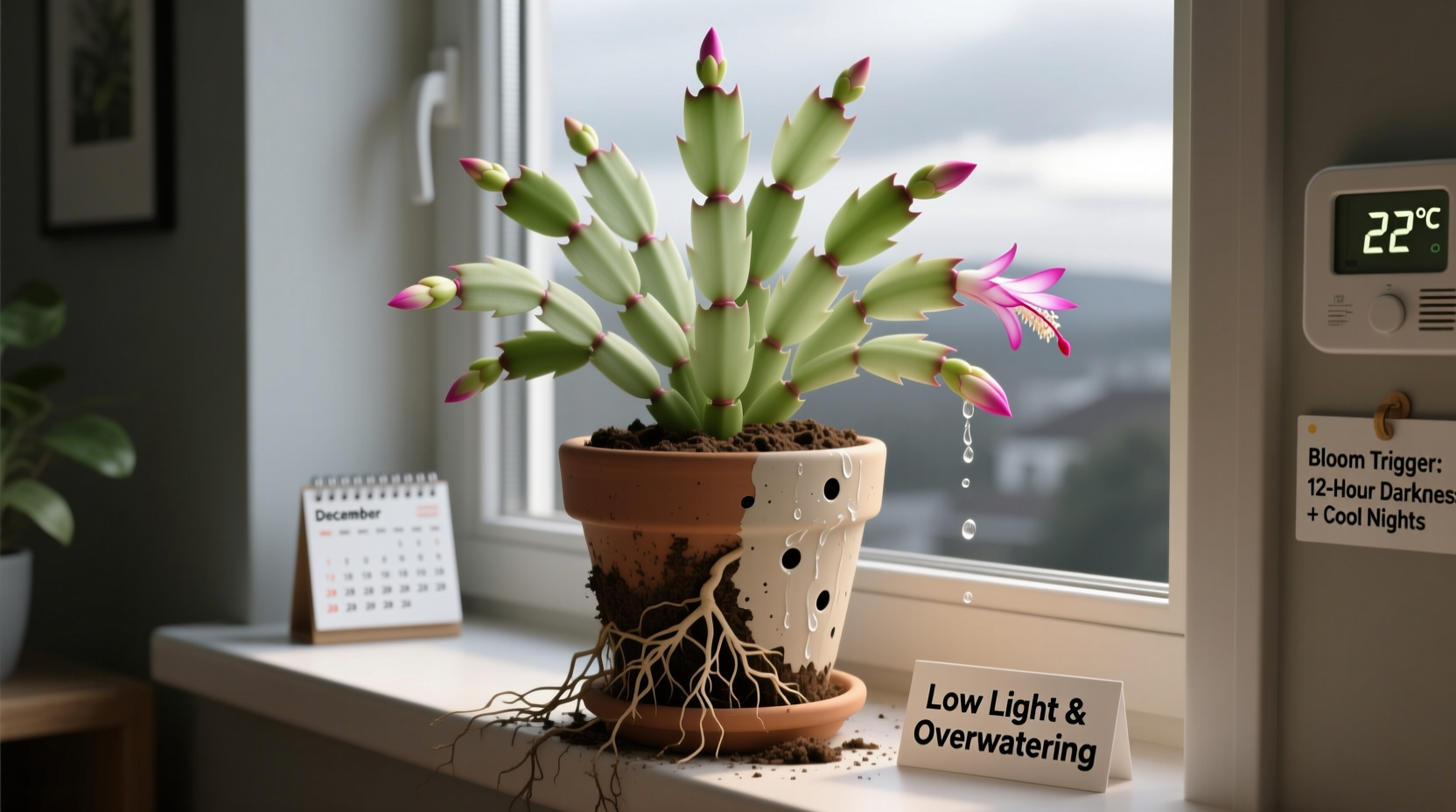
Christmas cacti are short-day plants. They don’t bloom in response to calendar dates—but to uninterrupted darkness. Flower initiation begins only after the plant receives at least 12–14 hours of continuous, unbroken darkness each night for 6–8 consecutive weeks. Even brief exposure to artificial light—a porch lamp, hallway bulb, or smartphone screen—resets the internal clock and delays or prevents bud formation entirely.
This requirement explains why indoor plants fail most often: homes rarely offer true darkness. A study published in HortScience found that 92% of non-blooming Christmas cacti in home environments received at least 37 seconds of supplemental light during their dark period—enough to inhibit phytochrome conversion and suppress flower primordia development.
2. Temperature: The Critical Chill Factor
Darkness alone isn’t enough. Cool temperatures act synergistically with long nights to trigger floral differentiation. Ideal pre-bloom conditions require consistent nighttime temperatures between 50–55°F (10–13°C) for at least four weeks. Warmer nights—even just 60°F or above—disrupt hormonal balance and promote stem elongation instead of bud set.
Many growers mistakenly assume “cool” means “cold.” But frost or sustained temps below 45°F damage cell membranes, causing stem reddening and bud drop. Likewise, daytime warmth above 70°F without corresponding cool nights creates thermal stress that halts reproductive development.
| Condition | Ideal Range | Risk if Outside Range |
|---|---|---|
| Nighttime temperature (Oct–Nov) | 50–55°F (10–13°C) | <45°F: tissue damage; >60°F: no bud initiation |
| Daytime temperature (Oct–Nov) | 60–68°F (15–20°C) | >72°F: excessive vegetative growth, weak buds |
| Bud development temp (once formed) | 62–65°F (17–18°C) | <58°F: slow opening; >70°F: premature bud drop |
| Humidity | 50–60% RH | <40%: bud desiccation; >75%: fungal risk |
3. Watering Discipline: The Dormancy Imperative
Overwatering is the second-most common cause of non-blooming—especially when paired with warm, low-light conditions. In nature, Schlumbergera experiences a dry-down phase before flowering, triggered by reduced rainfall and cooler air. This mild water stress signals resource conservation and redirects energy toward reproduction.
From mid-September onward, reduce watering frequency by 50%. Allow the top third of the soil to dry completely before watering again—never let the pot sit in standing water. If leaves appear slightly less turgid (but not shriveled), that’s optimal. Resume regular watering only after visible buds appear (typically late November). Prematurely increasing moisture triggers new stem segments instead of flowers—and those soft, green tips are highly susceptible to rot.
“Flower induction in Schlumbergera is a physiological cascade—not a nutrient event. Pushing nitrogen or bloom boosters during dormancy actually suppresses flowering genes like FT and AP1. It’s about timing, not tonnage.” — Dr. Lena Torres, Plant Physiologist, University of Florida IFAS
4. A Real-World Fix: Maria’s Balcony Cactus
Maria kept her 12-year-old Christmas cactus on a sunny west-facing balcony in Austin, Texas. Each fall, it grew thick, glossy stems but never bloomed—despite monthly fertilizing and repotting every two years. She assumed it needed more light or nutrients. In October 2023, she shifted strategy: she moved it indoors to a spare bedroom with north-facing windows, covered it with a cardboard box from 6 p.m. to 8 a.m., and placed a small digital thermometer nearby. She noticed nighttime temps hovered at 62°F—too warm. She began opening the window 2 inches each night, using a fan on low to circulate cool air (not direct draft), and reduced watering to once every 10 days. By November 12, tiny pink nubs appeared at stem tips. By December 10, 47 buds had opened across three main branches. Her key insight? “I stopped treating it like a succulent and started treating it like a seasonal forest dweller.”
5. Step-by-Step Bloom Reset Timeline (October–December)
- October 1–7: Stop fertilizing. Move plant to a location with bright, indirect light (no direct sun) and begin monitoring nighttime temps.
- October 8–14: Initiate strict dark treatment: 14 hours of total darkness nightly. Confirm ambient light sources are eliminated.
- October 15–31: Maintain dark cycle + cool temps (50–55°F nights). Water only when top 1/3 of soil is dry. Observe for slight stem firmness loss—this is normal.
- November 1–15: Continue dark/cool regimen. Buds may appear as tiny swellings at stem tips. Resist watering until soil is dry to 2 inches deep.
- November 16–30: Once buds are ¼-inch long and firm, discontinue dark treatment. Keep nights at 58–62°F. Increase watering slightly—enough to moisten soil fully, then drain completely.
- December 1–25: Maintain stable 62–65°F temps. Avoid moving the plant or rotating the pot—bud drop occurs readily under stress. Enjoy blooms.
6. Common Environmental Pitfalls & Corrections
- “I keep it near my TV stand”: Even standby LEDs emit enough red/far-red light to disrupt phytochrome signaling. Relocate or use a light-proof cover.
- “It’s been in the same pot for five years”: Root-bound status doesn’t prevent blooming—but mineral salt buildup from tap water or fertilizer can raise soil pH and limit calcium uptake, weakening bud pedicels. Flush soil annually with distilled water.
- “I mist it daily”: Frequent misting raises humidity temporarily but encourages fungal spores on stems. Use a humidity tray (pebbles + water) instead.
- “I gave it ‘bloom food’ in September”: High-phosphorus fertilizer applied before dormancy increases osmotic pressure in roots, delaying abscission layer formation needed for bud set. Fertilize only March–August, with balanced 20-20-20 at half-strength.
7. FAQ
Why do some Christmas cacti bloom in November while others wait until January?
Genetics play a role—some cultivars like ‘White Christmas’ initiate earlier than ‘Golden Cream’. But the dominant factor is local environmental consistency. Plants exposed to earlier cool nights and longer natural darkness (e.g., northern latitudes or higher elevations) typically bloom sooner. Indoor growers who start dark treatment October 1 often see blooms by late November; those waiting until October 20 may not bloom until mid-December.
Can I force blooms twice a year?
Technically yes—but not sustainably. A second bloom cycle requires repeating the full 8-week dark/cool regimen, which exhausts carbohydrate reserves. Most experts advise against it. After the first bloom, allow natural recovery: resume feeding in March, prune lightly in June to encourage branching, and let the plant rest through summer. One strong, healthy bloom cycle per year supports longevity—many specimens live 30+ years with this rhythm.
My cactus formed buds, but they dropped off before opening. What went wrong?
Bud drop almost always traces to abrupt environmental change: sudden temperature swings (e.g., heater turning on overnight), relocation, overwatering during cool periods, or low humidity below 40%. Once buds reach ½-inch length, stability is non-negotiable. Avoid drafts, maintain even moisture (not soggy), and keep humidity above 45% using a pebble tray.
Conclusion
Your Christmas cactus isn’t broken—it’s waiting for the right signal. Blooming isn’t a random event or a matter of luck; it’s the plant’s precise, evolved response to measurable environmental conditions. You hold all the tools: a thermometer, a timer, a watering can, and the willingness to align your care with its native ecology—not your convenience. Start this October with intentional darkness and deliberate coolness. Track your progress. Adjust based on what the plant tells you—not what gardening blogs promise. When those first buds emerge, you’ll recognize them not as decoration, but as confirmation: you listened, you adapted, and nature responded. That’s not horticulture. That’s partnership.




 浙公网安备
33010002000092号
浙公网安备
33010002000092号 浙B2-20120091-4
Comments
No comments yet. Why don't you start the discussion?