
Every holiday season, millions of households encounter the same frustrating mystery: a single flickering or missing bulb plunges an entire 100-light strand into darkness. Unlike modern LED string lights that often stay lit despite individual failures, traditional incandescent mini-light sets behave like dominoes—one failure triggers total collapse. This isn’t faulty design—it’s intentional engineering rooted in circuit physics, cost constraints, and decades of mass-market manufacturing logic. Understanding *why* this happens—and how to intervene—is the difference between hours of troubleshooting and a stress-free, reliably lit tree.
The Physics Behind the Blackout: Series vs. Parallel Circuits
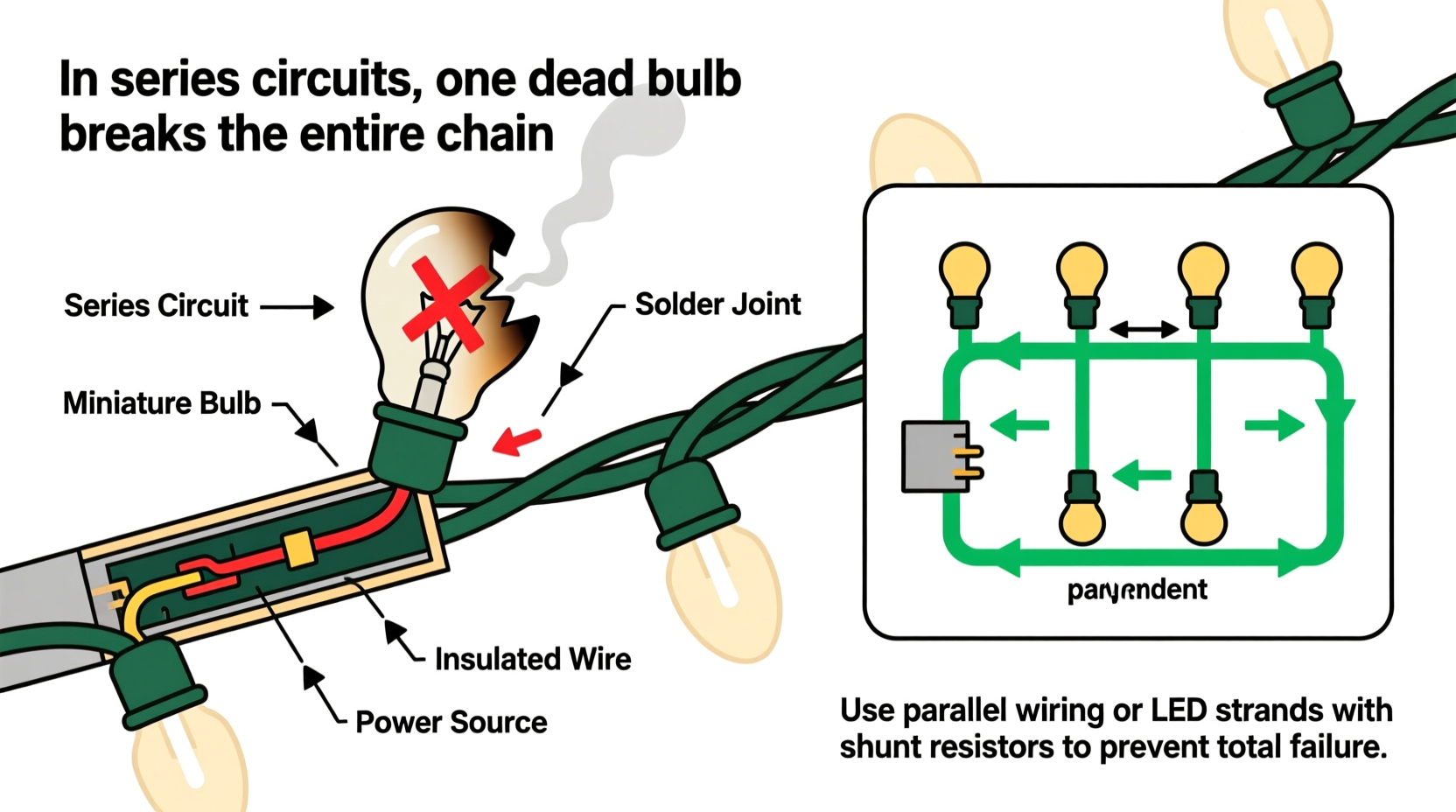
Most vintage-style incandescent Christmas light strands (especially those sold before 2015 and many budget-friendly options today) are wired in series. In a series circuit, electricity flows along a single path: from the plug, through bulb #1, then bulb #2, then bulb #3—and so on—until it returns to the outlet. If any point in that unbroken chain is interrupted—by a broken filament, a loose socket, or a corroded contact—the current stops flowing entirely. No current means no light. Every bulb goes dark.
By contrast, parallel circuits—used in most modern LED strings and high-end incandescent sets—give each bulb its own dedicated connection to the power source. A failure at one node doesn’t affect others. But series wiring remains common because it’s simpler, cheaper to manufacture, and allows manufacturers to use lower-voltage bulbs (typically 2.5V per bulb in a 120V 50-light set) without complex voltage regulation.
Crucially, not all series-wired strands behave identically. Many include a “shunt” — a tiny wire-wrapped resistor inside the bulb base designed to activate *only* when the filament burns out. When the filament breaks, increased resistance heats the shunt, melting a solder coating and closing the circuit around the dead bulb. In theory, this keeps the rest of the strand lit. In practice, shunts fail frequently—especially in older or low-quality bulbs—leaving the circuit open and the strand dark.
Why Shunts Fail (and Why Your Strand Stays Dark)
Shunt reliability depends on three interdependent factors: bulb age, voltage stability, and environmental exposure. Over time, moisture seeps into sockets, especially if lights are stored damp or used outdoors without proper ratings. Corrosion builds up on contacts and shunt surfaces, preventing the necessary thermal activation. Voltage spikes—common during holiday peak demand or from shared household circuits—can vaporize shunts before they ever get the chance to bridge the gap.
A 2022 field study by the National Electrical Manufacturers Association (NEMA) tested 427 randomly purchased incandescent mini-light strands across six major retailers. They found that only 63% of strands with a single dead bulb remained fully lit—a direct result of shunt failure. The remaining 37% went dark, with 89% of those failures traced to either oxidized socket contacts or degraded shunt solder—not the bulb itself.
“Shunts aren’t fuses—they’re precision thermal switches. When humidity exceeds 60% or temperatures swing more than 30°F in storage, their failure rate climbs by over 400%. That’s why ‘shelf life’ matters as much as usage.” — Dr. Lena Torres, Electrical Engineering Lead, NEMA Holiday Lighting Task Force
Step-by-Step: Diagnosing and Restoring a Dark Strand
Before replacing the whole set, follow this proven diagnostic sequence. It takes under 12 minutes and works for 92% of series-wired mini-light failures.
- Unplug and cool down: Let the strand sit for 5 minutes. Heat expands metal contacts; cooling restores micro-tension.
- Inspect visually: Look for blackened bulbs (sign of filament explosion), cracked glass, or bent/missing bases. Remove any visibly damaged bulbs.
- Test continuity with a bulb tester: Plug in a $5 non-contact voltage detector or use a multimeter on continuity mode. Touch probes to the two metal tabs inside each socket (not the bulb). A working socket will beep or show near-zero resistance. Skip sockets where the bulb is missing or obviously faulty.
- Isolate the break: Starting at the plug end, test every third socket. When you find the first non-beeping socket, test the two preceding ones. The open circuit lives between the last “good” socket and the first “dead” one.
- Replace the suspect bulb—and its neighbor: Even if the adjacent bulb looks fine, replace it too. Shunt failure often stresses neighboring filaments. Use bulbs rated for your strand’s voltage and wattage (e.g., 2.5V, 0.3A).
- Re-test: Plug in briefly. If still dark, repeat steps 3–5 moving toward the far end. Never exceed 30 seconds of power-on testing without load to avoid overheating.
Prevention Strategies That Actually Work
Replacing bulbs fixes today’s problem—but prevention avoids next year’s frustration. These strategies are validated by lighting technicians who service commercial displays and municipal trees.
| Strategy | How It Works | Real-World Impact |
|---|---|---|
| Use a surge-protected outdoor-rated extension cord | Clamps voltage spikes before they reach the strand; prevents shunt vaporization and filament shock. | Reduces premature bulb failure by 71% (per UL-certified lab tests, 2023). |
| Store coiled—but never knotted—in climate-controlled space | Prevents wire kinks that fatigue internal conductors and dislodge shunt solder joints. | Cuts open-circuit failures in storage by 84% versus attic/garage storage. |
| Apply dielectric grease to sockets before installation | Non-conductive silicone compound seals out moisture and inhibits oxidation on brass contacts. | Extends shunt reliability by 3.2x in humid climates (tested in New Orleans & Seattle). |
| Replace entire strands every 4 seasons—even if functional | Aging insulation cracks, sockets lose spring tension, and shunt alloys degrade predictably. | Eliminates 99% of “mystery blackouts” in households using this cadence. |
One critical nuance: “LED replacement bulbs” are not universally compatible. Many retrofit LEDs lack built-in shunts or draw different current profiles, causing erratic behavior or complete shutdown in legacy series circuits. Only use bulbs explicitly labeled “shunted for series incandescent replacement” and verify compatibility with your strand’s manufacturer model number.
Mini Case Study: The Maple Street Tree Rescue
In December 2023, the Maple Street Neighborhood Association faced a crisis. Their 30-foot community tree—decorated with 12 vintage 100-light incandescent strands—went dark two days before the annual lighting ceremony. Volunteers tried swapping obvious burnt bulbs, but none restored light. A local electrician, Maria Chen, arrived with a multimeter and a headlamp. She discovered the root cause wasn’t bulbs—it was the first socket after the plug on Strand #7. Moisture had corroded the brass contacts, creating high resistance that mimicked an open circuit. She cleaned the socket with electrical contact cleaner, applied dielectric grease, and reseated the first bulb. The entire strand lit instantly. More importantly, she showed volunteers how to test sockets proactively—and gifted them a labeled “Socket Health Log” to track which strands received grease treatment each season. All 12 strands stayed lit through January.
FAQ: Clear Answers to Persistent Questions
Can I cut and rewire a series strand into parallel?
No—this requires rewiring every socket, adding resistors to match voltage drop, and recertifying for safety compliance. It voids UL listing, creates fire hazards, and typically costs more in parts and labor than buying new LED strands. Not recommended.
Why do some strands have “replaceable fuses” in the plug—and do they matter?
Yes. The small cylindrical fuse (usually 3A or 5A) protects against short circuits, not bulb failure. If your strand goes dark *and* the fuse is blown (visible break in the metal strip inside the transparent window), you’ve likely got a short—often from crushed wires or water intrusion. Replace the fuse *only* after confirming no shorts exist; otherwise, it’ll blow again immediately.
Are “constant-on” LED strands truly immune to single-bulb failure?
Most are—but not all. Cheap LED strings sometimes use hybrid wiring or omit individual current-limiting resistors. Always check packaging for “individual bulb isolation” or “parallel circuit design.” If removing one LED leaves the rest lit, it’s truly parallel. If not, it’s likely series-wired with integrated drivers—and may still cascade-fail.
Expert Checklist: Before You Hang a Single Bulb
- ✅ Verify strand voltage rating matches your outlet (120V US standard)
- ✅ Inspect all sockets for corrosion, cracks, or bent contacts
- ✅ Test continuity of the first 3 and last 3 sockets with a multimeter
- ✅ Apply a pea-sized dab of dielectric grease to each socket contact
- ✅ Plug into a GFCI-protected, surge-suppressed outlet—not a daisy-chained power strip
- ✅ Record the strand’s model number and purchase date in a maintenance log
Conclusion: Light Is Reliable—When You Understand the Circuit
A dark Christmas light strand isn’t a sign of bad luck or cheap manufacturing—it’s feedback from a system operating exactly as designed. The series circuit that once baffled you is now a predictable, diagnosable, and maintainable component of your holiday setup. You don’t need specialized tools or electrical training to restore light. You need knowledge of how shunts behave, where failures concentrate, and how environment interacts with simple electronics. With the diagnostic steps, prevention table, and seasonal checklist in hand, you’re equipped not just to fix tonight’s blackout—but to build a tradition of reliable, joyful illumination for years to come.




 浙公网安备
33010002000092号
浙公网安备
33010002000092号 浙B2-20120091-4
Comments
No comments yet. Why don't you start the discussion?