
It’s a familiar holiday scene: you’ve lit up the house with festive strings of twinkling lights, poured a mug of hot cocoa, and queued up your favorite Christmas playlist. But every time the lights flicker—so does your music. The song stutters, pauses, or skips entirely. What should be a seamless seasonal soundtrack becomes a frustrating loop of buffering and reloading. This isn’t just bad luck—it’s physics, electronics, and power quality colliding in your living room. Understanding the root cause is the first step to reclaiming smooth holiday listening.
The Hidden Link Between Flickering Lights and Audio Interruptions
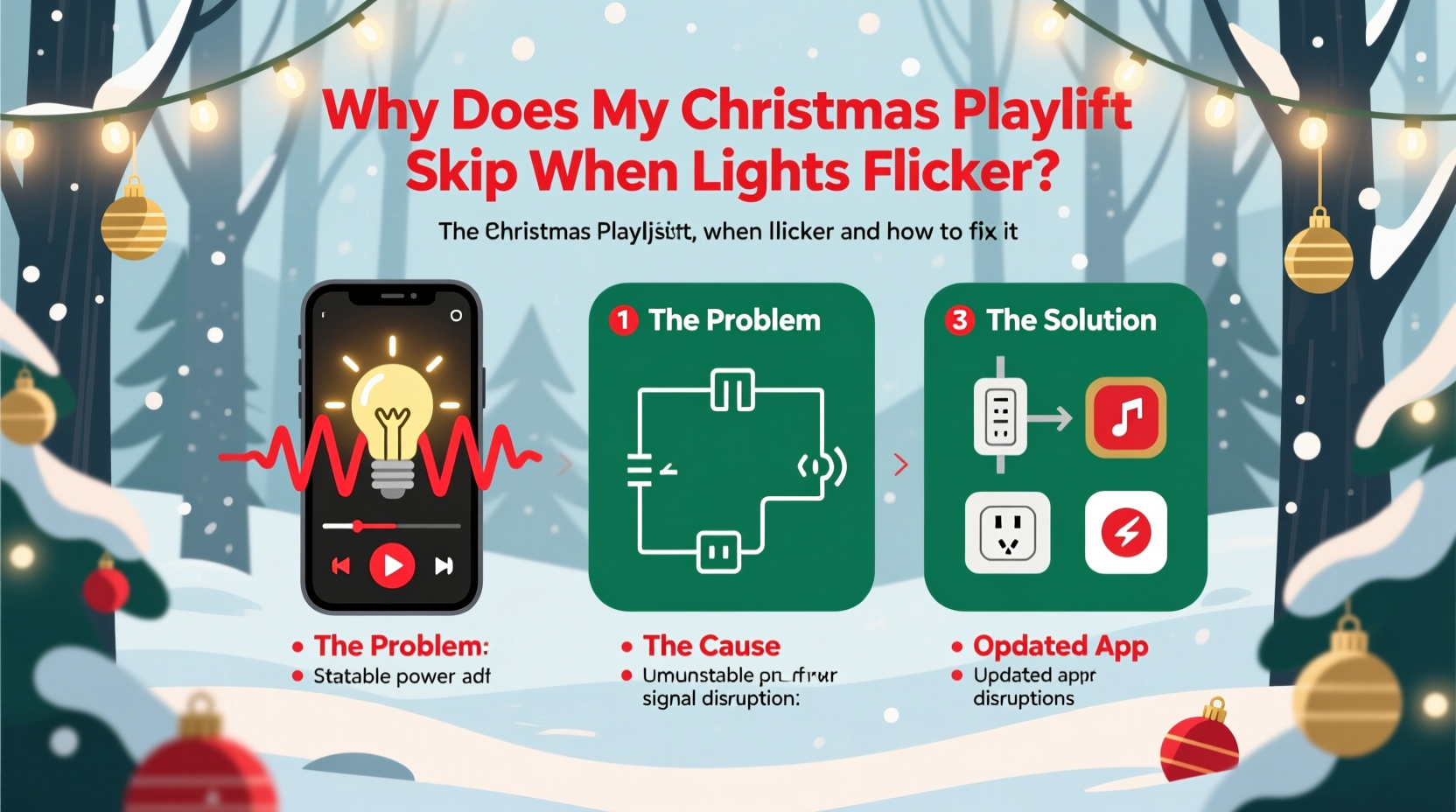
Flickering holiday lights aren’t always just a visual nuisance—they can signal deeper electrical issues that affect other devices on the same circuit. When incandescent or LED holiday lights flicker due to voltage fluctuations, they often share an electrical circuit with your audio playback device: whether it’s a smart speaker, smartphone, laptop, or streaming receiver. These devices rely on stable power to maintain consistent data flow and uninterrupted Bluetooth or Wi-Fi signals.
Here’s how it works: many modern audio systems draw power from wall outlets or USB adapters connected to the same household circuit as decorative lighting. When older or low-quality light strings cycle on and off rapidly (especially those with built-in flashers), they create small surges and sags in voltage. While these fluctuations may not trip a breaker, they’re enough to disrupt sensitive digital electronics. Your phone or speaker might momentarily lose power stability, causing the processor to reset briefly, drop its network connection, or buffer audio.
This issue is especially common in homes with outdated wiring, overloaded circuits, or daisy-chained extension cords—all typical during the holidays when multiple light strands are plugged into a single outlet.
How Power Quality Affects Digital Devices
Modern audio playback relies on continuous power and data integrity. Even minor power anomalies—called “transients” or “noise”—can interfere with digital signal processing. These disruptions don’t always shut down a device completely but can cause subtle malfunctions like audio skipping, Wi-Fi disconnections, or app crashes.
Consider this chain reaction:
- A string of older-style mini-lights cycles through a blinking pattern.
- Each blink causes a tiny surge as current flows and stops.
- These micro-surges travel through the circuit, affecting nearby devices.
- Your Bluetooth speaker experiences a voltage dip, resetting its wireless module.
- The speaker disconnects momentarily from your phone, causing the playlist to skip or pause.
Even if your speaker has internal batteries, the charging circuit may still be drawing AC power, making it vulnerable to line noise. Similarly, Wi-Fi routers powered on the same circuit can experience brief outages or signal degradation during light-induced power swings, disrupting streaming services like Spotify or Apple Music.
“Voltage instability from decorative lighting is one of the most overlooked causes of home electronics disruption during the holidays.” — Dr. Alan Reeves, Electrical Systems Engineer, Northeast Power Research Institute
Common Culprits Behind the Problem
Not all holiday lights are created equal. Some types are far more likely to cause electrical interference than others. Here’s a breakdown of the usual suspects:
- Incandescent Mini-Lights with Flasher Bulbs: Older sets often use a special \"flasher\" bulb that heats up and breaks the circuit, creating a visible blink. This mechanical switching introduces significant electrical noise.
- Daisy-Chained Light Strings: Connecting too many strands together increases load and resistance, leading to voltage drops and unstable current flow.
- Non-UL-Listed or Off-Brand Lights: Cheaply made lights may lack proper filtering or insulation, increasing electromagnetic interference (EMI).
- Shared Outlets with Sensitive Electronics: Plugging speakers, phones, or routers into the same strip as lights multiplies exposure to power fluctuations.
- Aged Extension Cords: Worn or undersized cords can't handle combined loads efficiently, contributing to inconsistent power delivery.
Mini Case Study: The Johnson Family’s Holiday Headache
The Johnsons in Ohio decorated their front porch with six strands of vintage incandescent lights, all plugged into a single outdoor outlet via a 50-foot extension cord. Inside, their Amazon Echo played Christmas carols streamed from Alexa. Every 8 seconds, when the lights blinked, the music would cut out for 2–3 seconds before resuming.
After troubleshooting apps and Wi-Fi, they noticed the pattern matched the blink cycle. An electrician tested the circuit and found voltage dropped from 120V to 108V during each flash. By moving the Echo to a different circuit and replacing the old lights with UL-listed LEDs, the skipping stopped immediately.
Solutions to Stop Playlist Skipping
The good news: this problem is fixable without dismantling your entire display. Here’s a practical roadmap to eliminate interference and enjoy uninterrupted holiday music.
Step-by-Step Guide to Eliminate Interference
- Identify the Circuit: Determine which electrical circuit powers both your lights and audio devices. You can do this by turning off breakers one at a time and checking what loses power.
- Separate the Loads: Plug your music-playing device (phone, speaker, tablet) into a different circuit. Ideally, use one that powers low-interference appliances like lamps or clocks.
- Upgrade to LED Lights: Replace older incandescent strings with modern LED holiday lights. LEDs draw less power and don’t rely on thermal cycling, reducing voltage swings.
- Use a Surge Protector with Noise Filtering: Invest in a high-quality surge protector labeled “EMI/RFI filtered.” These suppress electrical noise that can disrupt digital devices.
- Power Audio Devices via Battery or UPS: Run your speaker from its internal battery or connect it to a small uninterruptible power supply (UPS) to isolate it from grid fluctuations.
- Strengthen Wi-Fi Signal: Place your router centrally and avoid placing it near large metal objects or high-power decorations. Consider a Wi-Fi extender if needed.
- Download Playlists Locally: Instead of streaming, download your Christmas playlist to your device. Offline playback doesn’t rely on constant internet connectivity, making it immune to Wi-Fi hiccups caused by power noise.
Checklist: Prevent Holiday Audio Disruptions
- ✅ Identify shared circuits between lights and audio devices
- ✅ Move music players to a separate electrical circuit
- ✅ Replace old incandescent lights with energy-efficient LEDs
- ✅ Use EMI-filtered surge protectors for electronics
- ✅ Avoid daisy-chaining more than three light strands
- ✅ Download playlists for offline playback
- ✅ Test system under full load before guests arrive
Comparison: Lighting Types and Their Impact on Electronics
| Light Type | Power Draw | EMI Risk | Likely to Cause Audio Skipping? | Recommended Fix |
|---|---|---|---|---|
| Incandescent with Flasher Bulb | High (10–20W per strand) | High | Yes, very likely | Replace with LED or isolate circuit |
| Standard LED String | Low (2–5W per strand) | Low | No, rarely | Ensure proper surge protection |
| Smart RGB Lights (e.g., Philips Hue) | Medium | Very Low | Unlikely | Use dedicated hub power |
| Pre-lit Christmas Tree (Old Model) | Medium-High | Moderate | Possible | Plug tree into separate outlet |
| Solar-Powered Outdoor Lights | None (on grid) | Negligible | No | No action needed |
Advanced Protection: Beyond Basic Fixes
If you live in an older home or have persistent issues despite basic fixes, consider upgrading your power infrastructure for long-term reliability.
Install a Dedicated Circuit: For homes with extensive holiday displays, an electrician can install a new 15-amp circuit solely for decorative lighting. This permanently separates high-load decorations from general-use outlets.
Use a Line Conditioner: These devices filter out electrical noise and stabilize voltage. While typically used for home theaters or recording studios, a small line conditioner can protect a single speaker or streaming device.
Opt for Battery-Operated Speakers: Use portable, rechargeable Bluetooth speakers running on internal power during gatherings. Charge them fully beforehand and disable charging during use to avoid AC coupling.
Switch to Wired Audio: If feasible, connect your audio source directly via AUX cable instead of relying on wireless transmission. Wired connections are immune to Wi-Fi drops caused by power noise.
FAQ
Can LED lights still cause interference?
Most modern LED holiday lights produce minimal electromagnetic interference (EMI). However, cheap or poorly shielded LED strings—especially those with built-in controllers or dimming features—can emit high-frequency noise. Stick to UL-listed, reputable brands to minimize risk.
Why does only one speaker skip while others stay connected?
Different speakers may be on different circuits or using different power sources. One unit might be more sensitive to voltage changes due to aging components or lower-quality power supplies. Also, placement near large light transformers can increase susceptibility to EMI.
Will a power strip solve the problem?
Only if it’s a high-quality surge protector with EMI/RFI filtering. Basic power strips merely multiply outlets—they don’t protect against electrical noise. Look for models certified by organizations like Underwriters Laboratories (UL) with explicit noise suppression ratings.
Conclusion: Enjoy Smooth Holiday Sounds All Season
The flicker of holiday lights should enhance the mood, not disrupt your music. With a clear understanding of how power fluctuations affect digital devices, you can take targeted steps to protect your audio setup. From separating circuits to upgrading outdated lights, the solutions are straightforward and cost-effective. Most importantly, they ensure your Christmas playlist plays smoothly—no skips, no pauses, just seamless holiday cheer.
Don’t wait until the night before a family gathering to troubleshoot. Apply these fixes now, test your system, and enjoy a glitch-free season. A little electrical awareness goes a long way in preserving the magic of the holidays.




 浙公网安备
33010002000092号
浙公网安备
33010002000092号 浙B2-20120091-4
Comments
No comments yet. Why don't you start the discussion?