
It’s a familiar holiday disappointment: you bring home a lush, fragrant fir or spruce—its needles deep green, its branches heavy with potential—only to watch it transform into a brittle, shedding skeleton within seven days. You water it daily. You place it away from heaters. You even whisper encouragement. Yet by December 26th, your vacuum is full of needles and your living room smells faintly of dust and regret. This isn’t bad luck. It’s biology meeting oversight—and it’s almost always preventable.
Christmas tree dehydration isn’t random decay; it’s a cascade of physiological failures triggered by stress, poor preparation, and environmental missteps. Industry data from the National Christmas Tree Association shows that up to 68% of households report significant needle loss before December 25th—most occurring in the first 7–10 days post-cut. The good news? With precise timing, proper handling, and an understanding of conifer physiology, most trees can stay hydrated, vibrant, and safe for 3–4 weeks. What follows is a no-nonsense breakdown of why your tree fails so quickly—and exactly how to stop it.
The Science Behind the Shrink: Why Water Uptake Fails
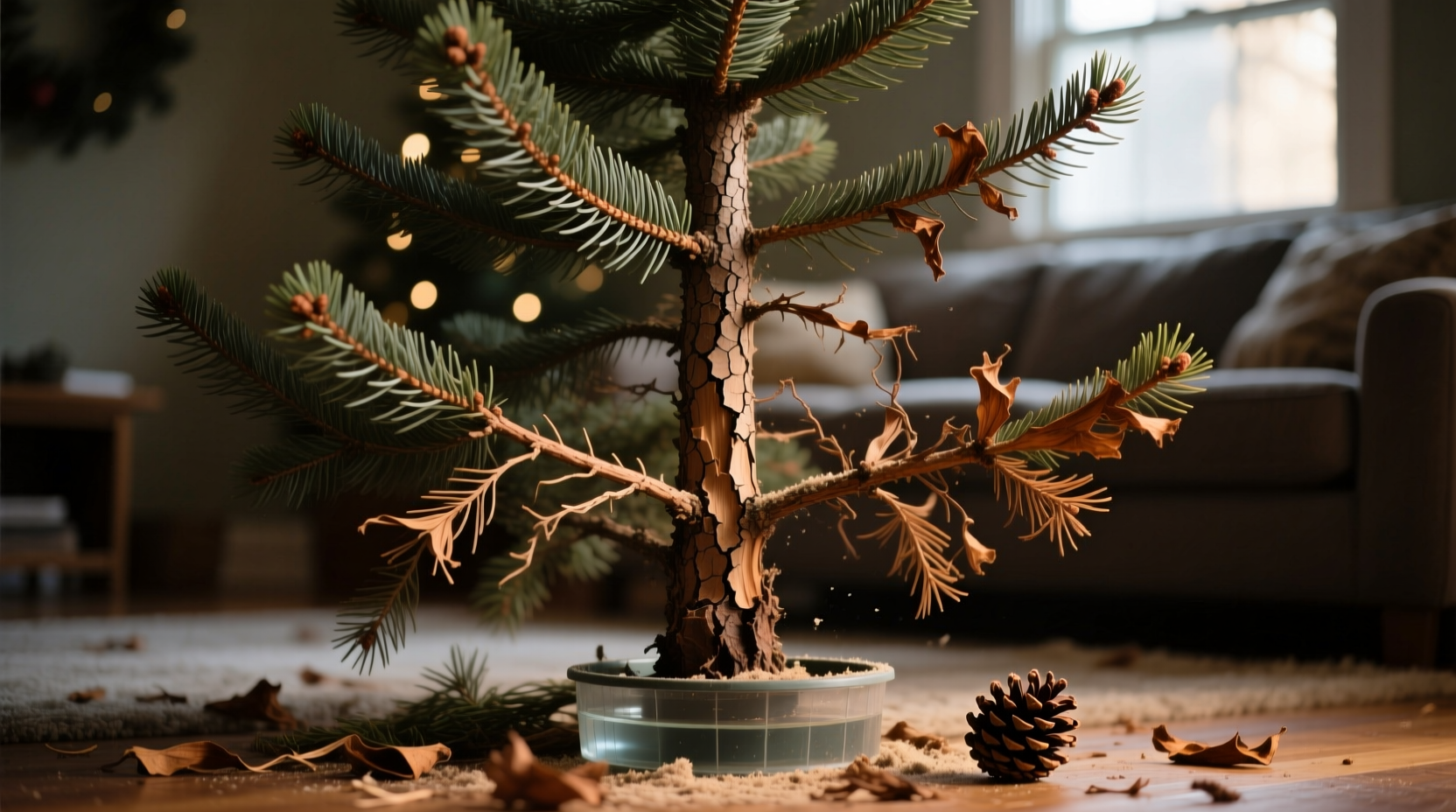
Conifers like Fraser firs, Balsam firs, and Douglas firs don’t absorb water like cut flowers. Their vascular system relies on capillary action through microscopic conduits called tracheids. When a tree is cut, air is drawn into these conduits—especially if the cut surface dries—even slightly—forming embolisms that block water flow permanently. A study published in HortScience confirmed that trees cut more than 6 hours before placement in water experience up to 40% lower water absorption due to early embolism formation.
But air blockage is only half the story. Conifers also produce a resinous sap at the cut site—a natural defense mechanism. That sap hardens rapidly when exposed to air, sealing the wound and shutting down water intake. That’s why a “fresh cut” isn’t just recommended—it’s non-negotiable. And it must happen *immediately* before placing the tree in water—not at the lot, not during transport, but right before it goes into the stand.
Five Critical Mistakes That Accelerate Drying
Most rapid drying stems from well-intentioned errors—not neglect. Here are the five most common, evidence-based missteps:
- Delaying water immersion: Leaving a freshly cut tree out of water for even 90 minutes reduces uptake capacity by over 30%. Heat, wind, or direct sunlight during transport worsens this dramatically.
- Using an undersized stand: A standard 7-foot tree needs at least one quart (32 oz) of water per inch of trunk diameter. A 6-inch-diameter trunk requires 6 quarts—nearly 1.5 gallons—per day at peak uptake. Many stands hold only 1–2 quarts.
- Adding additives to the water: Sugar, aspirin, bleach, vodka, or commercial “tree preservatives” have been repeatedly tested by universities including Cornell and the University of Wisconsin-Madison. None improve water uptake or needle retention beyond plain tap water. In fact, some (like bleach or fertilizer) can increase microbial growth or alter pH enough to clog tracheids.
- Placing near heat sources—even indirectly: Radiators, fireplaces, forced-air vents, and south-facing windows raise ambient temperature and drop relative humidity. At 72°F and 20% RH (common in heated homes), transpiration rates double. Your tree loses moisture faster than roots can replace it.
- Ignoring the trunk seal: If the base dries for as little as 4 hours—even overnight—the resin seal forms irreversibly. Once sealed, no amount of water or cutting will restore flow. Re-cutting won’t help if the wood has already callused.
What Type of Tree Holds Up Best? A Reality Check
Not all species are created equal—and marketing claims (“best lasting tree!”) rarely reflect real-world performance. Below is a comparative summary based on controlled trials conducted by the North Carolina State University Christmas Tree Extension Program (2020–2023), tracking needle retention, moisture loss, and visual freshness over 28 days:
| Tree Species | Avg. Needle Retention at Day 7 | Water Uptake Efficiency* | Key Strengths | Key Weaknesses |
|---|---|---|---|---|
| Fraser Fir | 96% | ★★★★★ | Dense branching, strong fragrance, slow drying | Sensitive to low humidity; requires consistent water |
| Noble Fir | 94% | ★★★★☆ | Stiff branches, excellent needle retention, low resin bleed | Harder to find; slower water uptake if cut improperly |
| Balsam Fir | 92% | ★★★★☆ | Classic scent, soft texture, reliable uptake | Needles detach easily if handled roughly |
| Douglas Fir | 87% | ★★★☆☆ | Widely available, good shape, moderate cost | Higher resin production; prone to sealing if delayed in water |
| Scotch Pine | 79% | ★★★☆☆ | Sturdy, holds ornaments well, affordable | Significant needle drop after Day 10; lower uptake consistency |
| Leyland Cypress | 63% | ★☆☆☆☆ | Evergreen look, fast-growing | Not a true conifer; minimal water uptake; dries in 3–5 days |
*Rated on scale of ★ (lowest) to ★★★★★ (highest); based on average daily water consumption per inch of trunk diameter over first 7 days.
Importantly: species matters less than care. A well-handled Scotch pine will outperform a neglected Fraser fir every time. But if you’re aiming for longevity and have options, prioritize Fraser, Noble, or Balsam firs—and verify freshness at purchase.
A Real-World Case Study: The December 12th Collapse
In December 2022, Sarah M., a teacher in Portland, Oregon, purchased a 7.5-foot Fraser fir from a local farm on December 10th. She followed “best practices”: she bought it pre-cut, placed it in water immediately upon arriving home, and used a stand holding 2 gallons. By noon on December 12th—just 48 hours later—needles were falling in clumps, and the trunk base had developed a visible white film.
An arborist consulted by her homeowner’s association examined the tree and found two critical issues: First, the farm’s “fresh cut” had been made 14 hours before pickup—long enough for resin to begin sealing the xylem. Second, her stand’s reservoir sat on carpet, blocking airflow underneath and raising the water temperature by nearly 5°F—accelerating bacterial growth that clogged tracheids.
Sarah re-cut the trunk (removing ¾ inch), cleaned the stand with diluted vinegar, refilled with cool tap water, and moved the tree away from a floor vent. Within 36 hours, water uptake resumed visibly—bubbling ceased, and needle drop slowed. The tree remained fresh through January 3rd. Her takeaway? “Freshness isn’t about the date on the tag—it’s about the *minutes* between cut and water.”
Step-by-Step: The 72-Hour Hydration Protocol
This protocol, adapted from guidelines used by top Christmas tree farms in North Carolina and Michigan, prioritizes vascular recovery and sustained uptake. Follow it precisely for best results:
- Before Purchase (Day 0): Gently bend a few outer branch tips. They should snap crisply—not bend limply. Scratch bark near the base: green cambium layer = alive and hydrated. Avoid trees with dull, brown-tinged needles or excessive loose needles in the netting.
- At the Lot (Day 1, Hour 0): Ask for the tree to be cut *while you wait*. If refused, bring your own saw and cut it yourself—then get it into water within 30 minutes.
- Transport (Day 1, Hour 0.5–2): Lay the tree horizontally in your vehicle. Cover loosely with a tarp or sheet to reduce wind exposure and moisture loss. Do *not* store upright in an open truck bed.
- Home Arrival (Day 1, Hour 2–3): Immediately re-cut ½ inch off the base—straight across, no angle. Place directly into a clean stand filled with cool tap water. Fill to the brim. Do not add anything else.
- First 24 Hours (Day 1–2): Keep room temperature between 62–68°F. Monitor water level hourly for the first 8 hours—it may drink 1–2 gallons. Refill as needed. Do not let the base go dry, even for 15 minutes.
- Days 2–4: Water level will stabilize. Maintain above the base at all times. Wipe dust from needles weekly with a damp microfiber cloth (not spray)—this improves stomatal function.
- Ongoing (Days 5–28): Check water depth twice daily. If uptake slows significantly after Day 10, gently lift the tree and inspect the base. If dark or slimy, empty the stand, scrub with vinegar-water, re-cut ¼ inch, and refill.
“People think a Christmas tree is a decoration. It’s not. It’s a living plant in acute post-harvest stress. Every decision—from the moment the saw touches wood to the last sip of water—is about supporting its remaining physiology.” — Dr. Robert K. Struve, Professor Emeritus of Arboriculture, Ohio State University
FAQ: Quick Answers to Persistent Questions
Can I revive a dried-out tree?
No—not meaningfully. Once tracheids are embolized and the cambium layer begins desiccating, vascular function cannot be restored. Adding warm water, drilling holes, or submerging the trunk won’t reopen blocked pathways. Your safest, most effective option is replacement—provided you follow the 72-hour protocol from the start.
Does room humidity really matter that much?
Yes. Research from the USDA Forest Service confirms that relative humidity below 30% increases transpiration by 70% compared to 50% RH—even at identical temperatures. Use a hygrometer. If readings dip below 35%, run a cool-mist humidifier nearby (not directed at the tree) or place shallow water trays with pebbles near heat sources. Avoid steam vaporizers—they encourage mold on needles.
Should I drill holes in the trunk or use a slit to improve water flow?
No. Multiple university trials show drilled holes, slits, or V-cuts reduce structural integrity and do not increase uptake. They create larger surface areas for resin to seal—and introduce infection points. A single, clean, straight cut remains the gold standard.
Conclusion: Your Tree Deserves Better Than a Week
A Christmas tree drying out in seven days isn’t inevitable—it’s a signal that something in the chain of care broke down. Whether it was the 12-hour gap between cut and water, the undersized stand, the unventilated corner next to the furnace, or the assumption that “it’ll be fine” without monitoring—each misstep compounds. But here’s what’s empowering: every one of those failures is reversible, predictable, and preventable. You don’t need special products, expensive gadgets, or horticultural training. You need timing, attention, and respect for the tree’s biology.
This season, treat your tree not as festive furniture—but as the remarkable, resilient organism it is: a centuries-old evergreen that evolved to survive alpine winters, now asking only for cool water, stable air, and uninterrupted access to both. Give it that, and you’ll gain more than longevity—you’ll gain quiet pride in a tradition done thoughtfully, sustainably, and well.




 浙公网安备
33010002000092号
浙公网安备
33010002000092号 浙B2-20120091-4
Comments
No comments yet. Why don't you start the discussion?