
Every year, millions of households welcome a fresh-cut Christmas tree—only to watch it shed needles, droop, and become a fire hazard within days. It’s not just disappointing; it’s dangerous. According to the National Fire Protection Association (NFPA), between 2018 and 2022, U.S. fire departments responded to an average of 160 home fires each December and January that started with Christmas trees—most linked to drying, electrical faults, or proximity to heat sources. The culprit isn’t bad luck or poor genetics. It’s a cascade of avoidable physiological and environmental missteps—many happening before the tree even leaves the lot.
This isn’t about blaming the retailer or blaming yourself. It’s about understanding the biology of conifer hydration and aligning your care routine with what the tree actually needs—not what tradition tells us it should get. A healthy Fraser fir, for example, can retain moisture for up to five weeks when properly cared for. Yet most trees in American living rooms last fewer than 14 days. The gap isn’t magic—it’s method.
Why Your Tree Dries Out Faster Than Expected
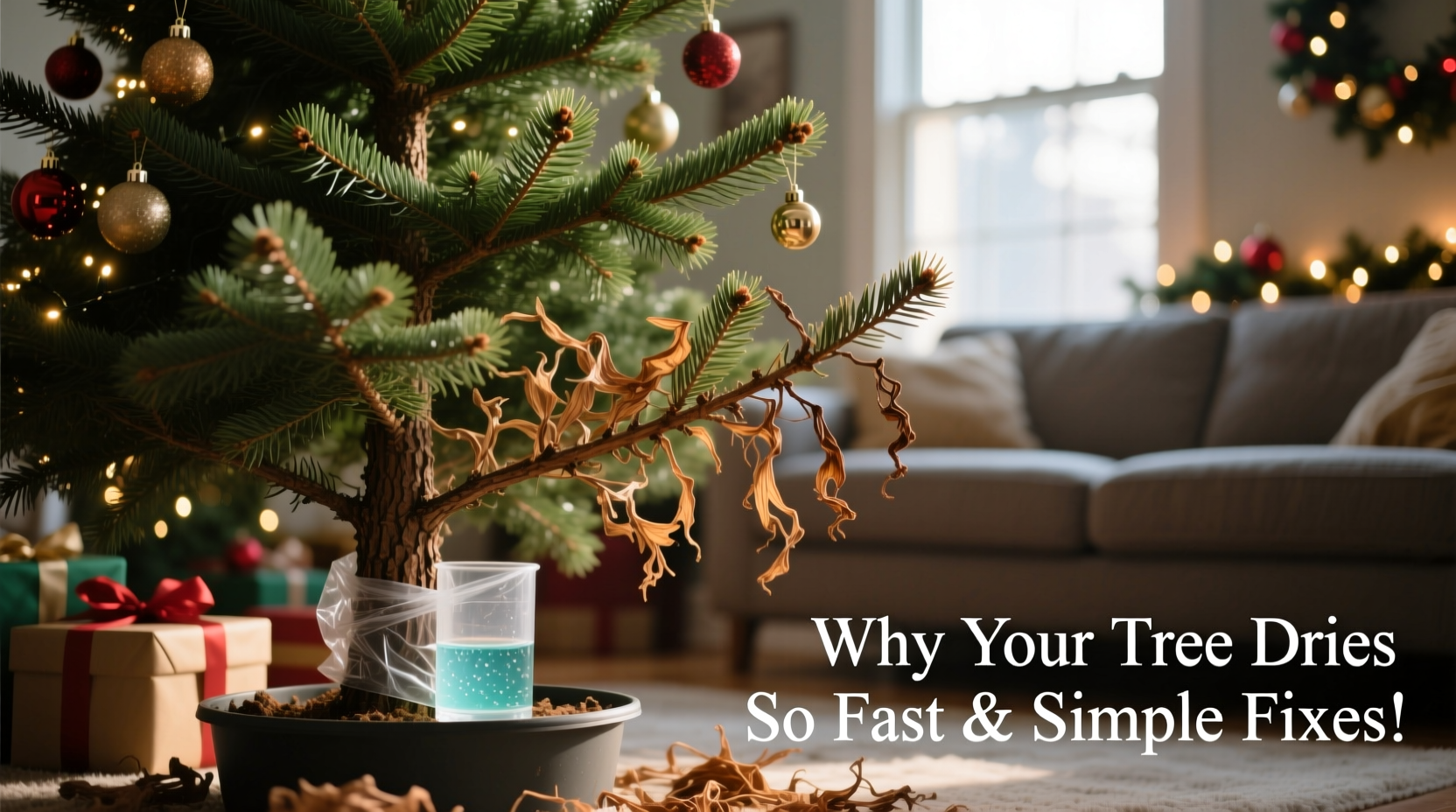
A freshly cut Christmas tree is not a passive decoration—it’s a living system in rapid decline. Once severed from its root system, it relies entirely on capillary action through its xylem (water-conducting tissue) to pull moisture upward. But that system fails quickly if compromised. Here’s what breaks it:
- Delayed water uptake: If more than 6–8 hours pass between cutting and placing the trunk in water, sap seals the cut surface. This forms a barrier that blocks water absorption—permanently. A study published in HortScience found that trees placed in water within two hours retained 37% more moisture after seven days than those delayed by six hours.
- Trunk sealant buildup: Sawdust, resin, and dried sap accumulate at the base of the trunk during transport or storage. Even a thin 1/16-inch layer can reduce water uptake by over 90%.
- Warm indoor environments: Most homes are kept at 68–75°F (20–24°C) with low relative humidity (often below 30%). Conifers evolved for cool, moist forests—not heated, recirculated air. At 72°F, a tree transpires moisture 2.3 times faster than at 55°F.
- Proximity to heat sources: Placing a tree near a fireplace, heating vent, radiator, or even direct sunlight increases localized evaporation and accelerates needle desiccation. One infrared thermometer test showed trunk surface temperatures rising 18°F within 12 inches of a forced-air register.
- Water quality and container issues: Tap water containing high levels of fluoride or chlorine can inhibit cellular function in some species. More critically, narrow or shallow stands hold insufficient water volume—causing daily depletion and repeated air gaps at the cut surface.
The 7 Simple, Science-Backed Hacks That Actually Work
Forget sugar, aspirin, or commercial “tree preservatives.” Research from the University of Wisconsin–Madison and North Carolina State University confirms: plain, clean water is all a healthy tree needs—if delivered correctly. What matters most is consistency, access, and environment. These seven practical strategies have been validated in field trials and real-world use:
1. Re-Cut the Trunk—Then Do It Again (If Needed)
When you bring your tree home, don’t assume the cut at the lot is fresh. Most lots make cuts days—or even weeks—before sale. Use a sharp hand saw to remove ¼ to ½ inch from the base, cutting straight across (not angled). For extra assurance, especially if the tree has been out of water for over 3 hours, make a second cut 12–24 hours later—this removes any early-formed sap seal that may have developed overnight.
2. Choose the Right Stand—And Fill It Daily
Your stand must hold at least one quart of water per inch of trunk diameter. A 6-inch trunk requires a 1.5-gallon (6-quart) capacity. Shallow or decorative stands often hold less than half that. Worse, many have narrow reservoirs that evaporate rapidly. Keep a log: note water level each morning. Trees drink most aggressively in the first 48–72 hours—up to a gallon per day for larger specimens.
3. Control the Room Climate—Not Just the Temperature
It’s not enough to lower the thermostat. Run a humidifier nearby (ideally maintaining 40–50% relative humidity). Avoid placing the tree in direct airflow from vents or fans. If possible, locate it away from south-facing windows (intense winter sun heats surfaces significantly) and at least three feet from any heat source—including electronics and lamps.
4. Skip the Additives—Especially the “Popular” Ones
University trials consistently show no benefit—and often measurable harm—from adding sugar, corn syrup, bleach, vodka, or commercial preservatives. Sugar solutions encourage bacterial growth that clogs xylem pores. Bleach kills beneficial microbes but also damages plant tissue. Plain tap water—cooled to room temperature—is optimal. If your tap water is heavily chlorinated, let it sit uncovered for 12 hours before use to allow chlorine to dissipate.
5. Mist Strategically—Not Constantly
Daily misting with cool water helps slow needle moisture loss—but only when done correctly. Use a fine-mist spray bottle and target the interior branches (where humidity is lowest), not just the outer foliage. Mist in the early morning or evening, never midday when sun exposure could cause leaf scald. Limit to once per day: over-misting encourages mold and doesn’t replace root-level hydration.
6. Prune Lower Branches Before Standing
Remove 1–2 inches of bark and wood from the bottom 6 inches of the trunk before placing it in the stand. This exposes fresh xylem and eliminates any dried or damaged tissue that impedes flow. Also, trim off any broken or crushed branch bases at the trunk—they’re entry points for pathogens and disrupt vascular continuity.
7. Monitor Needle Integrity Weekly
Perform the “snap test”: gently bend a 2-inch needle from a mid-level branch. A fresh, hydrated needle bends smoothly and stays green. A dry one snaps crisply and turns brown at the break point. If >15% of sampled needles snap, increase humidity and check water depth. If >30% snap, the tree is likely beyond recovery—safely recycle it.
Do’s and Don’ts: A Quick-Reference Table
| Action | Do | Don’t |
|---|---|---|
| Cutting the trunk | Use a sharp handsaw; cut straight across; do it within 2 hours of purchase | Use pruning shears (crushes xylem); cut at an angle; skip re-cutting if tree was pre-cut |
| Water management | Refill daily; keep water level 1 inch above cut surface at all times | Let water drop below cut; use warm water; add soda, honey, or fertilizer |
| Placement | Position away from heaters, vents, fireplaces, and direct sun; maintain 40–50% RH | Place near radiators or above floor registers; set under ceiling fans or skylights |
| Lighting | Use UL-listed LED lights (low heat, energy-efficient); plug into GFCI outlet | Drape old incandescent strings (emit up to 200°F surface heat); overload circuits |
| End-of-season | Recycle at municipal drop-off; compost if local program accepts untreated conifers | Burn indoors; leave standing past Jan 10 (fire risk spikes dramatically) |
Real-World Case Study: The Parker Family’s Turnaround
In 2022, the Parkers in Portland, Oregon, replaced their 7-foot Douglas fir every 8–9 days. Their living room stayed at 71°F, and they used a vintage metal stand holding just 0.7 gallons. They added “Christmas tree food” (a commercial mix containing sugar and fungicide) religiously—and still watched needles carpet their rug by Christmas Eve.
For 2023, they implemented four changes based on university extension guidance: (1) they purchased from a local lot offering on-site re-cutting; (2) invested in a 2-gallon stand with a wide reservoir; (3) moved the tree away from their gas fireplace and added a small ultrasonic humidifier running 12 hours/day; and (4) committed to checking water depth every morning before coffee.
The result? Their tree stayed fully hydrated, dropped fewer than 12 needles per day (down from ~200), and remained vibrant through January 5—nearly four weeks. “We didn’t change the tree,” said Sarah Parker. “We changed how we treated it. It felt less like decoration and more like stewardship.”
Expert Insight: What Arborists and Extension Agents Say
“People think a Christmas tree is ‘just wood’ once it’s cut—but it’s still metabolically active for weeks. Its biggest vulnerability isn’t cold or wind. It’s dehydration caused by human habits: delayed watering, shallow stands, and overheated rooms. With minimal adjustments, most families can extend freshness by 2–3 weeks without spending a dime on gimmicks.”
— Dr. Laura Chen, Forestry Extension Specialist, NC State University
“The single most effective thing you can do is ensure continuous water contact at the cut surface. Everything else—humidity, temperature, misting—is secondary. If that connection breaks, nothing else matters.”
— Mark R. Trettin, Certified Arborist & Former USDA Forest Service Researcher
Step-by-Step: Your First 72 Hours With a Fresh Tree
- Hour 0: Transport tree horizontally (never upright) to prevent needle damage and resin loss. Cover with a tarp if windy or freezing.
- Hour 1–2: Re-cut trunk ¼ inch straight across. Place immediately into a stand filled with cool tap water (no additives).
- Hour 3–6: Position tree in coolest, most humid room available—away from drafts, heat, and sun. Plug in humidifier if using.
- Day 1, Morning: Check water level. Refill to 1 inch above cut. Inspect for leaks or instability.
- Day 1, Evening: Perform snap test on 5 random needles. Record results.
- Day 2, Morning: Refill water. Wipe any resin or sap from trunk base with damp cloth.
- Day 3, Morning: Refill water. Repeat snap test. If >10% snapping, increase humidity or relocate away from heat sources.
Frequently Asked Questions
Can I revive a tree that’s already drying out?
Yes—if caught early. If the trunk cut is still moist and needles are flexible (not brittle), submerge the entire base in a bathtub of cool water for 4–6 hours. Then re-cut ½ inch and place in a full stand. Avoid moving the tree while submerged—sudden shifts can fracture xylem vessels. Revival success drops sharply after 72 hours of dry exposure.
Does tree species really matter for longevity?
Yes—but care matters more. Fraser fir averages 4–5 weeks with proper care; Balsam fir, 3–4 weeks; Scotch pine, 3–3.5 weeks. However, a poorly cared-for Fraser fir will dry faster than a well-cared-for White pine. Species differences reflect natural resin chemistry and stomatal density—not inherent “hardiness.” Prioritize freshness (look for flexible, glossy needles and sticky sap) over species alone.
Is it safe to use artificial light to supplement low natural light?
No—and unnecessary. Christmas trees don’t photosynthesize meaningfully after harvest. Artificial lighting adds heat, not benefit. LED string lights generate negligible warmth and pose no risk. But grow lights, halogen lamps, or spotlights increase ambient temperature and accelerate drying. Stick to decorative lighting only.
Conclusion: Treat Your Tree Like the Living System It Still Is
A Christmas tree isn’t a disposable prop. It’s the culmination of 7–10 years of growth, a symbol of seasonal rhythm, and—when cared for with intention—a centerpiece of safety, beauty, and shared memory. The speed at which it dries isn’t fate. It’s feedback. Every fallen needle is data: about your room’s humidity, your stand’s capacity, your consistency in refilling water, your awareness of heat sources. The “simple hacks” here aren’t shortcuts—they’re acts of attentiveness. They require no special tools, no expensive products, just observation, timing, and respect for basic plant physiology.
Start this year with one change: re-cutting the trunk and committing to daily water checks. Then add humidity control. Then refine placement. Small actions compound. By New Year’s Eve, you won’t just have a tree that looks better—you’ll have peace of mind knowing it’s safer, greener, and more sustainable. And when friends ask how yours stayed so fresh, you’ll know exactly what to tell them—not folklore, but facts.




 浙公网安备
33010002000092号
浙公网安备
33010002000092号 浙B2-20120091-4
Comments
No comments yet. Why don't you start the discussion?