
Nothing signals the holidays like the rich, resinous scent of a fresh-cut Christmas tree—and nothing dampens the season’s magic faster than waking up on December 12th to brittle needles littering the floor and a trunk that hasn’t absorbed water in days. It’s not just disappointing—it’s expensive. The average household spends $85–$120 on a premium Fraser fir or Balsam fir, yet many trees lose viability within 7–10 days of arrival. That’s not normal. Healthy, well-cared-for trees routinely last 4–5 weeks indoors. The rapid drying isn’t inevitable; it’s usually preventable. This article cuts through myth and marketing to explain exactly what causes accelerated dehydration—from harvest timing and transport conditions to your stand, placement, and daily habits—and gives you actionable, field-tested solutions backed by arborists, extension services, and decades of nursery data.
How Christmas Trees Lose Moisture: The Science Behind the Shed
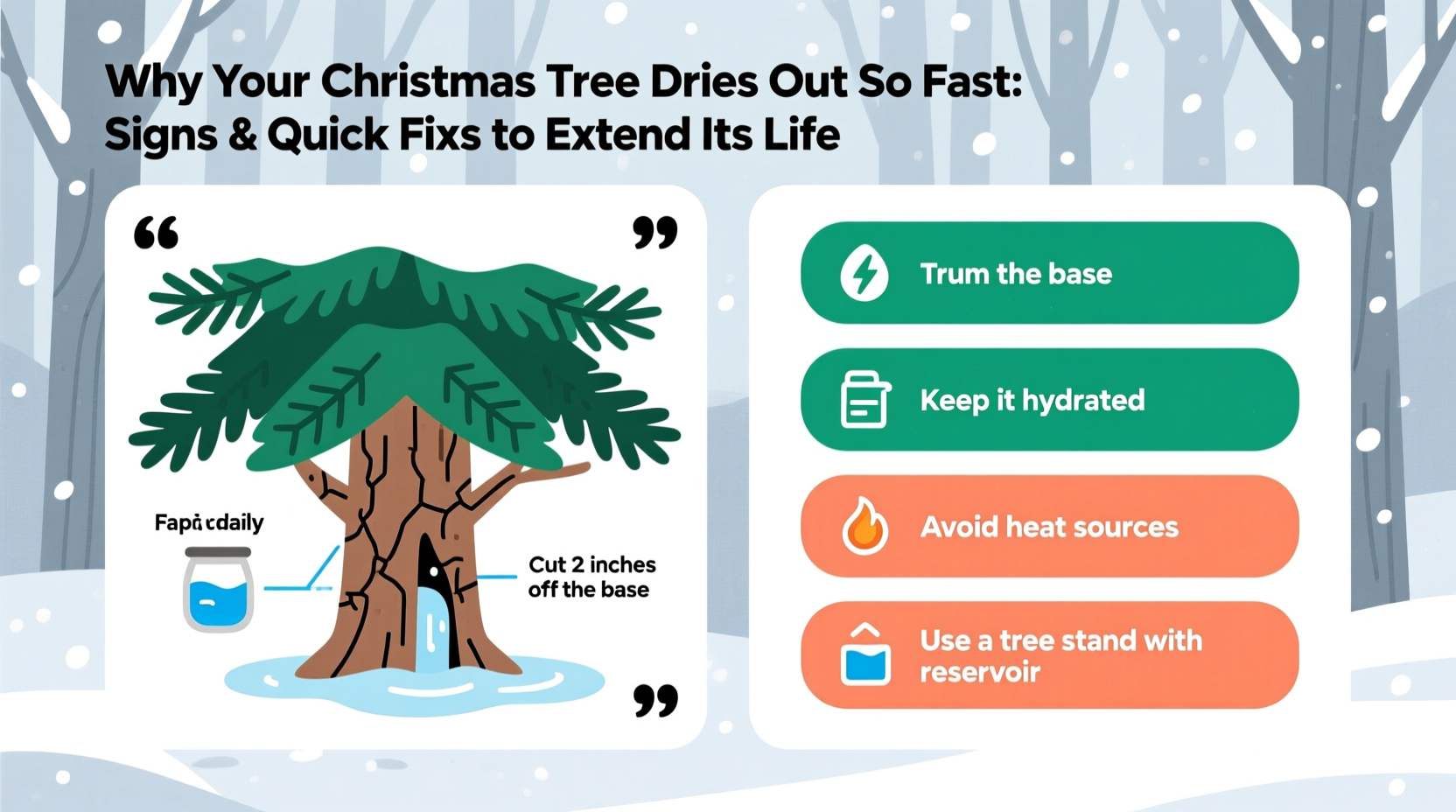
A cut Christmas tree is still biologically active—not dead, but disconnected from its root system. Its vascular tissue (xylem) continues pulling water upward via capillary action and transpiration—the same process that moves water through living trees outdoors. But unlike in nature, indoor conditions create a perfect storm for moisture loss: warm air (often 68–75°F), low humidity (frequently 15–25% in heated homes), and direct heat sources accelerate evaporation from needles while impeding water uptake at the base. When the cut surface seals with sap, resin, or debris—or when water levels drop below the cut—the xylem collapses, forming an air embolism that permanently blocks hydration. Once that seal forms, no amount of misting or aspirin will reopen the pathways. That’s why the first 24 hours after cutting are critical—and why “just adding water” rarely solves the problem if the fundamentals aren’t right.
5 Early Warning Signs Your Tree Is Drying Out Faster Than It Should
Catching dehydration early lets you intervene before irreversible damage occurs. These signs appear in sequence—not all at once—and often escalate rapidly after Day 3:
- Needle flexibility test fails: Gently run a branch between your thumb and forefinger. Healthy needles bend without snapping. If they shatter or detach easily—even with light pressure—it’s a sign of cellular dehydration.
- Trunk base feels dry or powdery: Touch the cut end. It should feel cool, slightly tacky, and damp. A chalky, dusty, or cracked surface indicates prolonged air exposure and compromised water absorption.
- Water level drops less than 1 inch per day: A healthy 6–7 foot tree drinks 1–1.5 quarts of water daily. If your stand loses under half that, uptake has slowed significantly—often due to a sealed cut or clogged stand.
- Pine scent fades noticeably within 48 hours: Volatile terpenes (the compounds responsible for that classic aroma) evaporate fastest when needle cells dehydrate. A weak or absent scent by Day 2 is a red flag—not nostalgia, but physiology.
- Lower branches droop or curl inward: Unlike natural tapering, this is turgor loss—the collapse of water pressure inside stem cells. It begins at the base and moves upward, often preceding visible needle drop.
Do’s and Don’ts: What Actually Works (and What Wastes Time)
Myths about tree care persist because they sound plausible—but most lack empirical support. The National Christmas Tree Association (NCTA) and university extension programs have tested dozens of popular remedies. Here’s what holds up—and what doesn’t:
| Action | Does It Work? | Why / Why Not |
|---|---|---|
| Add sugar, aspirin, bleach, or soda to water | No | Controlled trials show zero improvement in needle retention or water uptake. Sugars encourage bacterial growth in stands; bleach can corrode metal parts and harm plant tissue; aspirin offers no physiological benefit to conifers. |
| Re-cutting the trunk at home (at least ¼ inch) | Yes — essential | Removes dried sap and exposes fresh xylem. Must be done within 3–4 hours of purchase—and before placing in water. A dull saw blade creates crushing damage that impedes flow more than a clean cut. |
| Misting needles 2–3x daily | Minimal benefit | Increases surface humidity briefly but does nothing for internal hydration. Can promote mold in poorly ventilated rooms. Far less effective than proper stand maintenance. |
| Using a wide-based stand with ≥1 gallon capacity | Yes — critical | Trees consume water fastest in the first week. Small stands (<0.5 gal) require refilling multiple times daily, increasing risk of air gaps at the cut. NCTA recommends 1 quart of water per inch of trunk diameter. |
| Keeping tree away from heat sources (vents, fireplaces, radiators) | Yes — non-negotiable | Every 5°F above 68°F doubles transpiration rate. A tree 3 feet from a forced-air vent dehydrates 3× faster than one in a cooler corner. |
A Real-World Example: How One Family Doubled Their Tree’s Lifespan
In December 2022, the Chen family in Portland, Oregon, purchased a 7-foot Noble fir from a local lot. By Day 4, needles were shedding heavily, and the water level hadn’t dropped in 36 hours. They called their county extension office, which sent an arborist for a free home consultation. She observed three critical issues: the trunk had been recut with a kitchen knife (creating jagged, crushed fibers); the stand held only 0.75 gallons and was placed directly atop a radiant-heated floor; and the tree had sat unwatered in their garage for 18 hours after purchase. The arborist guided them through a rescue protocol: a clean ½-inch recut using a handsaw, transfer to a 1.5-gallon stand filled with room-temperature water, relocation 8 feet from the heat source, and strict daily monitoring. Within 24 hours, water uptake resumed. The tree remained full and fragrant through January 5—42 days total. Their key insight? “We thought ‘fresh cut’ meant ‘cut recently.’ We didn’t know it meant ‘cut cleanly, immediately before water immersion.’”
The 7-Day Hydration Timeline: What to Do When, and Why
Tree longevity hinges on precise timing—not just what you do, but when. Follow this evidence-based sequence:
- Day 0 (Purchase Day): Choose a tree with flexible needles, strong fragrance, and green bark. Ask when it was cut—ideally within 24–48 hours. Transport it home upright, covered, and out of wind/sun.
- Day 0 (Within 3 hours of purchase): Make a fresh, straight, ¼–½ inch cut with a sharp hand saw. Place immediately into water—no air exposure. Fill stand to capacity with plain, cool tap water.
- Day 1: Check water level twice. If empty, refill and recheck in 2 hours. Do not let the cut leave water for >30 minutes. Wipe sap from the stand rim to prevent clogging.
- Day 2–3: Water uptake peaks. Expect 1–1.5 inches of drop daily. Wipe any sap buildup around the cut surface with a damp cloth to maintain contact.
- Day 4–5: If uptake slows, gently lift the tree and inspect the cut. If discolored or sealed, remove the tree, make another ¼-inch cut, and return to fresh water immediately.
- Day 6–7: Switch to filtered or distilled water if tap water is very hard (high mineral content). Minerals can form deposits that block xylem pores over time.
- Ongoing: Maintain water level above the cut at all times—even overnight. Use a stand with a built-in water level indicator or mark minimum fill line with tape.
“The single biggest predictor of tree longevity isn’t species or fertilizer—it’s whether the cut surface stayed submerged continuously from the moment it left the stump. Everything else is secondary.” — Dr. Sarah Lin, Forestry Extension Specialist, Oregon State University
FAQ: Answering Your Most Pressing Questions
Can I revive a tree that’s already stopped drinking water?
Yes—if caught early. Remove it from the stand, inspect the cut. If it’s dark, cracked, or gummy, make a fresh ½-inch cut with a sharp saw. Immediately place it in a bucket of warm (not hot) water—about 100°F—for 2–4 hours. Then transfer to its stand with fresh cool water. Success depends on how long it’s been dry: revival is likely within 48 hours of uptake stopping, unlikely after 72+ hours.
Does spraying the tree with glycerin or commercial preservatives help?
No peer-reviewed study shows measurable improvement in needle retention or water uptake. Glycerin sprays create a waxy film that may inhibit transpiration but also blocks gas exchange needed for residual metabolic activity. The NCTA states flatly: “No spray or additive has proven more effective than plain water and proper care.”
Is it better to buy a real tree or go artificial for sustainability?
It depends on usage. A high-quality artificial tree must be used for 10+ years to offset its carbon footprint versus annually harvested, locally grown real trees—which are farmed on dedicated acreage, sequester carbon while growing, and are fully recyclable (mulched into soil amendment). For most households using a real tree for 4 weeks, then recycling it, the environmental impact is lower than a 5-year artificial tree discarded prematurely.
Conclusion: Your Tree Deserves Better Than Guesswork
Your Christmas tree isn’t failing you—it’s signaling unmet needs. That brittle branch, that faint scent, that stagnant water level—they’re not quirks of fate. They’re data points pointing to specific, correctable conditions. You don’t need special products, secret formulas, or inherited wisdom. You need precision: a sharp cut, uninterrupted hydration, intelligent placement, and daily attention during the critical first week. These aren’t holiday chores; they’re small acts of stewardship that honor the tree’s life cycle and protect your investment. Start tonight. Check your stand’s water level. Feel your trunk’s cut. Move it away from that drafty window or roaring heater. Those few minutes could add two full weeks of vibrant greenery—and with it, more shared laughter, more quiet mornings with coffee and carols, more moments that truly feel like home. The season is short enough. Don’t let your tree’s story end too soon.




 浙公网安备
33010002000092号
浙公网安备
33010002000092号 浙B2-20120091-4
Comments
No comments yet. Why don't you start the discussion?