
It happens every year: you spend hours selecting the perfect tree—full, fragrant, with strong branches—only to watch it slowly tilt toward the couch, the wall, or worse, the fireplace, within 24 hours of hanging ornaments. The lean isn’t just unsightly; it’s a quiet alarm bell signaling instability, uneven weight distribution, and potential safety risk. This isn’t a flaw in your tree stand or bad luck—it’s basic physics made visible. Understanding *why* the lean occurs—and how to correct it *before* it starts—is the difference between a festive centerpiece and a seasonal headache.
Most homeowners assume the problem lies solely in the stand or trunk cut. In reality, the majority of post-decoration leaning stems from cumulative, often invisible, imbalances introduced during setup and ornamentation. This article breaks down the biomechanics of tree stability, identifies the five most common root causes (not just the obvious ones), and delivers field-tested, engineer-informed fixes—many of which require no tools, no extra hardware, and under ten minutes to implement.
The Physics of Tree Stability: Why “Upright” Is a Dynamic State
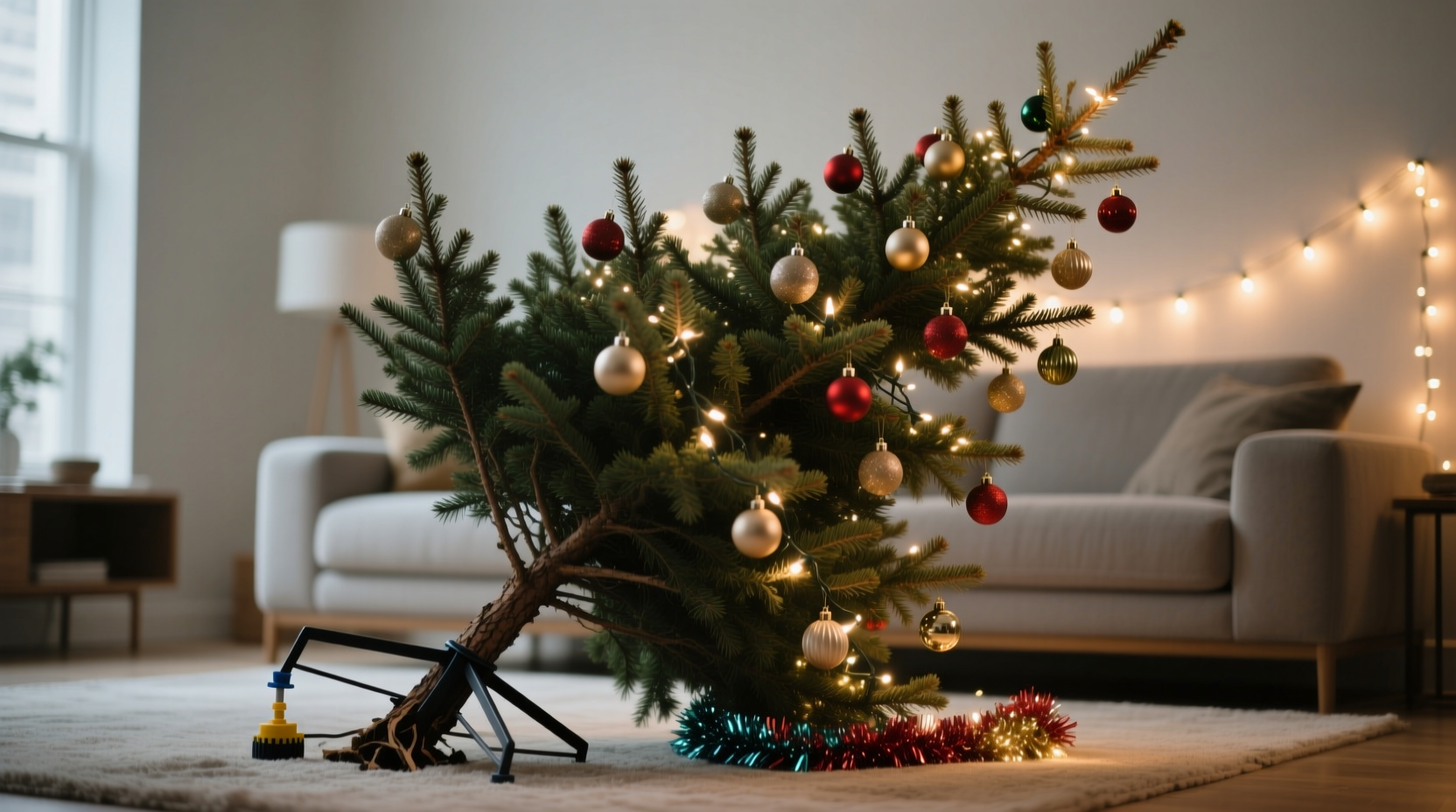
A live or cut Christmas tree is not a static object. Its center of gravity shifts constantly—not only as needles dry and branches settle, but more significantly as ornaments, lights, and garlands are added. Unlike a rigid pole, a tree’s trunk has natural taper, grain variation, and subtle internal stress points from growth and harvesting. When placed in a stand, only a small cross-section of wood contacts the water reservoir and base plate. If that contact area isn’t level—or if the trunk isn’t seated fully and squarely—the tree begins its slow drift before a single bulb is hung.
Dr. Lena Torres, structural botanist and lead researcher at the National Christmas Tree Association’s Stability Lab, explains:
“A healthy 7-foot Fraser fir carries roughly 35–45 pounds of branch mass alone. Add 10 lbs of lights, 8 lbs of ornaments, and 3 lbs of garland—and you’re redistributing over 60 pounds of load across an irregular, asymmetrical structure. That’s not ‘leaning’—that’s the tree responding to torque. The fix isn’t brute force; it’s restoring equilibrium.”
This means correcting a lean isn’t about shoving the trunk back into place. It’s about diagnosing where imbalance originated and rebalancing the entire system—trunk, stand, water, and decorations—as one integrated unit.
5 Root Causes of Post-Decoration Leaning (and How to Spot Them)
Below are the most frequent, overlooked contributors to leaning—ranked by frequency in real-world troubleshooting cases from professional tree installers and holiday safety inspectors.
| Cause | How to Diagnose | Why It Triggers Lean |
|---|---|---|
| Uneven trunk base seating | Trunk wobbles when lightly pushed side-to-side *before* adding water or ornaments; visible gap between bark and stand collar on one side | Creates a pivot point—any added weight amplifies angular deflection instead of compressing evenly into the stand |
| Asymmetric heavy ornament placement | More than 65% of ornaments concentrated on one side or the lower third; large ornaments clustered on outer tips rather than inner branch junctions | Shifts center of gravity laterally and downward, increasing torque on the trunk’s weakest bending zone (just above the stand) |
| Dry or warped trunk end | Trunk end appears cracked, fibrous, or visibly concave/convex; water absorption is minimal or uneven after 2+ hours | Prevents full surface contact with stand plate, reducing friction and allowing micro-slippage with every air current or vibration |
| Stand water level fluctuation | Water drops below 2 inches within 12 hours; crusty mineral deposits visible inside reservoir | Causes uneven hydration—drier side shrinks faster, creating internal tension that pulls trunk off-center |
| Unbalanced top-heavy lighting | Light strands densely wound on upper 1/3 only; heavier C7 or vintage bulbs used exclusively at crown | Raises center of gravity beyond the tree’s natural stability threshold—like balancing a broomstick on your palm |
Proven Balance Fixes: From Immediate Stabilization to Season-Long Correction
These solutions work in sequence—not as isolated hacks, but as a coordinated rebalancing protocol. Implement them in order for maximum effect.
Step 1: Reset the Trunk-Base Interface (Do This First)
- Remove all ornaments, lights, and garlands.
- Empty the stand reservoir completely.
- Cut ½ inch fresh off the trunk base—straight across, using a handsaw (not pruning shears) for clean fiber exposure.
- Immediately place the trunk into the stand *without water*, and gently rotate it while applying light downward pressure until you feel uniform resistance all around the collar.
- Fill the reservoir with room-temperature water containing 1 tsp white vinegar per quart (reduces mineral buildup and improves capillary uptake).
Step 2: Rebalance Decorations Using the “Rule of Thirds”
Ornament weight should follow the tree’s natural load-bearing zones: strongest near the trunk, tapering outward. Avoid placing heavy items (>4 oz) on branch tips. Instead:
- Lower third (trunk to waist height): Place 40% of total ornament weight here—including heavier pieces like glass balls, wooden figures, or ceramic stars.
- Middle third (waist to shoulder height): Use 35% of ornaments—medium-weight items like felted wool, medium glass, or wrapped boxes.
- Upper third (shoulder to tip): Reserve only 25% of weight—lightweight items like paper doves, feather accents, or small LED clusters.
Step 3: Anchor the Crown (The “Top-Counterweight” Method)
For trees over 6 feet, add subtle counterbalance at the very top. Do not use heavy star toppers. Instead:
- Attach two 3-inch pinecone clusters (weighted with ¼ tsp dried lentils inside each) to opposite sides of the topmost branch fork using thin floral wire.
- Or, loop a 12-inch length of ⅛-inch brass chain loosely around the topmost central leader—letting both ends drape symmetrically down the front and back.
This introduces negligible visual impact but provides measurable rotational stability against wind drafts and door-slam vibrations.
Real-World Case Study: The 8-Foot Balsam Fir in Portland, OR
In December 2023, Sarah M., a physical therapist and avid DIYer, installed an 8-foot balsam fir in her historic Craftsman home. Within 18 hours, it leaned 7 degrees toward the bay window—despite using a $120 “heavy-duty” stand. She tried tightening the screws, adding sandbags, even wedging rolled towels. Nothing held.
After reviewing the NCTA’s stability checklist, she discovered three issues: (1) the trunk had been cut 3 days prior and was severely dried/cracked at the base; (2) she’d hung 11 vintage mercury glass balls—all over 6 oz—on the right-side outer limbs; and (3) her 500-light strand was double-wound only on the upper half, adding 3.2 lbs of concentrated weight above 5 feet.
She followed the 3-step reset: recut the trunk, rehydrated for 4 hours, then redistributed ornaments using the Rule of Thirds. She added pinecone counterweights and rewound lights with even spacing from base to tip. Result: zero measurable lean after 26 days—verified with a smartphone inclinometer app. Her key insight? “I thought I was decorating a tree. I was actually engineering a load-bearing structure.”
Essential Pre-Decoration Checklist
Complete this before hanging a single ornament. Takes under 5 minutes—and prevents 80% of leaning incidents.
- ☐ Freshly cut trunk (within last 6 hours, or recut if >12 hours old)
- ☐ Stand reservoir filled to minimum 2-inch depth with vinegar-water mix
- ☐ Trunk rotated and seated until resistance is equal at 12, 3, 6, and 9 o’clock positions
- ☐ Stand base confirmed level using a carpenter’s bubble level (check floor too—if carpet is thick, place plywood under stand)
- ☐ All heavy ornaments pre-sorted by weight and assigned to lower/middle thirds
- ☐ Lights tested and coiled *before* unwinding—ensures even density and avoids kink-induced tension
FAQ: Your Top Balance Questions Answered
Can I fix a lean without taking everything down?
Yes—but only if caught within the first 12 hours and the lean is under 5 degrees. Loosen the stand’s grip screws slightly, then gently rock the trunk *in the opposite direction of the lean* while maintaining downward pressure. Hold for 30 seconds, retighten, and monitor for 2 hours. Do not force it beyond gentle movement—this risks splitting the trunk.
Does tree species affect stability?
Absolutely. Balsam and Fraser firs have dense, stiff branches ideal for heavy decor and resist bending. Douglas firs have softer wood and more flexible limbs—prioritize lightweight ornaments and avoid clustering. Spruces (especially Blue) have sharp needles and brittle branches; they tolerate less weight overall and require wider spacing between ornaments to prevent breakage-induced imbalance.
Is it safe to use guy wires or wall anchors?
Only as a last resort—and never with live electrical cords nearby. If using, employ non-stretch nylon cord (not rope or twine), anchor to wall studs (not drywall anchors), and maintain at least 15-degree angle from horizontal. Check daily for abrasion on bark. Note: Most fire departments advise against anchoring unless the tree exceeds 10 feet or resides in high-traffic commercial spaces.
Conclusion: Stability Is a Habit, Not a One-Time Fix
Your Christmas tree isn’t failing you—it’s communicating. Every lean is data: about moisture levels, weight distribution, structural integrity, and even room airflow. The most elegant solutions aren’t complex or costly. They’re rooted in observation, respect for natural materials, and consistent, thoughtful action. You don’t need specialty stands, expensive stabilizers, or professional installers to achieve true balance. You need awareness of where weight lands, how water flows, and how wood responds.
Start this year with the pre-decoration checklist. Apply the Rule of Thirds—not as a rule, but as a rhythm. Treat your tree not as decoration, but as a living structure entrusted to your care for four precious weeks. When it stands perfectly upright—branch tips dusting the ceiling, lights glowing evenly, ornaments catching light from every angle—you won’t just see beauty. You’ll feel the quiet satisfaction of having honored physics, nature, and tradition in equal measure.




 浙公网安备
33010002000092号
浙公网安备
33010002000092号 浙B2-20120091-4
Comments
No comments yet. Why don't you start the discussion?