
A sharp blue flash, a loud *pop*, the acrid scent of ozone—and your hand jerking back from the outlet. That moment isn’t just startling—it’s a red flag waving urgently. Sparking at the point where your Christmas tree lights connect isn’t normal holiday ambiance; it’s evidence of an unsafe electrical condition that can escalate rapidly. Unlike flickering bulbs or dim strands, sparking indicates current arcing—electricity jumping across unintended gaps, generating intense localized heat. This phenomenon poses real risks: melted wire insulation, scorch marks on sockets, tripped breakers, and, in worst cases, ignition of dry pine needles or nearby combustibles. Understanding *why* this happens isn’t about diagnosing like an electrician—it’s about recognizing danger signs early, taking immediate action, and making informed decisions before the first light goes on.
Why Sparking Happens: The Physics Behind the Pop
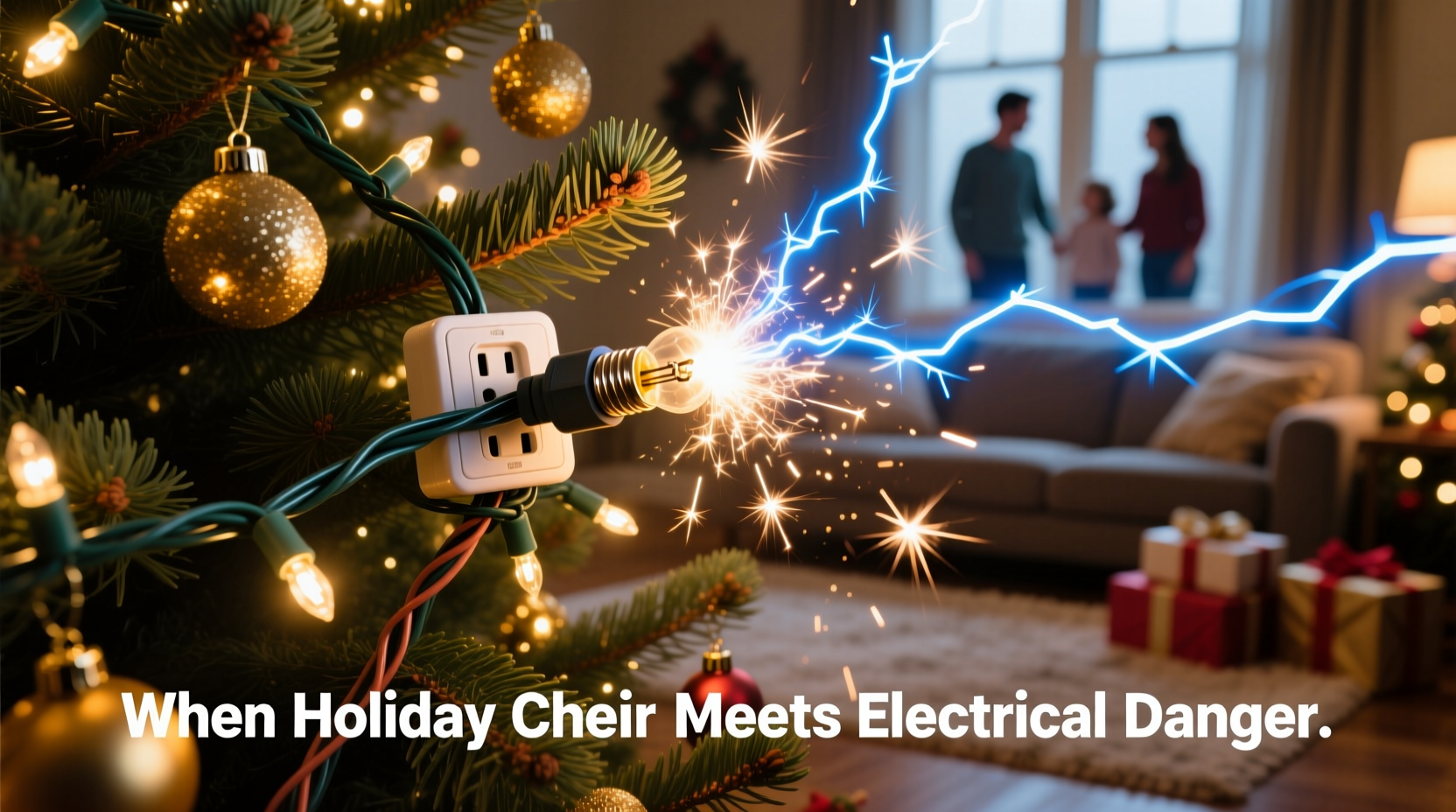
Sparking occurs when electricity arcs—jumping across a gap between conductors instead of flowing smoothly through intact wiring. On a Christmas tree, this almost always originates at one of three points: the plug connection, the first socket in the strand, or a damaged section of wire near the base. Arcing requires two conditions: sufficient voltage (standard 120V household current is more than enough) and a path of reduced resistance—often created by compromised insulation, corrosion, moisture, or physical damage.
Modern incandescent and LED light sets operate on low-voltage principles *within* the strand, but they’re still connected directly to line voltage at the plug. When a plug is partially inserted, bent, or worn, contact between the prongs and outlet terminals becomes intermittent. As the plug wiggles or heats up, microscopic gaps open and close—causing repeated micro-arcs. Each arc reaches temperatures over 3,000°F, instantly vaporizing tiny bits of metal and carbonizing surrounding plastic. Over time, this degrades both the plug and the outlet, increasing resistance and creating a vicious cycle.
Moisture plays a critical role—even ambient humidity in a heated living room can condense on cold wires brought in from a garage or basement. Combine that with dust accumulation inside sockets or corrosion on brass contacts (especially in older light sets), and you create ideal conditions for tracking: electricity creeping along contaminated surfaces rather than staying confined within insulated conductors.
Immediate Safety Protocol: What to Do *Right Now*
If you’ve witnessed sparking, stop using the lights *immediately*. Do not attempt to “test it one more time” or plug it into another outlet. Unplug the strand at the wall—not just at the tree—and physically separate it from the tree. Keep pets and children away from the cord and plug. Then follow this sequence:
- Inspect visually: Examine the plug for scorch marks, melted plastic, or bent prongs. Check the first 12 inches of cord for kinks, cuts, or exposed copper.
- Smell carefully: A burnt odor—even faint—means insulation has degraded. Discard the strand.
- Test the outlet: Plug in a known-working device (e.g., lamp). If it sparks or trips the breaker, the outlet itself is faulty and requires an electrician.
- Assess the tree: Dry trees (especially those over 4 weeks old or kept in warm rooms) become highly flammable. If the spark occurred near branches, inspect for charring or singed needles.
- Document: Take photos of the plug, cord, and outlet before discarding anything. This helps if insurance or warranty claims arise.
Root Causes & How to Identify Them
Not all sparking stems from the same issue. Pinpointing the cause determines whether replacement is necessary—or if a simple fix suffices. Below is a diagnostic table summarizing common origins, telltale signs, and likelihood of repair:
| Cause | Key Indicators | Repairable? | Risk Level |
|---|---|---|---|
| Worn or Damaged Plug | Melted plastic housing, discolored prongs, loose fit in outlet, visible copper at base of prong | No—replace entire strand | High: Increases arcing with each use |
| Corroded Socket Contacts | Greenish-white residue inside first bulb socket, difficulty inserting bulb, intermittent lighting | Yes—if only first socket affected; clean with contact cleaner and fine emery cloth | Moderate: Can lead to overheating if ignored |
| Pinched or Crushed Cord | Flattened section near base, audible “crackle” when bending, localized warmth during operation | No—cord integrity is compromised | High: Risk of short circuit or shock |
| Moisture or Salt Residue | White crystalline deposits on plugs/sockets, frequent tripping in humid rooms, history of outdoor use | Yes—if thoroughly dried and cleaned; otherwise discard | Moderate-High: Accelerates corrosion and tracking |
| Overloaded Circuit | Sparking only when multiple strands are daisy-chained, breaker trips after 5–10 minutes, warm outlet faceplate | Yes—redistribute load or install dedicated outlet | Moderate: Fire risk increases with sustained overload |
One often-overlooked factor is daisy-chaining. Many consumers connect 5–7 strands end-to-end, assuming “if it fits, it’s fine.” But most manufacturers specify a maximum of three standard incandescent strands or five LED strands per circuit. Exceeding this overloads the first strand’s internal wiring—its fuse may not blow fast enough to prevent arcing at weak points.
Real-World Case Study: The Three-Year Old Strand That Almost Ignited a Living Room
In December 2022, Sarah K., a schoolteacher in Portland, OR, noticed a faint “buzzing” sound from her pre-lit artificial tree. She’d used the same set for three seasons—storing it loosely coiled in a cardboard box in her attic. On Christmas Eve, as she plugged in the final extension cord, a bright blue arc erupted from the plug, followed by smoke curling from the outlet. She unplugged immediately and called an electrician.
The inspection revealed three converging failures: First, the plug’s molded plastic had cracked microscopically from thermal cycling, exposing the brass terminals to attic dust and humidity. Second, the outlet—installed in 1978—had worn internal contacts that couldn’t maintain firm grip. Third, the strand’s internal fuse was rated for 5A, but the cumulative load of six daisy-chained strands drew 6.8A continuously. The electrician replaced the outlet and advised discarding all lights over two years old unless rigorously tested. Sarah replaced every strand—and now tests outlets annually with a $12 receptacle tester. Her takeaway: “I thought ‘working last year’ meant ‘safe this year.’ It doesn’t. Wires fatigue. Plugs degrade. Outlets wear out. Assuming safety is the first step toward danger.”
Prevention Checklist: Before You Hang a Single Bulb
Adopt this checklist every season—not just when problems arise. Prevention takes under 10 minutes but eliminates 90% of spark-related incidents:
- ✅ Inspect every plug and socket with a flashlight: Look for cracks, discoloration, bent prongs, or debris.
- ✅ Test each strand separately on the floor before attaching to the tree—use a GFCI-protected outlet.
- ✅ Check your circuit load: Add up wattage of all devices on the same circuit (lights + TV + stereo + space heater). Stay below 80% of breaker rating (e.g., ≤1,440W on a 15A circuit).
- ✅ Use UL-listed surge-protecting power strips (not basic power strips) for multi-strand setups—never daisy-chain strips.
- ✅ Store lights properly: Wind around a rigid spool or use commercial light reels; never toss loosely into boxes where wires kink and insulation abrades.
- ✅ Replace strands every 3–4 years, even if functional—internal wire brittleness isn’t visible.
“Electrical components on seasonal decorations undergo extreme thermal stress—from storage in unheated garages to operation near heat vents. Their safe lifespan is finite, not indefinite. If a plug feels warm during use, it’s already failing.” — James R. Lin, P.E., Senior Electrical Safety Engineer, Underwriters Laboratories (UL)
FAQ: Critical Questions Answered
Can I fix a sparking plug with electrical tape?
No. Electrical tape provides no mechanical reinforcement or insulation against 120V arcing. It may temporarily conceal damage but creates a false sense of security. A compromised plug must be replaced entirely. Attempting DIY repairs voids UL certification and violates NEC (National Electrical Code) Section 410.134, which prohibits field modification of listed lighting products.
Why do LED lights spark less often—but still can?
LED strands draw significantly less current (typically 2–4W per 100 bulbs vs. 40–60W for incandescent), reducing thermal stress and arcing energy. However, their driver circuits contain sensitive electronics vulnerable to voltage spikes, poor connections, and moisture-induced leakage paths. A failing capacitor or corroded input terminal can still cause sparking—often with a sharper, higher-pitched pop than incandescent arcing.
Is it safe to use an old outlet tester on my Christmas lights?
Outlet testers verify correct wiring (hot/neutral/ground) and GFCI function—but they don’t test for high-resistance faults that cause sparking. For light strands, use a multimeter to check continuity and insulation resistance (set to megaohms) between conductors and ground. Anything below 1MΩ indicates compromised insulation and warrants replacement. Most consumers lack this equipment; when in doubt, replace.
Conclusion: Respect the Spark—It’s Not Festive, It’s Forensic
That spark isn’t a quirk of holiday magic—it’s electricity screaming for attention. It’s the physical manifestation of degradation, overload, or neglect. Modern Christmas lights are engineered for convenience, not eternity. Their components age: plastics embrittle, metals oxidize, solder joints fatigue, and insulation loses dielectric strength. Treating them as disposable isn’t wasteful—it’s responsible. Every strand you replace before it fails protects your home, your family, and your peace of mind.
This season, make safety part of your tradition. Test outlets. Count watts. Store carefully. Replace proactively. And when you see that flash—don’t dismiss it. Investigate it. Act on it. Because the most beautiful tree isn’t the one with the most lights—it’s the one that stays lit, safely, all season long.




 浙公网安备
33010002000092号
浙公网安备
33010002000092号 浙B2-20120091-4
Comments
No comments yet. Why don't you start the discussion?