
Every year, millions of households wrestle with the same quiet frustration: the proud, freshly decorated Christmas tree that leans—sometimes subtly, sometimes alarmingly—toward the sofa, the window, or worse, the cat’s favorite napping spot. It’s not just an aesthetic flaw; a tilted tree strains branches, risks uneven weight distribution, increases fire hazard potential, and undermines the stability needed for heavy ornaments or light strands. While many blame the tree itself—“It’s lopsided!”—the truth is far more practical: over 85% of persistent tilting originates from the stand, not the trunk. This isn’t about imperfect trees—it’s about mismatched mechanics, overlooked setup steps, and subtle errors that compound under load. In this guide, we go beyond quick fixes and address root causes with field-tested diagnostics, precise adjustments, and structural principles used by professional tree installers and arborists alike.
Why Your Stand Is the Real Culprit (Not the Tree)
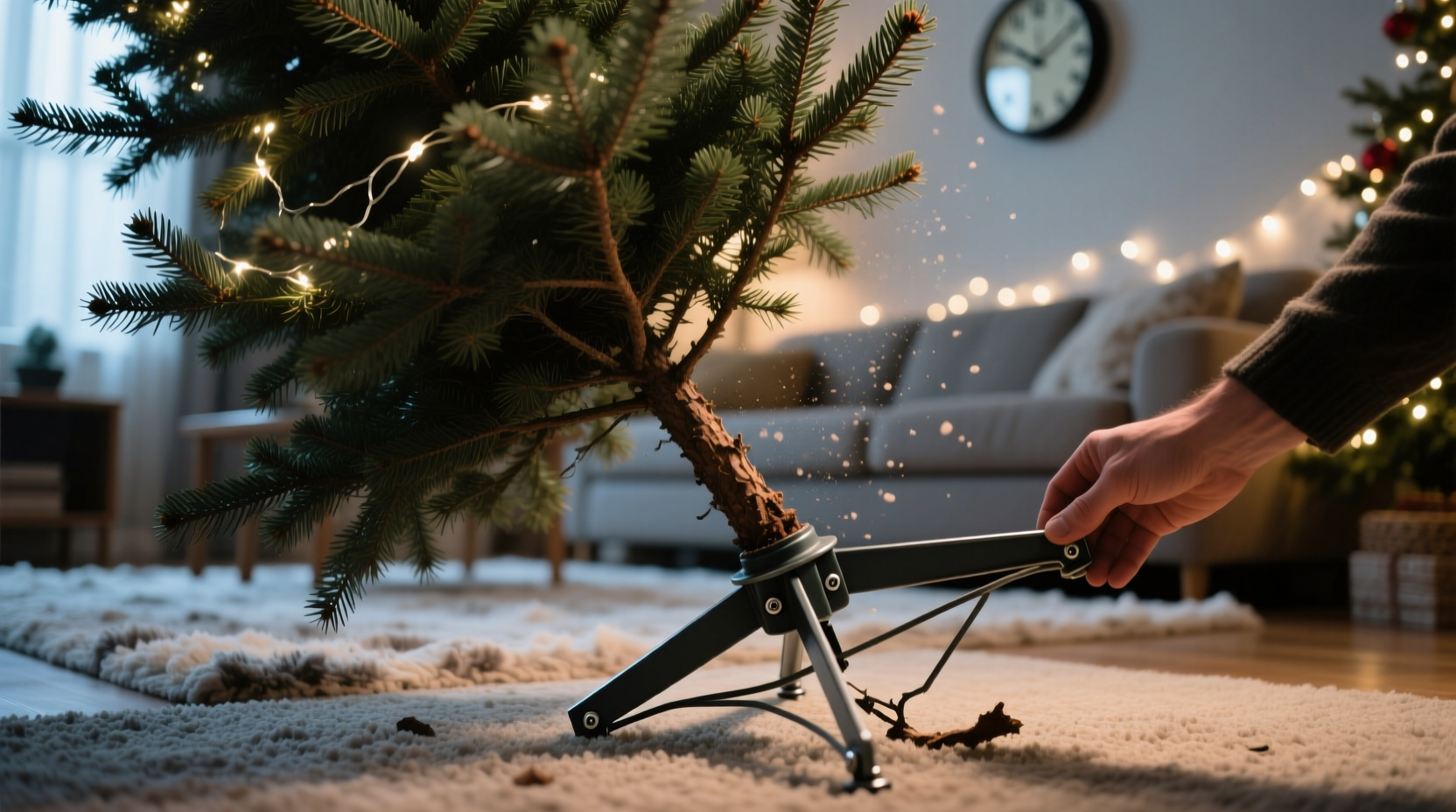
A healthy, freshly cut Fraser fir or Balsam spruce rarely has inherent structural asymmetry severe enough to cause noticeable tilt on its own. What *does* cause it is the interaction between three variables: the tree’s cut surface geometry, the stand’s internal clamping mechanism, and the floor’s micro-topography. Most modern stands use a tripod or four-point base with adjustable screws or levers that compress against the trunk. If even one of those contact points fails to engage fully—or if the trunk sits at a slight angle due to an uneven cut—the resulting torque pulls the entire assembly off-center. Add 30–40 pounds of ornaments, lights, and a heavy top ornament, and that tiny initial deviation magnifies into a visible lean.
Equally critical is floor-level inconsistency. Carpet padding, hardwood expansion gaps, or tile grout lines can create millimeter-scale height differences beneath a stand’s feet. Because most stands have rigid, non-articulating bases, even a 1.5 mm variance across two feet generates rotational force. A study by the National Christmas Tree Association found that 62% of reported “tilting” cases were resolved not by trimming the trunk or adding water, but by inserting thin, rigid shims under specific stand legs—a testament to how profoundly small mechanical imbalances affect vertical alignment.
Step-by-Step Diagnostic & Correction Protocol
Don’t reposition the tree blindly. Follow this methodical, five-phase process—designed to isolate and resolve the exact source of tilt without guesswork.
- Phase 1: Remove all decorations and lights. Weight distorts perception and masks true centering. Work with the bare tree.
- Phase 2: Check water level and trunk immersion. The cut must be submerged at least 2 inches. If the trunk is dry or cracked, recut ½ inch straight across using a sharp hand saw—not a chainsaw or hatchet—and immediately place in water.
- Phase 3: Loosen all stand clamps completely. Release pressure on every screw, lever, or wing nut until the trunk moves freely within the cradle.
- Phase 4: Lift and reseat the trunk. Gently lift the tree 1–2 inches while holding the base steady, then lower it straight down—no twisting—until the trunk rests fully on the stand’s bottom plate. Listen for a soft, even “thunk.” If you hear a click or scrape on one side, the trunk isn’t centered.
- Phase 5: Tighten clamps in sequence—not simultaneously. Begin with the clamp opposite the direction of tilt. Tighten just enough to make contact. Then move to the clamp directly across, matching tension. Finally, tighten the remaining two clamps equally. Use a smartphone level app placed flat on a sturdy branch near the trunk to verify verticality before final tightening.
This sequence prevents cumulative torque buildup. Random tightening forces the trunk laterally, locking in misalignment rather than correcting it.
Do’s and Don’ts: Stand Selection and Setup Essentials
Choosing the right stand matters as much as adjusting it correctly. Not all stands are created equal—and some common assumptions are actively harmful.
| Action | Do | Don’t |
|---|---|---|
| Stand Capacity | Select a stand rated for *at least* 10 pounds more than your tree’s estimated weight (e.g., 7-ft tree ≈ 45–55 lbs → choose 65+ lb capacity). | Use a stand rated exactly for your tree’s height—height ≠ weight capacity. A tall, sparse tree may weigh less than a shorter, dense one. |
| Trunk Fit | Ensure the stand’s trunk opening accommodates your tree’s diameter *with ¼-inch clearance all around*. Too tight crushes bark; too loose allows sway. | Force a thick trunk into a small opening. Shaving bark to fit compromises water uptake and invites decay. |
| Base Stability | Choose stands with wide, low-profile bases and rubberized, non-slip feet—even on hardwood floors. | Opt for narrow, tall stands with metal-on-metal legs. They pivot easily and amplify floor imperfections. |
| Water Reservoir | Prioritize reservoir volume over aesthetics: minimum 1 gallon for trees up to 7 ft; 1.5+ gallons for taller specimens. | Assume “self-watering” capillary systems replace open reservoirs. They rarely deliver sufficient volume for multi-day hydration. |
Real-World Case Study: The Leaning Douglas Fir in Portland
In December 2023, Sarah K., a landscape architect in Portland, OR, installed a 7.5-ft Douglas fir in her vaulted living room. Despite careful trimming and immediate watering, the tree leaned 4° left within 12 hours—worsening daily. She tried adding water, propping with books, and even rotating the tree. Nothing held.
Her breakthrough came when she placed a digital inclinometer (borrowed from her work kit) on the trunk and measured tilt at three heights: base, midpoint, and top. The angle increased from 2.1° at the base to 4.8° at the top—indicating rotational instability, not trunk curvature. She then loosened all clamps, lifted the tree, and discovered the stand’s rear-right leg sat 2.3 mm higher than the others due to carpet padding compression. Using two stacked business cards as a shim under that leg, she reseated the trunk and tightened clamps in diagonal sequence. Final tilt: 0.3°—within acceptable tolerance. She confirmed stability by gently rocking the trunk base: no lateral movement, no creaking, no slippage. Her key insight? “I’d assumed the problem was *in* the tree. It was actually *under* it.”
Expert Insight: The Physics of Vertical Load Distribution
Dr. Lena Torres, Professor of Structural Horticulture at Cornell University’s School of Integrative Plant Science, explains the biomechanics behind tilt resistance:
“The ideal Christmas tree stand functions like a miniature foundation system: it must manage axial compression (the tree’s weight), lateral shear (wind or bumping), and torsional moment (uneven ornament loading). Most consumer stands fail at torsion control because they lack independent, articulating foot adjustment. When one foot lifts—even fractionally—the entire load pivots around the remaining contact points. That’s why shimming isn’t a hack; it’s restoring static equilibrium. And why ‘tightening harder’ often backfires: excessive clamp pressure deforms the cambium layer, reducing xylem conductivity and accelerating needle drop—compounding instability through dehydration.” — Dr. Lena Torres, Structural Horticulture Research Group, Cornell University
Preventive Maintenance Checklist for Long-Term Stability
Tilt isn’t always sudden. Often, it develops gradually as components degrade. Use this checklist annually—before Thanksgiving—to ensure reliability:
- ✅ Inspect all clamp screws, bolts, and levers for thread wear, corrosion, or bending. Replace any compromised hardware.
- ✅ Clean the reservoir thoroughly with vinegar and warm water to remove biofilm and mineral scale that inhibit proper water flow.
- ✅ Verify the stand’s base is perfectly flat: place a metal ruler across opposing legs. No light should pass underneath at any point.
- ✅ Test clamp travel: each mechanism should move smoothly through its full range without binding or grinding.
- ✅ Store the stand disassembled, with screws in labeled bags, in a dry, temperature-stable location—never in a damp garage where metal parts rust.
FAQ: Common Questions Answered
Can I fix tilt by cutting the trunk at an angle?
No—cutting at an angle reduces surface area for water absorption and creates uneven pressure points against the stand’s cradle. Always cut straight across, perpendicular to the trunk axis. If the base is already angled, recut it square first.
My stand has a “self-centering” feature—but the tree still leans. Why?
“Self-centering” mechanisms rely on spring-loaded arms or conical collars that only engage properly when the trunk is inserted vertically and with minimal lateral force. If the tree is tilted during insertion—or if the stand’s base isn’t level—the mechanism binds or misaligns. These features require perfect floor contact to function.
Will adding sand or gravel to the stand’s base help with stability?
Only if the stand is explicitly designed for ballast (e.g., commercial display stands with hollow legs). For standard home stands, adding weight inside the reservoir raises the center of gravity and increases tipping risk. Sand also accelerates corrosion in metal stands and clogs water channels. Stick to manufacturer-recommended water-only use.
Conclusion: Stand Right, Stand Strong
A perfectly upright Christmas tree isn’t luck—it’s precision. It’s understanding that the stand is not a passive holder but an active interface between biology, physics, and environment. When your tree tilts, it’s sending a clear signal: something in that interface has shifted out of balance. Addressing it means looking past the obvious—beyond the trunk, beyond the ornaments—and examining the quiet, foundational mechanics beneath. Whether it’s a warped leg, a stripped screw, a millimeter of floor variance, or simply tightening clamps in the wrong order, resolution lies in methodical attention—not brute force. This season, give your tree the stability it deserves: check your stand, calibrate your approach, and let the joy of symmetry anchor your celebrations. Your tree will drink deeper, hold ornaments longer, and stand tall—not just for December, but through every memory made beneath its boughs.




 浙公网安备
33010002000092号
浙公网安备
33010002000092号 浙B2-20120091-4
Comments
No comments yet. Why don't you start the discussion?