
There’s nothing more disappointing than waking up excited for a rich, aromatic cup of coffee, only to be met with a harsh, acrid bitterness. If your home-brewed coffee consistently tastes unpleasantly bitter, you're not alone—and the problem isn’t necessarily your beans or your taste buds. More often than not, bitterness stems from controllable brewing factors: grind size, water temperature, brew time, and even how you store your beans. The good news? With a few simple adjustments, you can transform your daily cup from bitter to balanced.
Bitterness in coffee isn't inherently bad—it's one of the core flavor notes, like sweetness or acidity. But when it dominates the palate, overshadowing nuanced flavors like chocolate, fruit, or nuttiness, something has gone awry in the extraction process. Extraction refers to how much flavor is pulled from the coffee grounds during brewing. Too little extraction results in sour, underdeveloped coffee; too much leads to over-extraction, which brings out excessive bitterness. The goal is balance.
Understanding Coffee Extraction and Bitterness
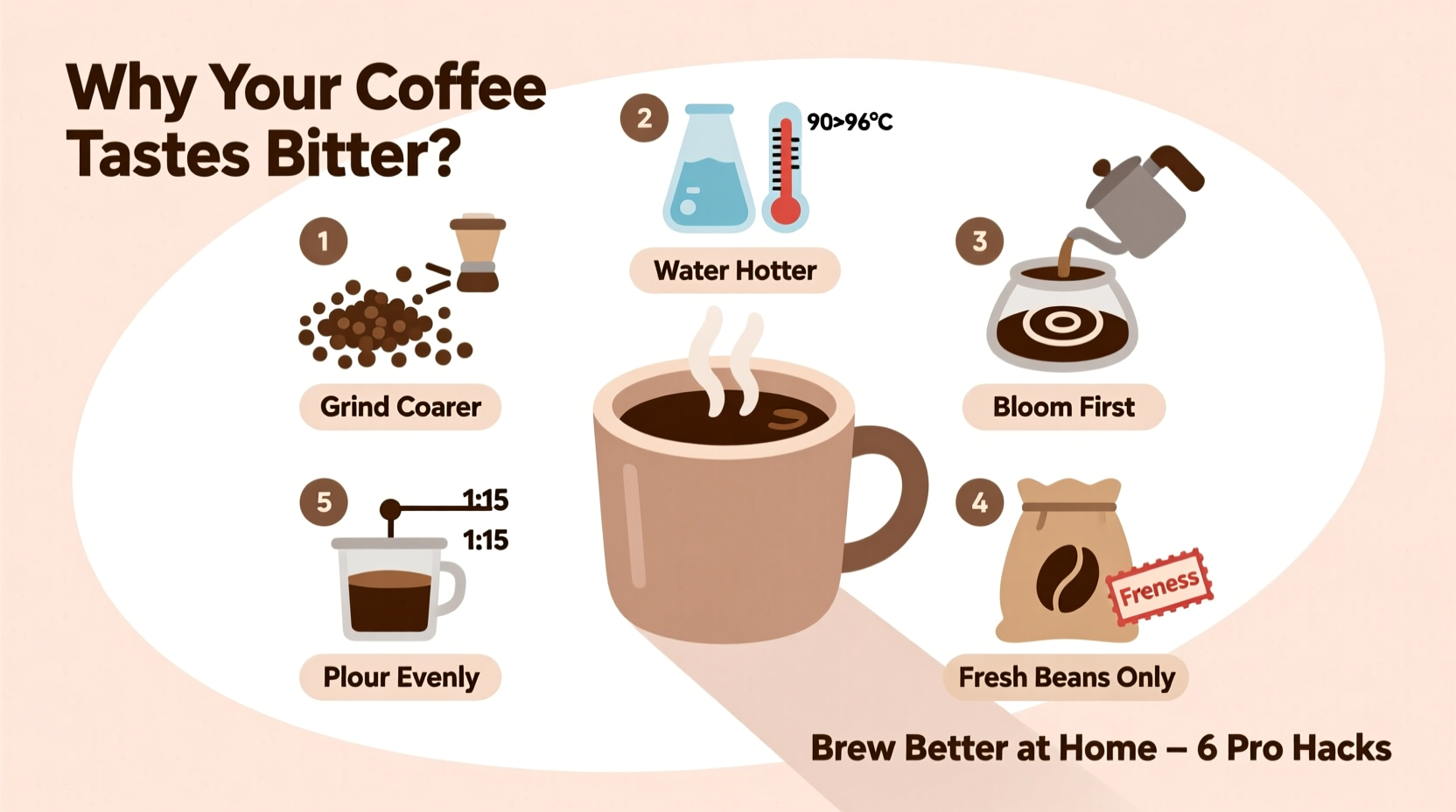
Coffee extraction is a chemical process where hot water dissolves soluble compounds in ground coffee. These include acids (which contribute brightness), sugars (for sweetness), and bitter compounds (mainly from cellulose breakdown and certain phenols). Ideally, about 18–22% of the coffee’s mass should dissolve into your cup—this is known as the \"golden ratio\" of extraction.
When extraction exceeds 22%, you start pulling out undesirable bitter compounds. This happens most commonly due to:
- Over-extraction: Too fine a grind, too long a brew time, or water that’s too hot.
- Poor grind consistency: Uneven particles lead to some over-extracting while others under-extract.
- Low-quality or stale beans: Old beans lose sweetness and develop woody, bitter notes.
- Hard water: High mineral content amplifies bitterness and reduces clarity.
The key is identifying which factor—or combination—is affecting your brew.
5 Brewing Hacks to Reduce Bitterness at Home
You don’t need a $500 espresso machine to make great coffee. Most fixes are low-cost and easy to implement. Here are five proven hacks to dial in a smoother, less bitter cup.
1. Adjust Your Grind Size
Grind size is the single most impactful variable after water quality. A grind that’s too fine increases surface area, allowing water to extract bitter compounds too quickly—especially in methods like French press or pour-over.
If you’re using a blade grinder, upgrade to a burr grinder if possible. Blade grinders create inconsistent particle sizes, leading to uneven extraction. Even an entry-level conical burr grinder makes a dramatic difference.
“Consistency in grind size is more important than precision. You can have the perfect recipe, but if half your grounds are dust and half are pebbles, you’ll never get balanced flavor.” — James Hoffmann, World Barista Champion
For drip coffee or pour-over, aim for a medium-fine grind—like table salt. For French press, go coarse, similar to breadcrumbs. If your coffee tastes bitter, try coarsening the grind slightly and reassess after brewing.
2. Control Water Temperature
Water that’s too hot (above 205°F or 96°C) scalds coffee grounds, extracting bitter compounds rapidly. Ideal brewing temperature is between 195°F and 205°F (90–96°C).
If you don’t have a temperature-controlled kettle, here’s a simple hack: Boil your water, then let it sit off the heat for 30 seconds before pouring. This brings it into the ideal range.
| Brew Method | Recommended Grind | Water Temp | Brew Time |
|---|---|---|---|
| Pour-Over (V60) | Medium-fine | 200–205°F | 2:30–3:00 |
| French Press | Coarse | 195–200°F | 4:00 |
| Drip Machine | Medium | 195–205°F | 5:00–6:00 |
| AeroPress | Fine to medium | 175–205°F | 1:00–2:30 |
Note: Lower temperatures (e.g., 175°F) can reduce bitterness in sensitive light roasts when using AeroPress.
3. Shorten Brew Time
Longer contact between water and coffee increases extraction. In immersion methods like French press, exceeding 4 minutes often leads to over-extraction. Try reducing brew time to 3:30 and taste the difference.
For pour-over, ensure your flow rate isn’t too slow. A clogged filter or overly fine grind can extend brew time beyond 3 minutes, increasing bitterness. Aim for total brew time (including pouring) between 2:30 and 3:00 for a 12-ounce cup.
4. Use Fresh, High-Quality Beans
Stale coffee is a silent culprit. After roasting, beans begin losing volatile aromatics within days. By week three or four, they’ve lost much of their sweetness and complexity, leaving behind flat, bitter notes—even if stored properly.
Buy whole beans roasted within the past two weeks. Look for roast dates on packaging, not just “best by” labels. Store beans in an opaque, airtight container at room temperature—never in the fridge or freezer, where moisture and odors degrade quality.
5. Improve Your Water Quality
Tap water varies widely in mineral content. Hard water (high in calcium and magnesium) can over-extract and amplify bitterness. Soft or distilled water lacks minerals needed for proper extraction, resulting in flat, lifeless coffee.
Ideal brewing water contains moderate levels of minerals—specifically calcium and bicarbonate—for balanced extraction. Third Wave Water offers mineral packets designed for coffee, or you can use bottled spring water as a consistent alternative.
Alternatively, mix 80% distilled water with 20% tap water to dilute excess minerals while retaining some buffering capacity.
Real Example: Fixing a Bitter French Press Habit
Sarah, a remote worker in Denver, loved her morning French press ritual but always added extra milk to mask the bitterness. She used pre-ground coffee from a supermarket and boiled water directly from the tap, letting it steep for 5 full minutes.
After learning about extraction principles, she made three changes:
- Bought whole beans from a local roaster (roasted 10 days prior).
- Invested in a $40 burr grinder and set it to coarse for French press.
- Reduced steep time to 4 minutes and switched to filtered water.
The result? Her next cup was noticeably sweeter, with hints of dark chocolate and walnut. No milk needed. “I didn’t realize I’d been punishing my taste buds for years,” she said. “Now I actually taste the coffee.”
Step-by-Step Guide to Dialing In Your Brew
Follow this sequence to systematically eliminate bitterness:
- Start fresh: Use beans roasted within the last 14 days.
- Grind just before brewing: Set grinder to medium-coarse for French press, medium for drip, medium-fine for pour-over.
- Heat water to 200°F: Boil, then wait 30 seconds.
- Brew within optimal time: 4:00 for French press, 2:30–3:00 for pour-over.
- Taste immediately: Note dominant flavors—bitter, sour, sweet?
- Adjust one variable: If bitter, coarsen grind or shorten time. If sour, do the opposite.
- Repeat next day: Small tweaks compound over time.
This methodical approach prevents confusion and helps isolate what works.
Do’s and Don’ts of Avoiding Bitter Coffee
| Do | Don’t |
|---|---|
| Use freshly roasted whole beans | Buy pre-ground coffee in bulk |
| Grind right before brewing | Grind hours in advance |
| Use filtered or balanced mineral water | Use hard tap water |
| Store beans in a cool, dark, airtight container | Store in fridge or clear jar on counter |
| Experiment with brew time and grind | Change multiple variables at once |
Frequently Asked Questions
Why does my coffee taste bitter even with good beans?
Even high-quality beans can taste bitter if over-extracted. Check your grind size, brew time, and water temperature. A fine grind or extended steeping pulls out bitter compounds regardless of bean quality.
Can dark roast coffee be less bitter?
Counterintuitively, darker roasts aren’t always more bitter. While they contain more caramelized and roasted compounds, skilled roasting preserves balance. However, poorly roasted dark beans can taste charred. Try a medium roast for brighter, cleaner profiles with natural sweetness.
Does adding salt really reduce bitterness?
Yes—scientifically. A tiny pinch of salt (literally 1/16 teaspoon per cup) can suppress bitter perception by interfering with taste receptors. It won’t remove over-extraction, but it can make an already-brewed bitter cup more palatable in a pinch.
Checklist: Eliminate Bitterness in 7 Steps
- ✅ Buy fresh, whole-bean coffee (check roast date)
- ✅ Invest in a burr grinder
- ✅ Grind immediately before brewing
- ✅ Use water between 195°F and 205°F
- ✅ Match grind size to your brew method
- ✅ Stick to recommended brew times
- ✅ Use filtered or balanced mineral water
Conclusion: Take Control of Your Cup
Bitter coffee doesn’t have to be your daily norm. With attention to detail and a willingness to experiment, you can unlock the full potential of your beans. The tools you need are already in your kitchen—your hands, a grinder, a kettle, and a little patience. Great coffee isn’t about perfection; it’s about intention. Each adjustment brings you closer to a cup that’s not just drinkable, but truly enjoyable.




 浙公网安备
33010002000092号
浙公网安备
33010002000092号 浙B2-20120091-4
Comments
No comments yet. Why don't you start the discussion?