
For many families, the Christmas tree is a symbol of joy and tradition. But for dogs, it’s often an unsettling anomaly—a towering, fragrant, glittering intruder in their carefully calibrated world. Sudden barking, pacing, growling, or even attempts to knock it over aren’t “naughty” behavior. They’re signals: your dog is experiencing genuine stress, confusion, or perceived threat. Unlike humans, dogs don’t interpret holiday decor through cultural lenses—they process it sensorially and instinctively. The tree’s scent, texture, movement, lights, and associated human activity all converge into a potent stress cocktail. This article moves beyond quick fixes like distraction or suppression. It explores the biological and behavioral roots of the reaction, offers practical, evidence-informed interventions, and helps you transform the holiday season from a source of anxiety into one of calm connection.
Why the Tree Triggers Stress: A Canine Sensory Breakdown
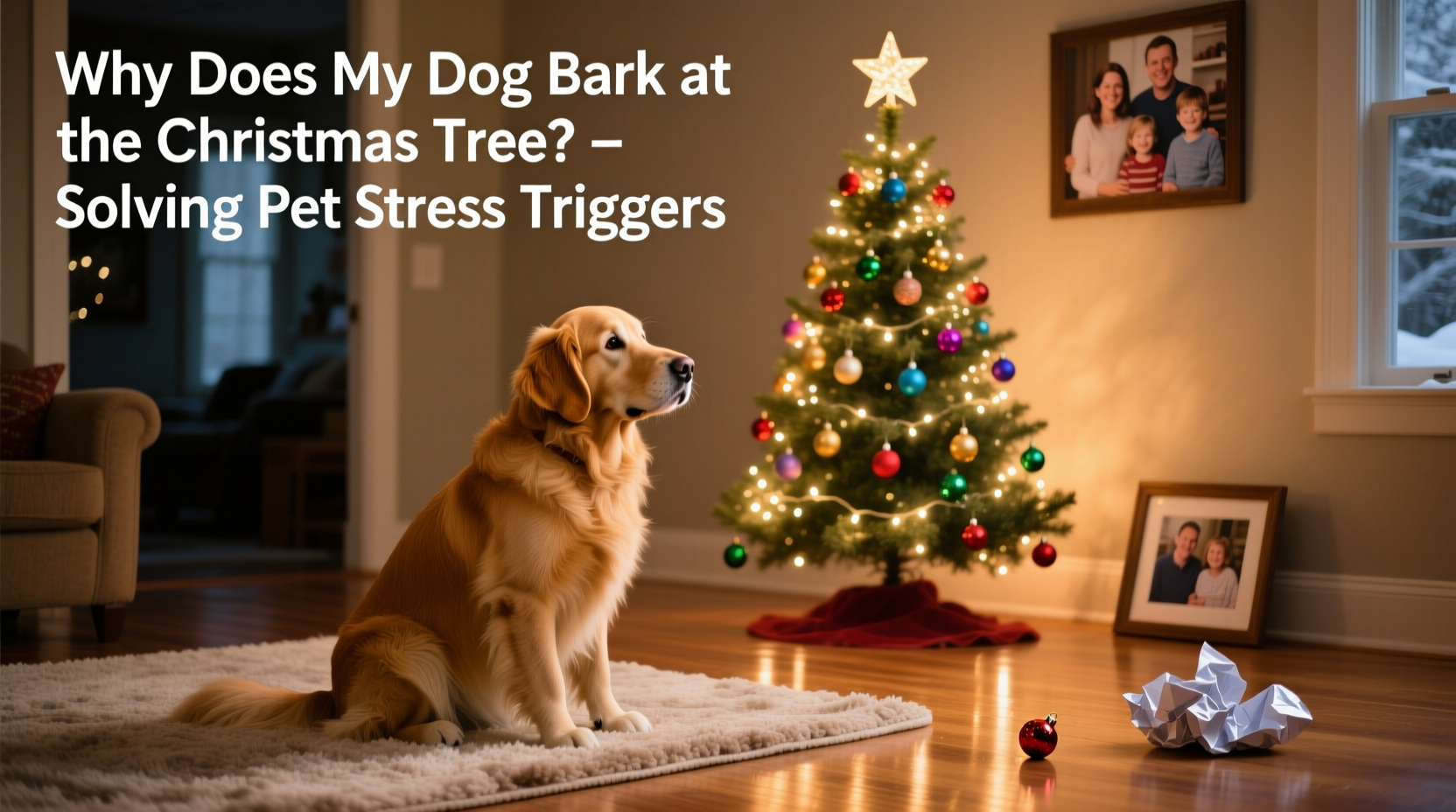
Dogs experience the world primarily through smell, hearing, and motion detection—not sight or symbolism. A Christmas tree disrupts their environmental baseline across multiple sensory channels:
- Olfactory overload: Fir, pine, or spruce emit volatile organic compounds (VOCs) that are intensely aromatic to dogs—up to 10,000 times more sensitive than humans. These scents can mimic alarm pheromones or signal unfamiliar territory.
- Visual novelty and instability: A tall, asymmetrical object that sways slightly (even from HVAC airflow), reflects light unpredictably, and changes daily with new ornaments creates visual noise. Dogs rely on consistent spatial cues; sudden large objects violate that predictability.
- Acoustic anomalies: Crackling lights, buzzing transformers, rustling tinsel, or ornaments that chime in drafts introduce high-frequency or intermittent sounds—many of which fall within the canine hearing range (40–60,000 Hz), far beyond human perception.
- Tactile uncertainty: Low-hanging ornaments, dangling ribbons, or textured boughs invite investigation—but also pose risk. Dogs may bark defensively to create distance from something they can’t safely explore or understand.
- Human behavior shifts: Increased foot traffic, loud gatherings, altered routines, and heightened human excitement change household energy. Dogs read emotional contagion; if you’re rushed or stressed, they absorb it—and may project that unease onto the most novel element: the tree.
This isn’t “bad behavior.” It’s functional communication: “This is unfamiliar. It feels unsafe. I’m trying to control or alert to a potential threat.” Ignoring or punishing the barking only suppresses the symptom while deepening the underlying anxiety.
Do’s and Don’ts: Immediate Response Strategies
How you respond in the moment shapes whether the behavior escalates or de-escalates. Consistency matters more than perfection—your goal is to build trust, not enforce silence.
| Action | Do | Don’t |
|---|---|---|
| When barking starts | Calmly redirect with a known cue (“Let’s go,” “Find your bed”) and reward quiet, relaxed behavior *before* escalation. | Yell, jerk the leash, or use punitive tools (e.g., spray collars). These increase fear and associate the tree with pain or confusion. |
| During setup | Introduce the tree gradually over 3–5 days—first just the bare stand, then the trunk, then branches, then lights (unlit first), then ornaments (start with non-reflective, non-rattling ones). | Bring the fully decorated tree home all at once and expect immediate acceptance. |
| At night or when unsupervised | Use baby gates or pet-safe barriers to create a calm zone *away* from the tree—never as punishment, but as a predictable sanctuary. | Confine your dog in a crate directly beside the tree or in a room where they must constantly monitor it. |
| With children or guests | Teach kids to move slowly near the tree, avoid sudden gestures, and never chase or tease the dog near it. | Allow unstructured play or roughhousing near the tree—especially with excited children or visiting pets. |
A Step-by-Step Desensitization & Counterconditioning Plan
This 7-day protocol is grounded in veterinary behavior science and designed for dogs of all ages and temperaments. It requires patience—not intensity. Progress depends on your dog’s comfort level, not the calendar.
- Day 1–2: Neutral exposure
Set up the bare tree stand in its final location. Place your dog’s bed or mat 8 feet away. Feed meals and offer chews there. No interaction with the stand—just calm presence. - Day 3: Introduce the trunk
Add the tree trunk (no branches). Keep distance at 6 feet. Drop small, irresistible treats (e.g., cooked chicken) *on the floor* near your dog—never toward the trunk—to reinforce calm observation. - Day 4: Add lower branches
Place 2–3 low, stable branches. Reduce distance to 4 feet. Begin “Look at That” (LAT) training: say “Yes!” and treat the *instant* your dog glances at the branches—then looks away. Repeat 10x/session, 2x/day. - Day 5: Introduce unlit lights
Wrap lights loosely around lower branches. Keep distance at 3 feet. Continue LAT. If your dog shows tension (stiffness, whale eye), increase distance and slow down. - Day 6: Lights on (low brightness)
Turn on LED lights at lowest setting for 5 minutes, twice daily. Pair with favorite puzzle toy or lick mat placed well away from the tree. - Day 7: First ornament introduction
Hang one soft, matte, non-reflective ornament at dog-eye level. Observe closely. If no stress signs, proceed. If barking or avoidance occurs, pause and repeat Day 6 for two more days. - Ongoing: Maintain & generalize
Once comfortable, add one new element every 2–3 days (e.g., second ornament, ribbon, higher placement). Always end sessions on a calm, successful note—even if brief.
Key principle: If your dog stops taking treats, freezes, paces, or whines, you’ve moved too fast. Back up one step and rebuild confidence. Rushing triggers regression—not resilience.
Mini Case Study: Luna, a 3-year-old rescue terrier mix
Luna had lived in a quiet, minimalist apartment before adoption. Her new family welcomed her just before Thanksgiving. When the 7-foot Fraser fir arrived, she didn’t bark—she froze, then retreated under the couch for 36 hours. Attempts to coax her out with treats failed. Her owners consulted a certified behavior consultant who observed Luna’s stress signals: pinned ears, lip licking, and rapid blinking—not aggression, but acute overwhelm. They implemented the step-by-step plan above but adjusted timing: Luna needed 4 days on the bare stand before adding the trunk. By Day 9, she’d approach within 2 feet of the unlit tree to sniff, tail wagging tentatively. By Christmas Eve, she napped 5 feet away while lights shimmered softly. Crucially, her owners stopped using the tree as a “test” of obedience—and instead treated it as shared space to be earned, not demanded. Her transformation wasn’t about silencing barking—it was about restoring her sense of safety in her own home.
Expert Insight: What Veterinary Behaviorists Emphasize
Dr. Sarah Wooten, DVM, CVBT (Certified Veterinary Behavior Technician) and author of Canine Calm in Human Chaos, explains the stakes clearly:
“The Christmas tree isn’t inherently threatening—but for dogs with limited novelty exposure, past trauma, or high environmental sensitivity, it becomes a perfect storm of sensory triggers. Punishment doesn’t teach safety; it teaches that the human is unpredictable. The most effective intervention isn’t training the dog to ignore the tree—it’s helping the dog feel so secure in their relationship with you that the tree simply becomes background noise.” — Dr. Sarah Wooten, DVM, CVBT
This aligns with recent research in Frontiers in Veterinary Science (2023), which found dogs exposed to gradual, choice-based desensitization showed 68% lower cortisol levels during holiday periods compared to those subjected to forced exposure or correction-based methods.
FAQ: Addressing Common Concerns
My dog only barks when the lights are on—could it be a vision issue?
Possibly. Flickering or strobing lights (especially older incandescent strings) can cause visual discomfort in dogs with sensitive retinas or early cataracts. Switch to steady, warm-white LEDs. If barking persists *only* with lights—even after desensitization—schedule a veterinary ophthalmology consult. Never assume it’s “just behavior” when a physical cause is plausible.
Is it safe to use calming aids like CBD oil or Adaptil diffusers?
Adaptil (dog-appeasing pheromone) diffusers have strong clinical support for reducing environmental anxiety and are safe for long-term use. CBD oil remains less regulated; quality varies widely, and dosing for dogs lacks standardized guidelines. Consult your veterinarian *before* use—especially if your dog takes medications or has liver/kidney conditions. These aids support behavior work—they don’t replace it.
What if my dog knocks the tree over?
This is rarely “spite”—it’s usually frustration, redirected energy, or an attempt to remove a perceived threat. Secure the tree to a wall stud with a flexible, pet-safe strap (not wire or rope they can chew). Use a weighted base. Remove all low-hanging ornaments, tinsel, and edible decorations (which pose ingestion risks). Most importantly: assess *why* the behavior emerged. Was it preceded by prolonged barking? Did it happen during high-stress events (e.g., guests arriving)? Address the root trigger—not just the outcome.
Conclusion: Reclaiming the Season with Compassion
Your dog’s barking at the Christmas tree isn’t a flaw in their character or a failure in your training. It’s a window into their perceptual world—one shaped by evolution, individual history, and neurobiology. When you respond with curiosity instead of correction, with patience instead of pressure, you do more than quiet a bark. You affirm your dog’s right to feel safe. You strengthen the bond that makes holidays meaningful—not just for you, but for them. This season, let the tree stand not as a test, but as an invitation: to observe more closely, listen more deeply, and meet your dog where they are—not where tradition expects them to be. Start small. Honor their pace. Celebrate quiet glances as victories. And remember: the most enduring holiday tradition isn’t perfection—it’s presence.




 浙公网安备
33010002000092号
浙公网安备
33010002000092号 浙B2-20120091-4
Comments
No comments yet. Why don't you start the discussion?