
Dogs don’t bark at flashing lights because they’re “scared of light.” They bark because their nervous system interprets erratic, high-contrast visual stimuli as a potential threat—especially when those flashes are unpredictable, rapid, or originate from unfamiliar sources like security cameras, LED billboards, or even passing car headlights reflecting off wet pavement. Unlike steady light, flashing light violates the brain’s expectation of environmental consistency. For a species that relies heavily on pattern recognition for safety, this disruption triggers an orienting response—followed by vocalization when no clear resolution (e.g., identifying the source, assessing distance, or receiving calming feedback) occurs. The behavior isn’t irrational; it’s neurologically coherent. What makes it puzzling is its specificity: your dog may ignore thunderstorms but lunge at a flickering porch light. That selectivity points not to fear alone, but to a learned association, sensory sensitivity, or underdeveloped impulse control in visually dynamic contexts.
The Neurological & Behavioral Roots of Flash-Specific Reactivity
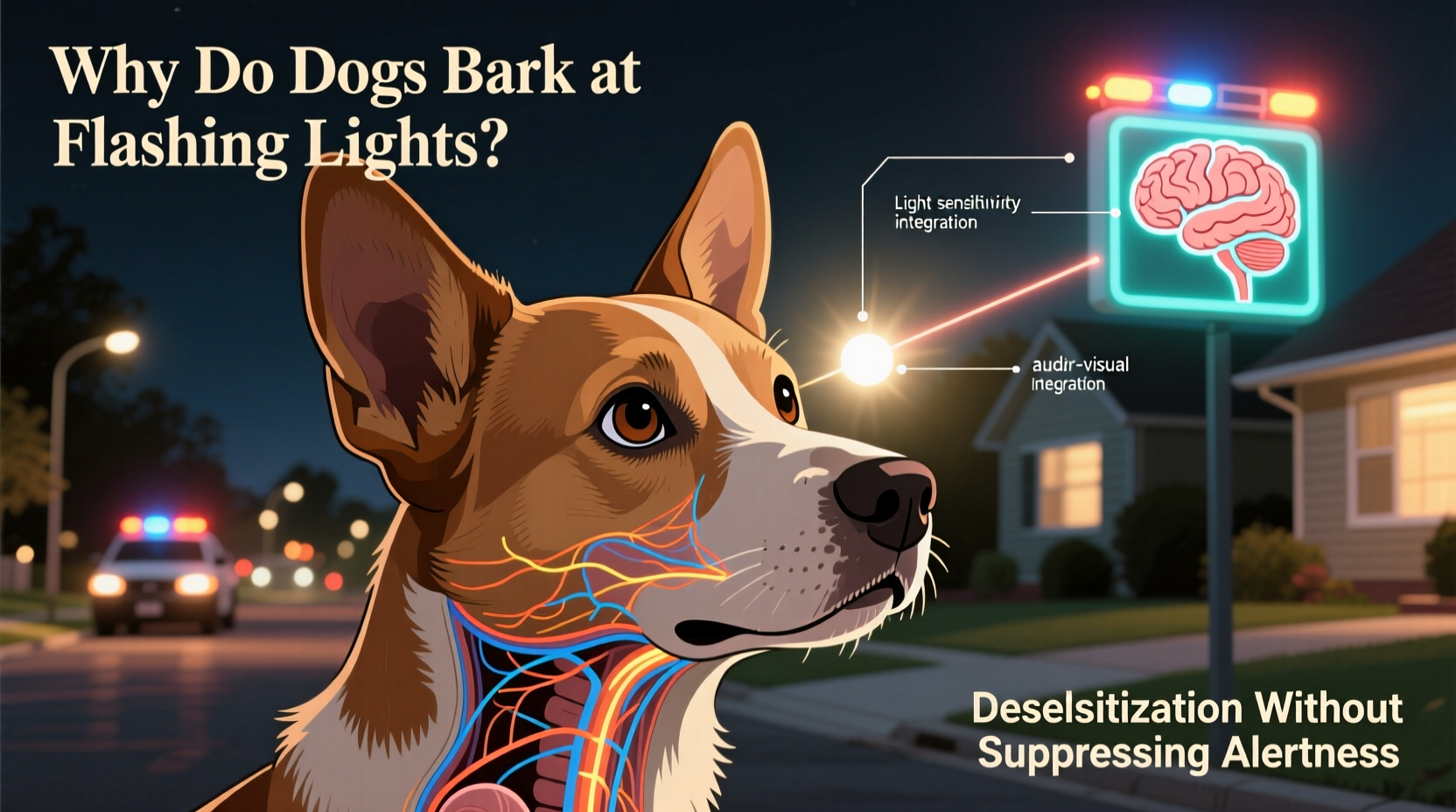
Flashing lights engage multiple canine sensory pathways simultaneously. Dogs process visual motion up to 70–80 frames per second—nearly double the human rate—making them exquisitely sensitive to intermittent stimuli. When light pulses at frequencies between 3–15 Hz (common in faulty LEDs, strobes, or rotating beacons), it can trigger neural resonance in the thalamus and visual cortex—regions linked to threat detection and arousal regulation. This isn’t photosensitive epilepsy (rare in dogs), but rather a heightened orienting reflex gone unmodulated. Add to that the fact that many flashing sources emit faint ultrasonic harmonics (e.g., from power supplies) or subtle electromagnetic fields—both detectable by dogs but imperceptible to us—and you have a multi-sensory trigger masked as “just light.”
Crucially, this reactivity often co-occurs with under-practiced self-regulation. A dog who hasn’t learned to pause, assess, and choose a calm response when startled will default to barking—not out of aggression, but as a displacement behavior that temporarily lowers physiological arousal. Suppressing the bark without addressing the underlying neurological and behavioral drivers doesn’t resolve the issue; it merely pushes the stress response inward, potentially manifesting as lip-licking, yawning, avoidance, or redirected frustration later.
Why Suppression Backfires: The Cost of Silencing Natural Alertness
Alert barking serves an evolutionary purpose: it signals awareness, deters intruders, and coordinates group responses. In domestic dogs, this instinct remains intact—but its expression must be shaped, not erased. Traditional suppression methods—yelling “No!”, using citronella collars, or punishing the bark—don’t teach the dog *what* to do instead. They teach only that vocalizing in that context carries risk. Over time, this erodes trust, increases hypervigilance (since the dog now scans for punishment cues *as well as* threats), and disconnects the dog from his own body language. You may stop the barking, but you’ll likely see increased pacing, trembling, or sudden snapping at harmless objects—a sign the alert system is now misfiring.
Worse, suppression conflates two distinct functions: perception (noticing the flash) and response (barking). You cannot—and should not—dull perception. A dog who stops noticing anomalies is unsafe. What you *can* and *must* shape is the response: teaching him to notice, pause, look to you, and settle—without shutting down his capacity to assess novelty.
“Alertness isn’t the problem—it’s the absence of choice that creates reactivity. A well-desensitized dog doesn’t ignore the flash; he chooses not to escalate. That distinction separates trained confidence from conditioned silence.” — Dr. Sarah Lin, Veterinary Behaviorist and Co-Director, Canine Cognitive Wellness Institute
A Step-by-Step Desensitization Protocol (Weeks 1–6)
This protocol prioritizes neurological safety over speed. It uses controlled exposure, paired with voluntary engagement, to rebuild the dog’s sense of agency. Never rush stages—progress only when your dog offers relaxed body language (soft eyes, loose mouth, weight shifted back onto hindquarters) for 90% of each session.
- Baseline Assessment (Day 1): Identify the exact flash source, frequency, and distance at which your dog first shows orientation (ear twitch, head turn, stillness). Note his threshold—the point just before barking begins.
- Stage 1: Passive Exposure (Days 2–5): At 3× your baseline distance, briefly activate the flash (e.g., tap a flashlight button for 0.5 sec) while offering high-value treats *only if* your dog remains still and looks at you. No treats if he barks or lunges. Repeat 5x/session, max 3 sessions/day.
- Stage 2: Voluntary Choice (Days 6–12): At baseline distance, present the flash—but only *after* your dog offers eye contact. Mark and reward the look *before* the flash occurs. Gradually increase flash duration from 0.5 to 2 seconds. If he breaks focus, reset—don’t punish.
- Stage 3: Interrupt & Redirect (Days 13–21): Introduce a low-distraction “look at me” cue *during* the flash. Reward any glance toward you mid-flash—even for 0.2 seconds. Build duration slowly. If he barks, calmly walk away (no reprimand)—this teaches that barking ends access to reinforcement.
- Stage 4: Real-World Integration (Weeks 5–6): Practice near actual triggers (e.g., parked car with blinker on) at reduced intensity (cover part of the light with tape to soften contrast). Always end sessions with a calm, non-triggered activity (e.g., sniffing game).
Do’s and Don’ts of Flash Desensitization
| Action | Do | Don’t |
|---|---|---|
| Timing | Start sessions when your dog is physiologically calm (e.g., 30 min after a walk, not right after play) | Begin during high-arousal states (after greeting, during meal prep, or when visitors arrive) |
| Reinforcement | Use food rewards *only* when your dog is below threshold and actively choosing calm | Force treats into his mouth during barking or use them to “distract” through stress |
| Environment | Control variables: dim ambient light, eliminate competing sounds, use consistent flash source | Practice near busy roads, loud HVAC units, or with children running nearby |
| Progression | Hold at one stage for 3+ days if progress stalls—consolidation builds neural resilience | Jump to closer distance or longer flash duration after one “good” session |
| Owner Role | Maintain neutral posture and breathing—even if your dog barks; your calm is his anchor | Lean forward, tense shoulders, or speak sharply when he reacts |
Real-World Case Study: Luna, 3-Year-Old German Shepherd Mix
Luna barked exclusively at the rhythmic red flash of her neighbor’s security camera—32 times per minute, always at dusk. Her owner, Maya, had tried covering the window, spraying water, and yelling “Quiet!” with no lasting effect. Luna began avoiding the living room entirely at twilight, her tail tucked, ears pinned. A behavior assessment revealed Luna wasn’t fearful of the light itself—she’d happily watch sunbeams move across the floor—but of its predictability and lack of resolution. The camera never approached, never changed, never stopped. To her, it was a perpetual, unsolvable puzzle.
Using the step-by-step protocol, Maya started at 12 feet (Luna’s initial threshold was 8 feet) with a modified flashlight set to pulse every 2 seconds. For three days, she rewarded only eye contact *before* the flash. On Day 4, Luna began voluntarily looking at Maya *during* the pulse. By Week 3, Maya introduced the real camera—but covered half the lens with black tape to reduce contrast. Luna’s barking dropped from 32 to 3 incidents per session. By Week 6, she’d lie on her bed, watch the flash, then rest her chin on her paws—her version of “I see it, and I’m fine.” Crucially, Luna remained highly alert to new people at the door and barked appropriately at unfamiliar sounds. Her vigilance hadn’t diminished—her confidence in managing uncertainty had grown.
FAQ
Can dietary changes help reduce light-related reactivity?
Not directly—but nutritional deficits can lower neurological resilience. Omega-3 fatty acids (from fish oil), magnesium glycinate, and B-vitamin complexes support neural modulation. Consult your veterinarian before supplementing, especially if your dog has kidney or liver conditions. Avoid artificial dyes (e.g., Red 40) in treats, as some dogs show heightened reactivity to chromatic stimulation.
My dog only barks at certain colors of light (e.g., blue or red). Is this normal?
Yes. Canine color vision is dichromatic (blue/yellow spectrum), and rods dominate their retinas. Blue and violet wavelengths scatter more and appear brighter against dark backgrounds—making them more likely to trigger an orienting response. Red light, while less visible, creates high contrast against green foliage or gray concrete, potentially amplifying its salience. This isn’t preference—it’s optics meeting biology.
Will my dog ever stop reacting entirely—or is some reaction healthy?
Complete non-reaction isn’t the goal—or even desirable. A healthy outcome is *modulated* response: a brief head turn, a soft blink, maybe a single woof followed by disengagement. If your dog ignores a genuine threat (e.g., a person approaching your property at night), that’s a bigger concern than noticing a flashing light. Success means he trusts his ability to assess, choose, and return to calm—not that he becomes oblivious.
Conclusion
Flashing lights aren’t “just light” to your dog—they’re dynamic, unpredictable inputs that test his capacity to stay grounded amid sensory flux. Desensitization isn’t about erasing his vigilance; it’s about expanding his repertoire of calm, confident responses. Every time you pause before correcting, every time you reward a soft blink instead of demanding silence, every time you honor his threshold—you reinforce that he is safe, seen, and capable. That’s how alertness transforms from reactive noise into quiet competence. Start small. Track subtle shifts—a deeper breath, a slower tail wag, a glance toward you instead of the flash. Those micro-moments are where true resilience is built. Your dog isn’t broken. He’s waiting for you to meet his nervous system with patience, precision, and unwavering respect.




 浙公网安备
33010002000092号
浙公网安备
33010002000092号 浙B2-20120091-4
Comments
No comments yet. Why don't you start the discussion?