
Every December, thousands of pet owners face the same bewildering scene: ornaments scattered, pine needles carpeting the floor, and their dog calmly chewing on a freshly snapped branch from the living room Christmas tree. It’s not just inconvenient—it’s concerning. Pine needles can puncture digestive tracts; sap may irritate mucous membranes; and fallen branches pose choking or intestinal blockage risks. Yet scolding rarely works, and temporary fixes like bitter sprays often fail within hours. Understanding *why* this happens—and responding with behavioral science, environmental management, and canine empathy—is the only path to lasting change.
The Root Causes: More Than Just “Being Bad”
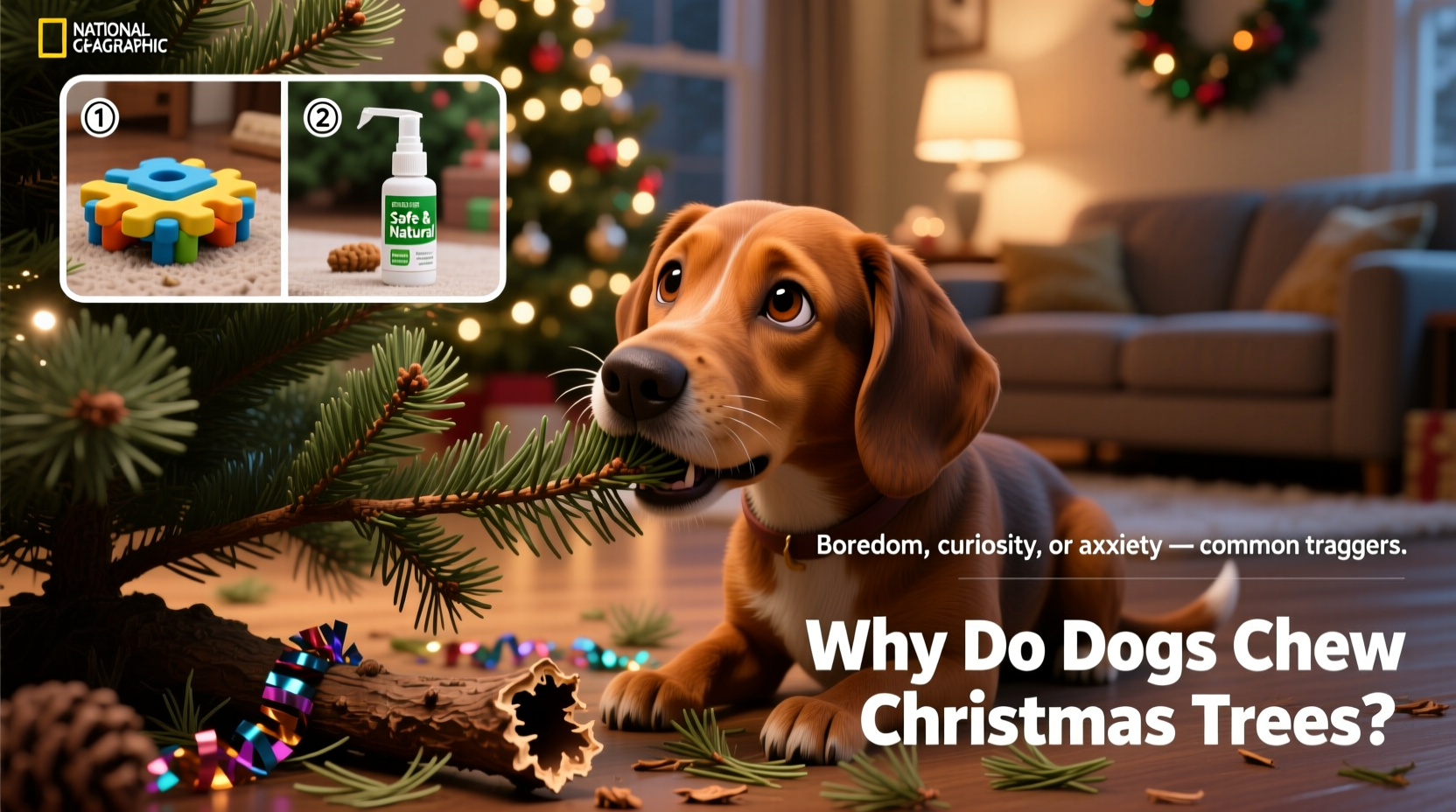
Dogs don’t chew Christmas trees out of spite or seasonal rebellion. Their behavior is driven by overlapping biological, psychological, and environmental triggers—many amplified during the holiday season. Research from the American Veterinary Society of Animal Behavior (AVSAB) confirms that chewing in adult dogs is rarely purely “destructive”; it’s usually a functional response to unmet needs.
Sensory appeal tops the list. Fresh-cut Fraser firs, balsam firs, and Douglas firs emit volatile organic compounds—including limonene and pinene—that dogs detect at concentrations 10,000 times greater than humans. To them, the tree isn’t just green décor—it’s an aromatic, texturally novel object: crisp yet fibrous, slightly sticky with resin, and rich with scent trails left by human handling.
Stress and overstimulation also play critical roles. Holiday routines shift dramatically: guests arrive unannounced, schedules fracture, noise levels rise, and familiar spaces are reconfigured. For dogs with baseline anxiety—or those who thrive on predictability—these changes elevate cortisol. Chewing releases endorphins, offering self-soothing relief. A 2022 study in Applied Animal Behaviour Science found that 68% of dogs exhibiting new chewing behaviors during holidays had concurrent signs of stress (panting, pacing, lip-licking, or avoidance).
Boredom and under-stimulation compound the issue. With families preoccupied by shopping, cooking, and social obligations, dogs often receive less structured play, training, or mental engagement. A dog left alone for extended periods near a fragrant, novel object will inevitably investigate—and chew is the most accessible form of interaction.
Finally, teething isn’t exclusive to puppies. While less common, adult dogs with dental pain (e.g., gingivitis, fractured teeth, or oral tumors) may seek firm, cool textures to relieve discomfort. If chewing emerges suddenly in a previously non-chewer, veterinary evaluation is essential—not optional.
Evidence-Based Prevention: What Actually Works
Effective intervention requires moving beyond punishment or quick fixes. The gold standard combines environmental modification, enrichment engineering, and consistent reinforcement. Here’s what veterinary behaviorists and certified professional dog trainers recommend—backed by field data and clinical outcomes.
Step-by-Step Tree-Safe Setup (A 5-Step Protocol)
- Choose the right tree species. Avoid highly aromatic varieties like balsam fir or white pine. Opt for less volatile options such as noble fir or blue spruce—still festive, but significantly lower in appealing terpenes.
- Erect a physical barrier—before decorating. Use a freestanding baby gate (not pressure-mounted), a sturdy exercise pen, or a custom-built wooden frame anchored to wall studs. Ensure it’s at least 36 inches tall and extends 18 inches beyond the tree’s widest branch.
- Eliminate ground-level temptation. Sweep fallen needles daily—don’t rely on vacuuming alone. Pine needles retain scent even when dry; use a damp microfiber cloth to lift residual oils from hardwood or tile floors.
- Redirect scent focus. Place your dog’s favorite chew toy (e.g., a frozen KONG stuffed with low-sodium broth and kibble) on the opposite side of the room—away from the tree—30 minutes before guests arrive or during high-stimulus moments.
- Install motion-activated deterrents—strategically. Use battery-operated devices that emit a high-frequency tone (inaudible to humans) *only* when the dog crosses a defined perimeter around the tree. Do not use citronella spray collars or shock-based systems—they increase fear and erode trust.
Enrichment That Replaces the Tree (Not Just Competes With It)
Chewing satisfies multiple needs: oral motor input, mental engagement, and stress modulation. To displace tree-chewing, enrichment must match or exceed its functional payoff. Generic “chew toys” rarely suffice—what matters is *matching the sensory profile* and *timing the delivery*.
| Tree Feature Dogs Seek | Canine Need Served | Science-Backed Alternative |
|---|---|---|
| Aromatic resin & pine scent | Olfactory stimulation + novelty | Snuffle mat with dried rosemary, mint, or food-grade cedar shavings (replaced weekly); avoid essential oils, which are toxic) |
| Crisp, fibrous texture | Oral motor satisfaction | Frozen beef tendon (supervised), Himalayan yak cheese chews, or sterilized deer antler (size-appropriate) |
| “Forbidden” status + attention from humans | Attention-seeking + novelty reinforcement | 10-minute “find-it” game using kibble hidden in cardboard boxes; reward calm observation of the tree with quiet praise and treats—never when dog approaches it |
| Chewing as stress relief | Endorphin release | Twice-daily 15-minute sessions of nosework (searching for hidden treats in grass or indoor turf mats); proven to lower salivary cortisol by 27% in anxious dogs (Journal of Veterinary Behavior, 2021) |
Crucially, alternatives must be offered *proactively*, not reactively. If your dog starts circling the tree, it’s already too late—the arousal threshold has been crossed. Schedule enrichment 20 minutes before predictable triggers: morning coffee prep, evening TV time, or guest arrivals.
Real-World Case Study: Luna, a 3-Year-Old German Shepherd Mix
Luna lived with a retired couple in Portland, Oregon. Each December, she’d snap branches from their 7-foot noble fir—despite prior training and consistent rules. Her owners tried lemon-spray deterrents, crate confinement during parties, and even moved the tree to the dining room. Nothing stuck. When they consulted board-certified veterinary behaviorist Dr. Aris Thorne, he observed three key patterns: Luna chewed most intensely between 4–6 p.m. (when her owners prepared dinner), she avoided eye contact afterward (indicating shame, not defiance), and her chewing ceased entirely when they walked her *before* dinner prep began.
Dr. Thorne recommended a dual-track plan: First, replace the 4–6 p.m. window with a 25-minute off-leash hike in a nearby forest—leveraging her breed’s drive for exploration and scent work. Second, install a low-profile baby gate with a visual barrier (a lightweight fabric drape) so the tree remained present but inaccessible. Within nine days, branch-chewing stopped. By week three, Luna chose her puzzle feeder over glancing at the tree. The solution wasn’t more control—it was better alignment with her biology and routine.
“Dogs don’t need ‘better obedience’ during the holidays—they need better predictability, safer outlets for instinct, and humans who notice *when* the behavior happens—not just *that* it happens.” — Dr. Aris Thorne, DACVB, Veterinary Behavior Specialist
What NOT to Do: A Critical Do’s and Don’ts Checklist
- DO consult your veterinarian before assuming the behavior is purely behavioral—rule out dental disease, gastrointestinal discomfort, or nutritional deficiencies.
- DO supervise your dog around the tree for the first 72 hours after setup, even if barriers are in place.
- DO rotate enrichment items every 48 hours to maintain novelty—dogs habituate quickly to static stimuli.
- DON’T punish chewing after the fact. Dogs cannot connect delayed consequences to past actions—this breeds fear, not learning.
- DON’T use citrus-based sprays, cayenne pepper, or vinegar solutions. These cause oral pain and may trigger aggression or avoidance of other safe objects.
- DON’T assume “just one more year” of tree-chewing is harmless. Chronic ingestion of pine oils can lead to mild hepatotoxicity over time, especially in small or senior dogs.
FAQ: Your Most Pressing Questions Answered
Is artificial Christmas tree chewing safer than real tree chewing?
No—artificial trees introduce different but serious risks. PVC and flame-retardant coatings can leach toxins when chewed; plastic branches pose sharp-edged laceration hazards; and the static charge many artificial trees hold attracts dust and allergens that worsen respiratory issues in sensitive dogs. Real trees carry botanical risks; artificial ones carry chemical and mechanical ones. Neither is “safe”—both require equal diligence in barrier design and supervision.
My dog only chews when I’m not home. Does that mean it’s separation anxiety?
Possibly—but not exclusively. While separation-related chewing is common, it’s often misdiagnosed. True separation anxiety includes vocalization, destruction of exit points (doors, windows), house-soiling, and frantic pacing *within 20 minutes* of departure. If chewing occurs only after 45+ minutes and coincides with other signs (excessive licking, yawning, hiding), it may reflect boredom or understimulation—not acute distress. Video monitoring for 3 full days provides definitive insight.
Will neutering/spaying stop this behavior?
No. Hormonal status has no direct causal link to holiday-specific chewing. While intact dogs may show increased roaming or marking behaviors, tree-chewing is driven by sensory, environmental, and emotional variables—not testosterone or estrogen levels. Surgical intervention won’t resolve the underlying drivers—and carries its own health trade-offs.
Conclusion: Safety, Empathy, and Sustainable Change
Stopping your dog from chewing Christmas tree branches isn’t about enforcing holiday perfection—it’s about honoring your dog’s nature while safeguarding their well-being. The tree isn’t the problem; it’s a mirror reflecting unmet needs, environmental mismatches, and moments where our routines unintentionally compromise their security. When you choose a barrier instead of a scolding, offer a snuffle mat instead of a spray bottle, or adjust your walk schedule instead of rearranging furniture, you’re not just preventing damage—you’re deepening trust, reducing stress, and affirming your role as a thoughtful steward of another life.
This season, let your compassion extend beyond the wrapping paper and carols. Observe closely. Act early. Prioritize safety over aesthetics. And remember: the most meaningful gift you can give your dog isn’t under the tree—it’s consistency, clarity, and care, wrapped in everyday choices.




 浙公网安备
33010002000092号
浙公网安备
33010002000092号 浙B2-20120091-4
Comments
No comments yet. Why don't you start the discussion?