
Dog owners across the world know that moment: you say something—a command, a question, even just their name—and suddenly, your dog’s ears perk up, one ear may twitch, and their head gently tilts to the side. That look melts hearts instantly. But beyond its undeniable charm, what’s really happening in your dog’s mind? Is this behavior a calculated cognitive response, a learned trick for attention, or simply an adorable quirk of anatomy? The truth lies somewhere in between—and science is beginning to uncover more than we once thought.
The head tilt isn’t random. While it appears spontaneous, research suggests it may be linked to auditory processing, visual perception, social bonding, and even problem-solving. Understanding why dogs tilt their heads offers insight into how they interpret human communication, process sound, and respond emotionally to our voices.
The Science Behind the Tilt: Auditory Processing and Ear Anatomy
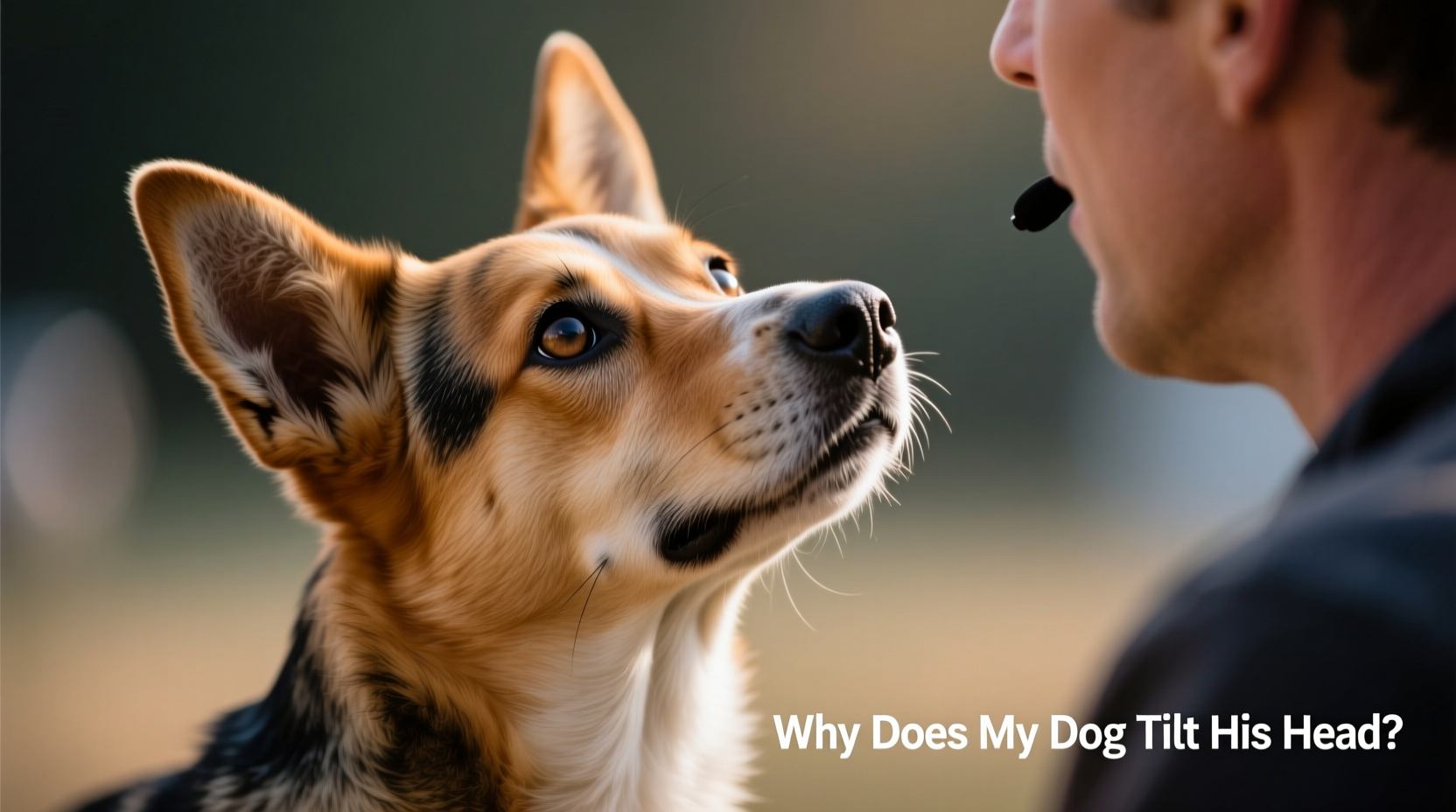
Dogs have highly sensitive hearing—far superior to humans in both range and directionality. However, their ear structure varies significantly by breed. Floppy-eared dogs like Basset Hounds or Cocker Spaniels often experience partial obstruction of their ear canals due to fur and cartilage. When these dogs hear a faint or unfamiliar sound, especially from a lower frequency or unusual direction, they may tilt their heads to adjust the position of their ears and improve sound localization.
According to Dr. Stanley Coren, a leading expert in canine psychology and author of *The Intelligence of Dogs*, “The head tilt may function as a way for dogs to reposition their ears so that the pinna—the external part of the ear—can better capture and funnel sounds into the ear canal.” This subtle movement helps them pinpoint where a noise is coming from, much like humans cupping a hand behind their ear.
In breeds with erect ears, such as German Shepherds or Siberian Huskies, the need for physical adjustment is less pronounced—but they still tilt their heads. This suggests that while auditory mechanics play a role, other factors are also at work.
Visual Perspective: Adjusting the Field of View
Another compelling explanation involves vision. A dog’s muzzle length and facial structure can obstruct their line of sight, particularly when looking up at a human face during conversation. By tilting their head, dogs may be compensating for this obstruction, gaining a clearer view of your mouth and facial expressions.
Since dogs rely heavily on lip reading and subtle facial cues to interpret human intent, adjusting their angle could help them \"read\" your emotions or anticipate commands. For example, if you say “Do you want to go for a walk?” while grabbing the leash, your dog might tilt their head not only to hear better but also to catch every nuance of your expression—eyes widening, smile forming—that signals excitement.
A 2021 study published in *Animal Cognition* observed that dogs with longer muzzles were more likely to tilt their heads when interacting with humans compared to brachycephalic (short-nosed) breeds like Pugs or Bulldogs. This supports the idea that anatomical differences influence the frequency and purpose of the behavior.
Cognitive Recognition and Word Learning
Perhaps the most fascinating angle is cognitive processing. Some researchers believe the head tilt is associated with mental effort—specifically, when a dog is trying to recognize a familiar word or understand context.
In a groundbreaking study conducted at Eötvös Loránd University in Budapest, Hungary, scientists trained a group of “superdogs”—exceptional learners capable of recognizing over 200 toy names. These gifted dogs consistently tilted their heads when owners asked them to retrieve a specific object, particularly when the requested item wasn’t immediately visible. The tilt occurred more frequently during moments of decision-making, suggesting it may coincide with memory retrieval or auditory discrimination.
“The head tilt appears to correlate with increased concentration. It’s not just reflexive—it may signal active listening and cognitive engagement.” — Dr. Claudia Fugazza, Ethologist, Department of Ethology, Eötvös Loránd University
This implies that for some dogs, the tilt isn’t merely habitual; it’s a sign of focused attention. Think of it as the canine equivalent of a person furrowing their brow when concentrating on a complex sentence.
How Dogs Learn Words: A Timeline
Dogs don’t learn language the way humans do, but certain individuals demonstrate remarkable abilities to associate sounds with objects. Here's a simplified timeline of how this learning unfolds:
- Early Exposure (Puppyhood): Puppies begin associating tone and rhythm with actions (e.g., “sit” paired with sitting).
- Repetition & Reinforcement: Consistent use of words alongside actions strengthens neural connections.
- Object Labeling: Advanced learners start linking specific nouns to items (e.g., “ball,” “rope”).
- Only about 1% of dogs show strong aptitude for this skill.
- Contextual Understanding: Dogs distinguish between similar-sounding words based on intonation, body language, and environment.
- Mental Retrieval: Upon hearing a known word, the dog accesses stored information—this is when head tilting often occurs.
Emotional Connection and Social Bonding
Beyond cognition and anatomy, the head tilt plays a powerful role in human-dog relationships. It triggers empathy and affection in people, which means dogs who tilt their heads are more likely to receive positive reinforcement—praise, treats, pets. Over time, they may learn that this gesture increases their chances of getting what they want.
This creates a feedback loop: the dog tilts → owner responds warmly → dog repeats the behavior. In behavioral terms, this is operant conditioning. Even if the initial tilt was unintentional, the reward system encourages repetition until it becomes a semi-voluntary social signal.
Consider this real-life scenario:
💬 Mini Case Study: Max, the Attention-Savvy Border Collie
Max, a three-year-old Border Collie, lived with a retired couple who doted on him. They found his head tilt utterly endearing and always responded with laughter and extra cuddles. Over time, Max began tilting his head not only during conversations but also whenever he wanted something—before meals, before walks, even when eyeing a treat jar across the room.
His owners realized he rarely did it when alone or unobserved. A hidden camera confirmed it: no audience, no tilt. While Max certainly used the gesture authentically during moments of curiosity, he had also mastered its power as a social tool.
This doesn’t make the behavior “fake.” Instead, it highlights dogs’ extraordinary social intelligence. They observe us closely and adapt their behavior to navigate our emotional responses effectively.
Is It Cute or Cognitive? Why Not Both?
The answer to whether the head tilt is cognitive or merely a cute habit isn’t either/or—it’s both. The behavior likely begins as a functional adjustment related to hearing or vision, especially in puppies encountering new sounds. As dogs mature, those with stronger social awareness refine the action into a communicative tool.
Think of it like human smiling: sometimes it’s a genuine expression of joy, other times it’s polite or strategic. Yet each instance carries meaning within its context. Similarly, a dog’s head tilt can reflect:
- Effort to hear or see better
- Active processing of known words
- Anticipation of rewards or commands
- Desire to engage socially
The interplay between instinct and learned behavior makes the head tilt a rich subject for understanding canine minds.
When to Be Concerned: Signs Beyond Normal Behavior
While occasional head tilting is normal, persistent or abnormal tilting—especially if accompanied by circling, loss of balance, or eye twitching—may indicate medical issues such as:
- Ear infections (otitis externa)
- Persistent inflammation of the inner ear (otitis interna)
- Vestibular disease
- Neurological disorders or tumors
If your dog suddenly starts tilting their head constantly—even when not engaged in conversation—seek veterinary evaluation promptly.
Checklist: What Your Dog’s Head Tilt Might Mean
Use this checklist to assess possible reasons behind your dog’s head tilt:
- ✅ Are they focusing on a sound? (Ears pricked, eyes alert)
- ✅ Is their view partially blocked by their muzzle?
- ✅ Did you use a word they know? (e.g., “treat,” “park,” “walk”)
- ✅ Have they been rewarded for tilting before? (Positive reinforcement pattern)
- ✅ Are they seeking attention or making eye contact?
- ✅ Is the tilt sudden, frequent, or one-sided outside of interactions?
- ❌ If yes to #6 and no obvious trigger, consult a vet.
Do’s and Don’ts of Responding to the Head Tilt
| Action | Recommended? | Reason |
|---|---|---|
| Smiling and praising when your dog tilts naturally | ✅ Yes | Strengthens positive bond and encourages attentive behavior |
| Calling your dog just to see the tilt | ⚠️ Occasionally OK | Fine in moderation, but avoid reinforcing excessive performance-seeking |
| Using high-pitched, excited tones every time | ⚠️ With caution | May condition dependency on exaggerated vocal cues |
| Ignoring signs of discomfort or imbalance | ❌ No | Potential health risk; early diagnosis improves outcomes |
| Training alternative focus behaviors (e.g., “watch me”) | ✅ Yes | Builds communication skills without overemphasizing cuteness |
FAQ: Common Questions About Canine Head Tilting
Do all dogs tilt their heads?
No, not all dogs do. Frequency varies widely by breed, individual personality, and hearing ability. Some dogs never develop the habit, while others do it frequently. Breeds with long muzzles and floppy ears tend to exhibit it more often.
Can I train my dog to tilt their head on command?
Yes—many trainers teach “tilt” as a fun trick using clicker training and treats. Hold a treat slightly above and to the side of your dog’s head so they naturally turn and incline their head to follow it. Mark and reward the motion until it becomes reliable. Just remember: don’t overdo it, and ensure your dog isn’t straining their neck.
Does head tilting mean my dog understands me?
It can be a sign of engagement, but not necessarily full comprehension. The tilt may reflect effort to process sound or recall a word, especially in dogs trained to recognize object names. However, many dogs tilt simply because they’ve learned it gets a reaction—not because they’re analyzing grammar.
Conclusion: Celebrate the Gesture, Understand the Mind
The next time your dog tilts their head as you speak, take a moment to appreciate what’s unfolding beneath the surface. That simple motion may involve intricate auditory calculations, visual adjustments, memory recall, and emotional attunement—all wrapped in a gesture that feels deeply personal.
Far from being just a cute habit, the head tilt reveals how finely tuned dogs are to human presence. Whether driven by biology, cognition, or social strategy, it underscores the depth of the connection we share with our canine companions.




 浙公网安备
33010002000092号
浙公网安备
33010002000092号 浙B2-20120091-4
Comments
No comments yet. Why don't you start the discussion?