
Dog owners often find themselves pausing mid-sentence, captivated by a sudden, charming tilt of their pet’s head. It’s a gesture so common it borders on cliché—yet behind that endearing motion lies a complex interplay of biology, cognition, and communication. While no single explanation applies to every dog in every situation, researchers and animal behaviorists have identified several compelling reasons why your dog might tilt his head when you speak. Understanding these can deepen your bond and reveal more about how your dog perceives the world—and you.
The Anatomy of a Head Tilt: How Dogs Hear and See Differently
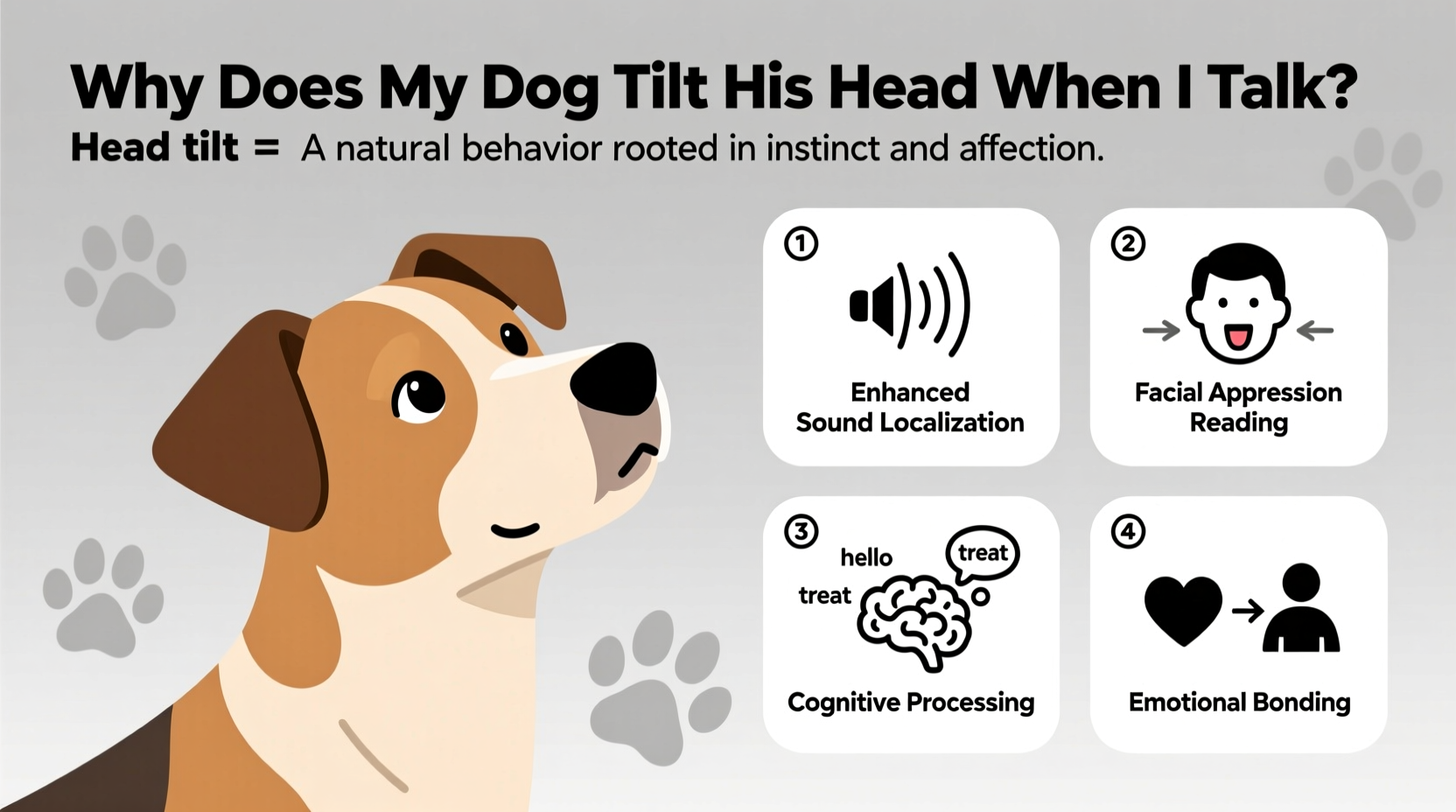
Dogs experience sound and sight differently than humans, and their physical structure plays a significant role in how they process auditory information. The shape of a dog’s skull, the length and density of their ear flaps (pinnae), and the positioning of their eyes all influence how they interpret what we say.
When a dog tilts its head, it subtly alters the position of its ears relative to the sound source. This small adjustment can help pinpoint where a sound is coming from by changing how sound waves enter the ear canal. For dogs with long, floppy ears—like Basset Hounds or Cocker Spaniels—the obstruction caused by ear tissue may require additional head movement to fully capture subtle frequencies.
Vision also contributes. A dog’s muzzle can partially block its line of sight, especially when looking up at a human face. Tilting the head shifts the angle, allowing better visibility of facial expressions, lip movements, and emotional cues. Since dogs rely heavily on visual signals during communication, this adjustment enhances their ability to “read” what you’re saying beyond just the words.
Cognitive Engagement: Listening for Familiar Words
Dogs don’t understand language the way humans do, but they are remarkably skilled at recognizing patterns. Research from Eötvös Loránd University in Hungary has shown that dogs process both the meaning and intonation of human speech using brain regions similar to those in humans. When your dog hears certain keywords—such as “walk,” “treat,” or “vet”—its brain activates in anticipation of action.
A head tilt may signal active listening. It’s a sign that your dog is concentrating, trying to extract meaningful information from your speech. Much like a person leaning forward during a conversation, the tilt reflects cognitive engagement. Over time, dogs learn which sounds predict outcomes, and they become finely tuned to the nuances of your voice.
This kind of focused attention is more common in intelligent, highly social breeds such as Border Collies, Poodles, and German Shepherds. However, even less vocal breeds exhibit this behavior when presented with novel or emotionally charged speech patterns.
“Dogs use multiple sensory inputs—auditory, visual, and contextual—to interpret human communication. The head tilt is often a deliberate effort to gather more data.” — Dr. Alexandra Horowitz, Canine Cognition Researcher, Barnard College
Emotional Connection and Social Reinforcement
Beyond physiology and cognition, there’s a strong social component to the head tilt. Dogs are acutely aware of human reactions, and behaviors that elicit positive responses tend to be repeated. If your dog has learned that tilting its head makes you smile, laugh, or offer affection, it may perform the gesture intentionally—even when not fully engaged.
This phenomenon is known as operant conditioning. A naturally occurring behavior (the head tilt) is reinforced by a reward (your attention), increasing its frequency. In some cases, dogs begin to associate the tilt with receiving treats or praise and will deploy it strategically, much like a child batting their eyelashes for ice cream.
Interestingly, studies suggest that dogs who live in highly interactive households—where verbal communication is frequent and expressive—are more likely to develop pronounced head-tilting habits. These dogs aren’t just reacting; they’re participating in a shared emotional dialogue.
Real Example: Max the Golden Retriever
Max, a three-year-old Golden Retriever from Portland, began tilting his head dramatically whenever his owner said the word “park.” Initially, it occurred spontaneously during walks. But after his owner started exclaiming, “You’re so smart!” each time Max reacted, the behavior intensified. Within weeks, Max would tilt his head at the mere mention of related words like “leash” or “outside,” even if he wasn’t looking directly at his owner. A veterinarian confirmed Max had normal hearing, suggesting the behavior had evolved into a socially reinforced communication tactic.
Medical Considerations: When a Head Tilt Isn’t Cute
While occasional head tilting is normal, persistent or uncontrolled tilting—especially when accompanied by other symptoms—can indicate an underlying health issue. Conditions affecting the vestibular system, which governs balance and spatial orientation, may cause a dog to hold its head at an abnormal angle.
Potential causes include:
- Ear infections: Otitis media or interna can disrupt balance and hearing.
- Poorly regulated ear wax buildup: Especially in breeds prone to narrow ear canals.
- Neurological disorders: Such as tumors, inflammation, or idiopathic vestibular disease.
- Toxic exposure: Certain medications or chemicals can damage inner ear structures.
In these cases, the tilt is usually constant rather than intermittent, and may be paired with circling, loss of coordination, nausea, or nystagmus (involuntary eye movement). Unlike the quick, responsive tilt seen during conversation, medical-related tilting tends to persist regardless of stimuli.
| Behavioral Head Tilt | Potential Medical Head Tilt |
|---|---|
| Occurs only during interaction | Present continuously, even at rest |
| Responsive to commands and sounds | Lack of response to familiar cues |
| No balance issues | Stumbling, falling, or circling |
| Normal appetite and energy | Loss of appetite, vomiting, lethargy |
| Intermittent and situational | Constant or worsening over time |
Step-by-Step: Assessing Your Dog’s Head-Tilting Behavior
If you’re curious whether your dog’s head tilts are purely communicative or potentially concerning, follow this simple assessment process:
- Observe the timing: Does the tilt occur only during speech or interaction? Or is it present throughout the day?
- Note the duration: Is it a brief, momentary movement, or does the head remain tilted for minutes at a time?
- Check for symmetry: Look at your dog’s face from the front. Are the eyes level? Is one ear held lower than the other?
- Test responsiveness: Call your dog’s name or use a known command from another room. Does it respond appropriately?
- Inspect the ears: Gently examine the outer ear for redness, odor, discharge, or excessive scratching.
- Monitor for secondary signs: Watch for stumbling, vomiting, changes in appetite, or reluctance to move.
- Document and consult: Keep a log of episodes and share it with your vet if abnormalities persist.
Frequently Asked Questions
Is head tilting a sign of intelligence in dogs?
Not directly. While intelligent dogs may be more attuned to human speech and thus more likely to tilt their heads in response, the gesture itself isn’t a measure of IQ. It’s more accurately a reflection of attentiveness and social learning.
Do all dogs tilt their heads, or is it breed-specific?
Most dogs are capable of head tilting, but it’s more commonly observed in breeds with high social engagement and expressive faces—such as Shetland Sheepdogs, Cavaliers, and Pomeranians. Brachycephalic breeds (like Bulldogs or Pugs) may tilt less due to facial structure, though individual variation is significant.
Can I train my dog to tilt its head on command?
Yes, using positive reinforcement. Hold a treat slightly above and behind your dog’s line of sight, prompting a natural upward turn. As the head moves, say a cue like “tilt” and reward. With repetition, many dogs learn to perform the gesture on command—though it’s important not to encourage excessive neck strain.
Actionable Checklist: Understanding and Responding to Head Tilts
- ✅ Observe when and how often your dog tilts its head
- ✅ Note whether it coincides with specific words or tones
- ✅ Avoid reinforcing the behavior excessively if it becomes obsessive
- ✅ Regularly clean your dog’s ears, especially if prone to infections
- ✅ Schedule a vet visit if the tilt becomes constant or asymmetric
- ✅ Use calm, clear speech to enhance your dog’s comprehension
- ✅ Reward understanding—not just cuteness—with treats and praise
“The head tilt is one of the clearest examples of dogs adapting their behavior to fit into human social worlds. It’s not just instinct—it’s adaptation.” — Dr. Brian Hare, Founder of the Duke Canine Cognition Center
Conclusion: More Than Just Cute—A Window Into Canine Mind
The next time your dog cocks its head in response to your voice, consider it a moment of connection—a silent question, a bid for understanding, or even a well-practiced charm offensive. Whether driven by anatomy, cognition, or social learning, the head tilt reveals how deeply dogs tune into our lives. They listen not just to our words, but to our emotions, rhythms, and intentions.
By paying attention to the context and consistency of this behavior, you gain insight into your dog’s health, perception, and personality. And while it’s tempting to adore the gesture for its charm alone, recognizing its deeper significance enriches the relationship you share.




 浙公网安备
33010002000092号
浙公网安备
33010002000092号 浙B2-20120091-4
Comments
No comments yet. Why don't you start the discussion?