
Dog owners often find themselves pausing mid-sentence, captivated by a sudden, curious movement: their dog tilting its head to the side as if listening more intently. This seemingly innocent gesture is one of the most endearing quirks in canine behavior—but it’s far from random. Behind that lopsided look lies a complex mix of sensory processing, emotional intelligence, and evolutionary adaptation. Understanding why dogs tilt their heads isn’t just about satisfying curiosity—it offers insight into how they perceive us, process sound, and communicate across species.
While popular culture treats the head tilt as pure charm, scientists and animal behaviorists have spent years decoding its purpose. From auditory adjustments to social manipulation, the reasons are both practical and profound. What may appear to be a simple trick for extra attention often serves deeper cognitive and physiological functions. By exploring the anatomy, psychology, and learned behaviors involved, we can better appreciate the intelligence and emotional depth our dogs bring to everyday interactions.
The Anatomy Behind the Tilt
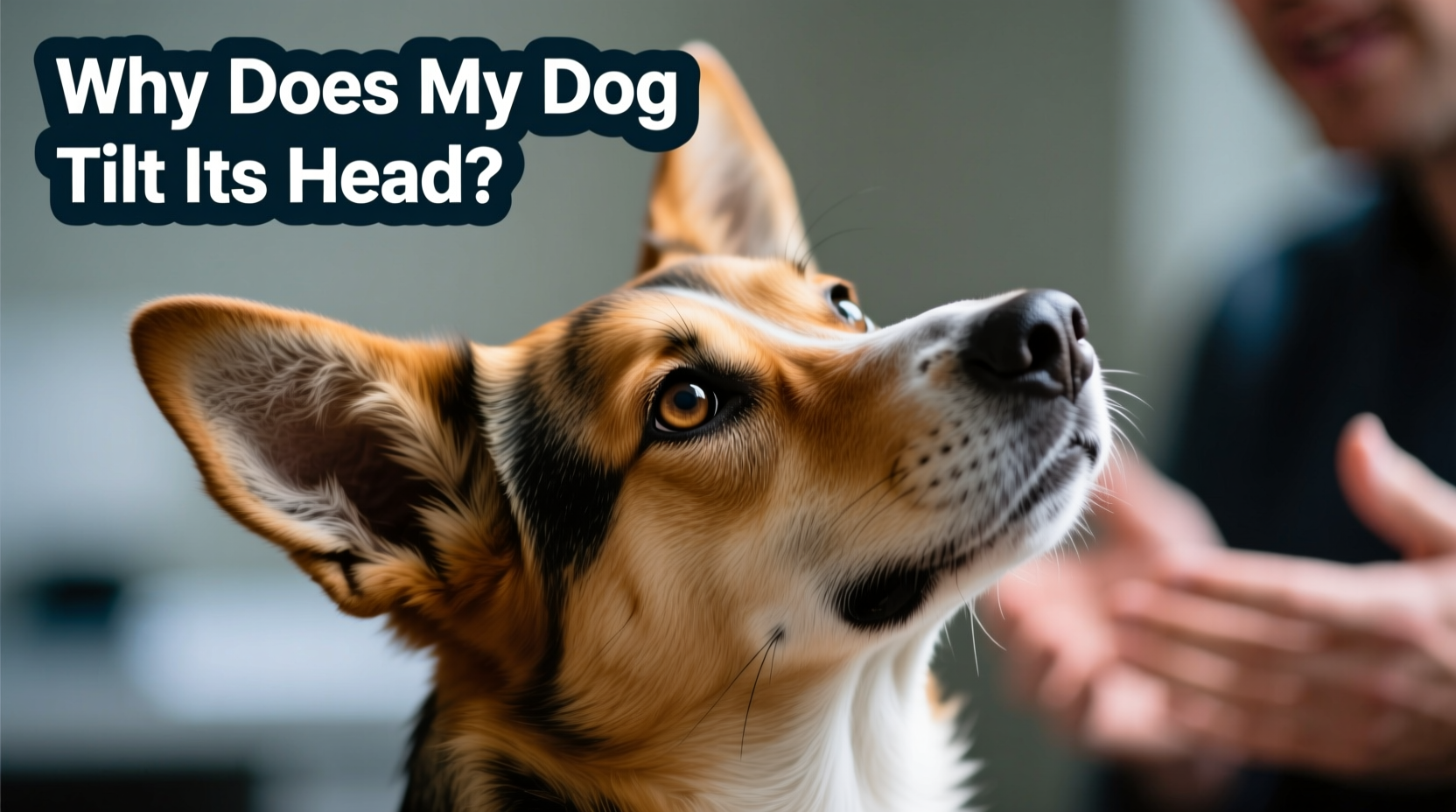
To understand the mechanics of head tilting, we must first examine the physical structure of a dog’s head and ears. Unlike humans, who rely heavily on visual cues, dogs are multisensory processors—especially attuned to sound and scent. Their ear shape, skull structure, and facial musculature all play roles in how they interpret auditory signals.
Dogs with long, floppy ears—such as Basset Hounds or Cocker Spaniels—are more likely to tilt their heads than breeds with erect ears like German Shepherds or Siberian Huskies. Why? Because drooping ears can partially obstruct sound waves entering the ear canal. A slight tilt helps reposition the ear flaps, improving sound localization. Think of it as adjusting a satellite dish for clearer reception.
Moreover, a dog’s muzzle length affects its field of vision. Breeds with longer snouts, such as Collies or Retrievers, may tilt their heads to shift their muzzles out of the way when trying to see your face clearly. This allows them to better read your expressions—a crucial component of interspecies communication.
Cognitive Processing and Sound Interpretation
When you speak, your dog doesn’t just hear noise; it listens for meaning. Research suggests that dogs can recognize up to 1,000 words and respond not only to vocabulary but also to tone, pitch, and rhythm. The head tilt may signal active cognitive engagement—your dog isn’t just hearing you, it’s analyzing what you’re saying.
A 2016 study conducted at Eötvös Loránd University in Hungary used MRI scans to show that dogs process familiar words in the left hemisphere of the brain, similar to humans. However, they rely more on intonation (how something is said) than semantics (what is said). When a word is spoken in a praising tone, even unfamiliar words activate reward centers in the brain. The head tilt might occur precisely at these moments—when the dog detects a meaningful pattern in speech and attempts to reconcile it with past experiences.
This mental effort requires concentration. Just as a person might cock their head while solving a puzzle, dogs may physically adjust their posture to aid auditory processing. It’s a sign of focused attention, not confusion.
“Dogs don’t just react to commands—they interpret emotional context. The head tilt is often part of a broader set of behaviors indicating deep listening.” — Dr. Brian Hare, Canine Cognition Expert, Duke University
Social Reinforcement and Learned Behavior
Not all head tilts are purely instinctive. Many dogs learn that this gesture elicits positive responses from humans—laughter, affection, treats. Over time, they may begin using it strategically to manipulate social outcomes.
Consider a scenario where a dog tilts its head after being asked, “Do you want a treat?” The owner responds with excitement, petting, and immediate reward. Through operant conditioning, the dog associates the head tilt with favorable consequences. Even in situations without food, the dog may repeat the motion hoping to trigger a similar reaction.
This form of behavioral shaping explains why some dogs become “professional” head-tilters, performing the move on cue. While rooted in genuine curiosity, the behavior becomes amplified through human encouragement. In essence, your dog has discovered an effective tool for emotional influence—and it works remarkably well.
Mini Case Study: Max the Manipulative Maltese
Max, a three-year-old Maltese, lives with a retired couple who adore his expressive nature. Every time one of them says, “Are you hungry?” or “Let’s go for a walk,” Max tilts his head sharply to the left, eyes wide. His owners laugh, call him “so smart,” and often reward him with a small snack—even if mealtime isn’t due.
Over several months, Max began tilting his head at unrelated phrases like “I need to vacuum” or “It’s raining.” There was no logical connection, yet he received pats and verbal praise each time. A behaviorist observed that Max had learned the head tilt as a general attention-getting strategy. When the owners were instructed to stop reinforcing the behavior unless accompanied by actual feeding cues, Max’s spontaneous tilting decreased by over 70% within two weeks.
This case illustrates how quickly dogs adapt socially intelligent behaviors based on feedback loops. The head tilt started as a natural response but evolved into a calculated social maneuver.
Emotional Intelligence and Bonding Signals
Beyond sound and sight, the head tilt plays a role in emotional bonding. Dogs are highly attuned to human emotions and often mirror our expressions and body language. A tilted head softens a dog’s appearance, making its eyes more visible and its expression appear more attentive and empathetic.
In evolutionary terms, features that resemble infantile traits—large eyes, rounded forehead, vulnerable posture—trigger caregiving instincts in humans. This phenomenon, known as *kindchenschema* or baby schema, makes the head tilt inherently appealing. Dogs may unconsciously use this to strengthen attachment and encourage nurturing behavior.
Furthermore, when a dog tilts its head while maintaining eye contact, it’s engaging in a non-threatening, affiliative gesture. It signals trust and openness—essentially saying, “I’m listening, and I care about what you’re saying.” This subtle act reinforces the human-dog bond, fostering mutual understanding and emotional synchrony.
Checklist: Is Your Dog’s Head Tilt Normal?
While occasional head tilting is typical, frequent or persistent tilting may indicate underlying issues. Use this checklist to assess whether further evaluation is needed:
- ✅ Occurs occasionally during conversation or when hearing new sounds – likely normal
- ✅ Paired with alert posture, wagging tail, and responsive behavior – healthy engagement
- ✅ Stops after a few seconds and returns to neutral position – expected pattern
- ⚠️ Happens constantly throughout the day, even when alone – potential concern
- ⚠️ Accompanied by loss of balance, circling, or disorientation – seek veterinary advice
- ⚠️ Shows signs of ear discharge, odor, or scratching – possible ear infection
- ⚠️ Tilts head in one direction only, persistently – could indicate neurological issue
Medical Considerations: When to Be Concerned
While most head tilts are harmless and even beneficial, chronic or abnormal tilting can point to medical conditions. One common cause is vestibular disease—a disorder affecting the inner ear and balance system. Symptoms include dizziness, stumbling, nausea, and a consistent head tilt toward one side.
Ear infections, especially in breeds prone to them, can also lead to discomfort and postural changes. Polyps, tumors, or inflammation in the middle or inner ear disrupt spatial orientation, prompting the dog to compensate with a tilt.
Less commonly, neurological disorders such as seizures, strokes, or brain lesions may manifest through prolonged head tilting. These cases usually involve additional symptoms like altered consciousness, muscle weakness, or behavioral changes.
If your dog suddenly develops a persistent head tilt—particularly if it lasts more than a few hours—it’s essential to consult a veterinarian. Early diagnosis improves treatment outcomes significantly.
Table: Common Causes of Head Tilting in Dogs
| Cause | Behavioral Signs | Action Required |
|---|---|---|
| Normal auditory focus | Intermittent tilt during speech or sounds; alert posture | None – natural behavior |
| Vestibular disease | Persistent tilt, loss of balance, rolling, vomiting | Veterinary consultation required |
| Ear infection | Head shaking, scratching, odor, redness in ears | Clinical examination and treatment |
| Learned attention-seeking | Tilts only around people, stops when ignored | Manage reinforcement patterns |
| Neurological condition | One-sided weakness, confusion, seizures | Immediate veterinary assessment |
Frequently Asked Questions
Is head tilting a sign of intelligence in dogs?
Not directly. While the head tilt often occurs during moments of concentration, it doesn’t measure intelligence. Instead, it reflects attentiveness and sensory processing. Intelligent dogs may tilt their heads more frequently because they’re actively interpreting complex cues, but the gesture itself isn’t an IQ indicator.
Do all dogs tilt their heads?
No—not all dogs exhibit this behavior regularly. Some breeds are more predisposed due to ear and muzzle structure. Others may simply lack the motivation if they haven’t been reinforced for the action. Shy or anxious dogs might avoid expressive movements altogether.
Can I train my dog to tilt its head on command?
Yes. Using positive reinforcement, you can shape the behavior. Hold a treat slightly above and to the side of your dog’s head, encouraging a natural tilt. Reward immediately. With consistency, your dog will associate the motion with a cue like “tilt.” However, avoid overuse, as repetitive neck strain should be prevented.
Conclusion: Listening Beyond the Surface
The next time your dog tilts its head while you speak, take a moment to reflect on the layers of perception happening beneath that adorable angle. It’s not merely a cute reflex—it’s a convergence of biology, cognition, and emotion. Your dog is fine-tuning its hearing, scanning your face for clues, and responding to the subtlest shifts in your voice. In doing so, it strengthens the unique bond that defines the human-canine relationship.
Understanding this behavior enriches our interactions and reminds us to listen as closely to our dogs as they do to us. Whether driven by curiosity, connection, or cleverness, the head tilt is a testament to the depth of canine awareness.




 浙公网安备
33010002000092号
浙公网安备
33010002000092号 浙B2-20120091-4
Comments
No comments yet. Why don't you start the discussion?