
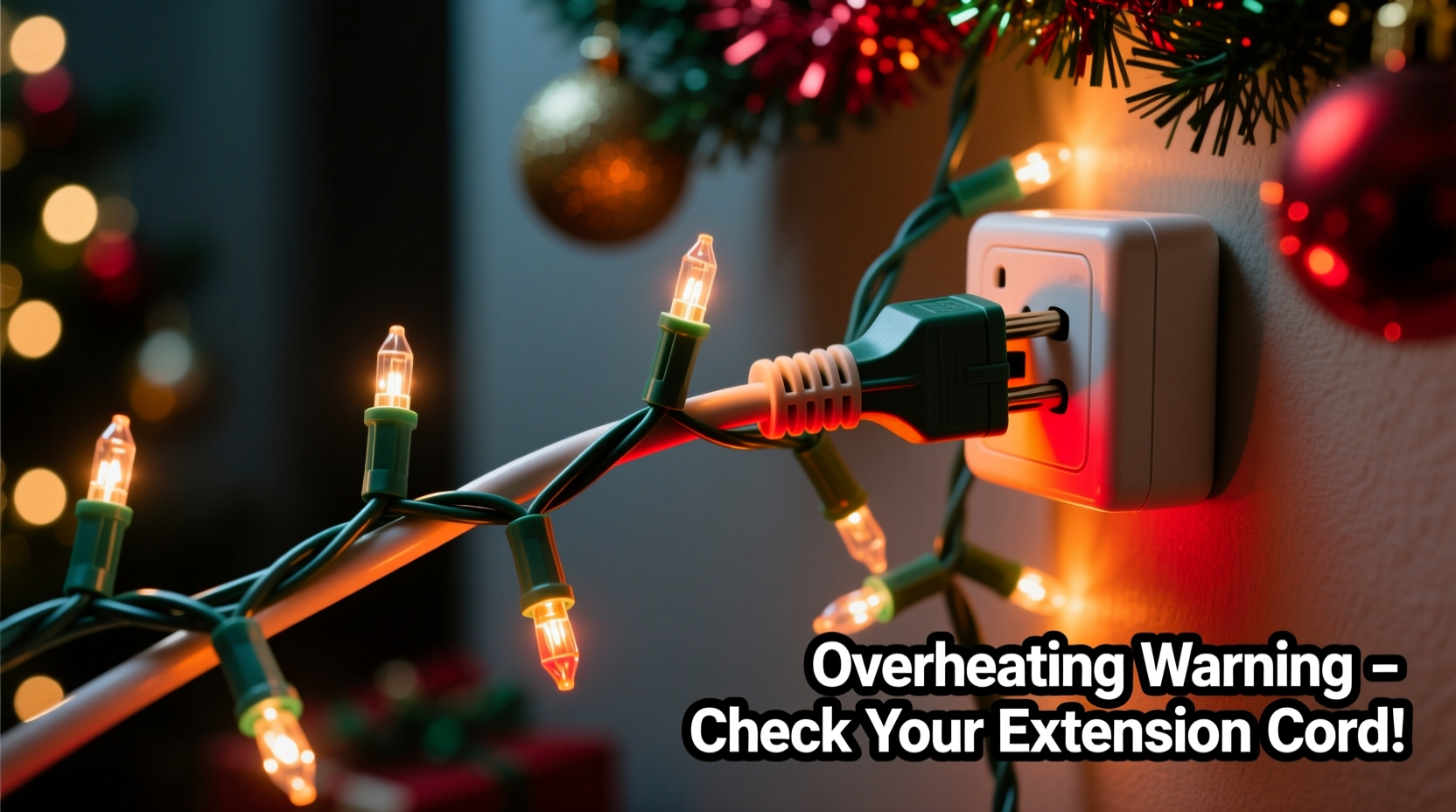
It’s a familiar holiday scene: strings of twinkling lights draped across the roofline, wrapped around railings, and glowing from porch eaves—powered by an extension cord snaking from the nearest outdoor outlet. Then you notice it: the cord feels noticeably warm to the touch. Not hot—just warm. Your first instinct might be to shrug it off as seasonal normalcy. But warmth in an extension cord isn’t just physics—it’s feedback. It’s your electrical system communicating load, resistance, and potential risk.
This isn’t about alarmism. It’s about understanding what “warm” really means—and distinguishing between benign thermal behavior and early warning signs of dangerous conditions. Every year, the U.S. Consumer Product Safety Commission estimates over 700 home fires are linked to decorative lighting, with improperly used or overloaded extension cords among the top contributing factors. Yet most of these incidents are preventable—not through guesswork, but through grounded knowledge of how electricity behaves under real-world holiday loads.
How Electricity Generates Heat in Extension Cords
When current flows through any conductor, energy is lost as heat due to electrical resistance—the natural opposition materials like copper or aluminum offer to electron movement. This phenomenon is described by Joule’s Law: P = I² × R, where power dissipated as heat (P) equals the square of the current (I) multiplied by the resistance (R) of the wire.
In practical terms, this means doubling the current quadruples the heat generated. A standard 16-gauge extension cord has higher resistance than a 12-gauge cord of the same length. So when you plug multiple light strands into a thinner or longer cord, resistance rises—and so does temperature.
Christmas lights compound this effect because they’re rarely used at their theoretical minimum load. Older incandescent mini-lights draw about 0.3–0.4 amps per 100-bulb string. A single 16-gauge 50-foot cord rated for 13 amps can safely handle up to 1,560 watts at 120 volts—roughly ten 150-watt strings. But add voltage drop over distance, aging outlets, or daisy-chained cords, and that margin evaporates quickly.
Five Common Causes of Cord Warming (and Which Ones Are Actually Dangerous)
Not all warmth is created equal. Here’s how to diagnose what’s happening:
- Excessive load beyond amp rating: The most frequent cause—and the most preventable. Plugging in more lights than the cord is rated for forces excess current, raising temperature exponentially.
- Using indoor-rated cords outdoors: Indoor cords lack UV-resistant jackets and moisture sealing. Cold weather stiffens insulation; dampness increases surface conductivity—all raising operating temperature and fire risk.
- Cord coiling or bundling during use: Trapping heat prevents natural dissipation. A tightly wound 50-foot cord running at 80% capacity can reach surface temps 15–20°F higher than the same cord laid flat.
- Voltage drop over long runs: For every 100 feet of 16-gauge wire at 12 amps, voltage drops ~4 volts. To maintain wattage, devices draw slightly more current—increasing resistive heating downstream.
- Aging or damaged cords: Frayed jackets, cracked insulation, corroded prongs, or internal strand breakage increase resistance at weak points—creating localized “hot spots” even at moderate loads.
The first three causes are often reversible with better habits. The last two—especially internal damage—are silent hazards. You can’t see corrosion inside a plug or broken strands beneath insulation. That’s why visual inspection alone isn’t enough.
Do’s and Don’ts: Safe Holiday Lighting Practices
| Action | Do | Don’t |
|---|---|---|
| Cord Selection | Use outdoor-rated, UL-listed cords marked “W-A” (weather-resistant) or “SJTW.” Choose 12- or 14-gauge for runs over 25 feet or high-wattage LED/mini-incandescent displays. | Use indoor-only cords (marked “SJT” or “SVT”) outside—even under awnings or covered porches. |
| Load Management | Calculate total wattage: Add labels on each light string (e.g., “4.8W” or “210W”). Keep total load ≤ 80% of cord’s rated capacity (e.g., max 1,440W on a 15A/120V circuit). | Daisy-chain more than one extension cord. Each connection adds resistance and potential failure points. |
| Placement & Ventilation | Lay cords flat and untangled. Elevate off wet ground using cord protectors or PVC standoffs. Avoid running under rugs or snow-covered walkways. | Wrap cords around trees, railings, or furniture legs—or tuck them into insulated enclosures while energized. |
| Inspection Routine | Test GFCI outlets before plugging in. Check plugs for warmth *before* connecting lights. Replace cords showing brittleness, cracking, or bent prongs. | Assume “it worked last year” means it’s safe this year. Insulation degrades 10–15% annually with UV exposure and thermal cycling. |
Real-World Scenario: The Overlooked Porch Display
Consider Mark, a homeowner in Portland who installed a modest display: 12 strands of vintage-style 100-bulb incandescent lights (210W each), plus two 60-watt LED icicle lights and a 300-watt animated reindeer. Total calculated load: 2,940 watts—well above the 1,800-watt limit of his 15-amp circuit. He used a single 100-foot, 16-gauge indoor-rated cord routed under his deck’s floorboards to reach the front porch.
By dusk, the cord near the outlet felt warm. By midnight, it was hot enough to smell insulation. He unplugged everything—only to discover the cord’s jacket had softened and warped near the male plug. A multimeter check revealed 2.3 ohms of resistance at that point (vs. 0.8 ohms for an undamaged section). That localized resistance spike converted nearly 50 watts into heat right at the plug—a known ignition point in fire investigations.
Mark’s mistake wasn’t negligence—it was information gap. He didn’t know his lights totaled nearly 25 amps across two circuits, nor that coiling the cord under decking trapped heat and accelerated insulation breakdown. After replacing the cord with a 12-gauge outdoor-rated version, shortening the run by 40 feet, and splitting loads across two GFCI outlets, surface temperatures dropped from 135°F to a safe 92°F.
Expert Insight: What Electrical Engineers Monitor in Real Time
“The ‘warm to the touch’ threshold isn’t arbitrary—it’s rooted in thermal aging curves for PVC and thermoplastic elastomer insulations. Sustained operation above 104°F (40°C) accelerates molecular breakdown by 2–3×. That’s why we specify derating factors: a 12-gauge cord rated for 20A indoors drops to 16A outdoors, and further to 12A in bundled or confined applications.”
— Dr. Lena Torres, P.E., Senior Electrical Engineer, National Fire Protection Association (NFPA) Code Development Group
Torres emphasizes that cord warmth isn’t just about immediate danger—it’s about cumulative degradation. Each hour above safe operating temperature permanently reduces dielectric strength and increases future failure probability. That’s why NFPA 101 (Life Safety Code) and NEC Article 400.5 require derating for ambient temperature, bundling, and installation method—not just wire gauge.
Step-by-Step: How to Audit Your Holiday Lighting Setup in Under 10 Minutes
- Identify your cord specs: Flip the cord over. Find the UL label listing gauge (e.g., “14 AWG”), amperage (e.g., “13A”), and rating (“Outdoor,” “W-A,” “SJTW”). If no label exists or it’s faded, assume it’s unsafe and replace it.
- Add up light wattages: Check tags on each string. For older incandescents, multiply bulb count × 0.5W (conservative estimate). For LEDs, use labeled wattage—typically 4–7W per 100 bulbs. Sum all strings on that cord.
- Calculate safe capacity: Multiply cord’s rated amps × 120V × 0.8 (80% safety factor). Example: 13A × 120V × 0.8 = 1,248W maximum safe load.
- Measure cord length & placement: Is it >50 feet? Coiled? Buried under mulch or snow? Any of these require stepping up one gauge size (e.g., 16 → 14 AWG) or splitting loads.
- Perform the hand test: With lights on for 15 minutes, gently feel the cord along its entire length—especially near plugs and splices. If any section is significantly warmer, unplug immediately and investigate.
- Verify outlet protection: Press “TEST” on your GFCI outlet. It should trip instantly. Press “RESET.” If it doesn’t reset or trips repeatedly, call an electrician—do not proceed.
FAQ: Your Top Questions Answered
Is it ever safe for an extension cord to get hot?
No—“hot” is never safe. Mild warmth (up to 95°F / 35°C) may occur under full-rated load with proper ventilation, but anything approaching 110°F (43°C) or higher indicates excessive resistance, overload, or damage. Heat is a symptom—not a feature.
Can LED lights eliminate cord warming?
LEDs reduce *absolute* heat generation (using ~85% less power than equivalent incandescents), but they don’t eliminate thermal risk. A 100-string LED set drawing 4.8W still contributes to cumulative load. More critically, many consumers replace incandescent strings with LEDs *without upgrading cords*, assuming lower wattage means safety—ignoring that old 16-gauge cords may be brittle, corroded, or undersized for modern high-density LED controllers.
Why do some cords warm only near the plug?
That’s almost always a sign of poor contact resistance—caused by bent, corroded, or loose prongs; worn receptacle contacts; or oxidation on aluminum conductors. This creates a high-resistance junction where heat concentrates. It’s the leading cause of outlet-related fires in holiday lighting incidents. Replace both cord and outlet if this occurs.
Conclusion: Warmth Is Information—Not Inconvenience
Your extension cord warming up isn’t a quirk of the season. It’s measurable, predictable, and deeply instructive. It tells you whether your setup respects the physical limits of copper, insulation, and circuit design. It reflects choices you’ve made—about cord quality, load distribution, environmental exposure, and maintenance discipline. And most importantly, it offers a chance to intervene before physics escalates from warmth to wire failure.
This holiday season, treat warmth like data—not background noise. Spend five minutes auditing your cords. Swap out that faded 16-gauge relic for a properly rated outdoor cord. Uncoil what’s bundled. Split loads across circuits. Test your GFCIs. These aren’t chores. They’re acts of care—for your home, your family, and the quiet magic of lights glowing safely against the winter dark.




 浙公网安备
33010002000092号
浙公网安备
33010002000092号 浙B2-20120091-4
Comments
No comments yet. Why don't you start the discussion?