
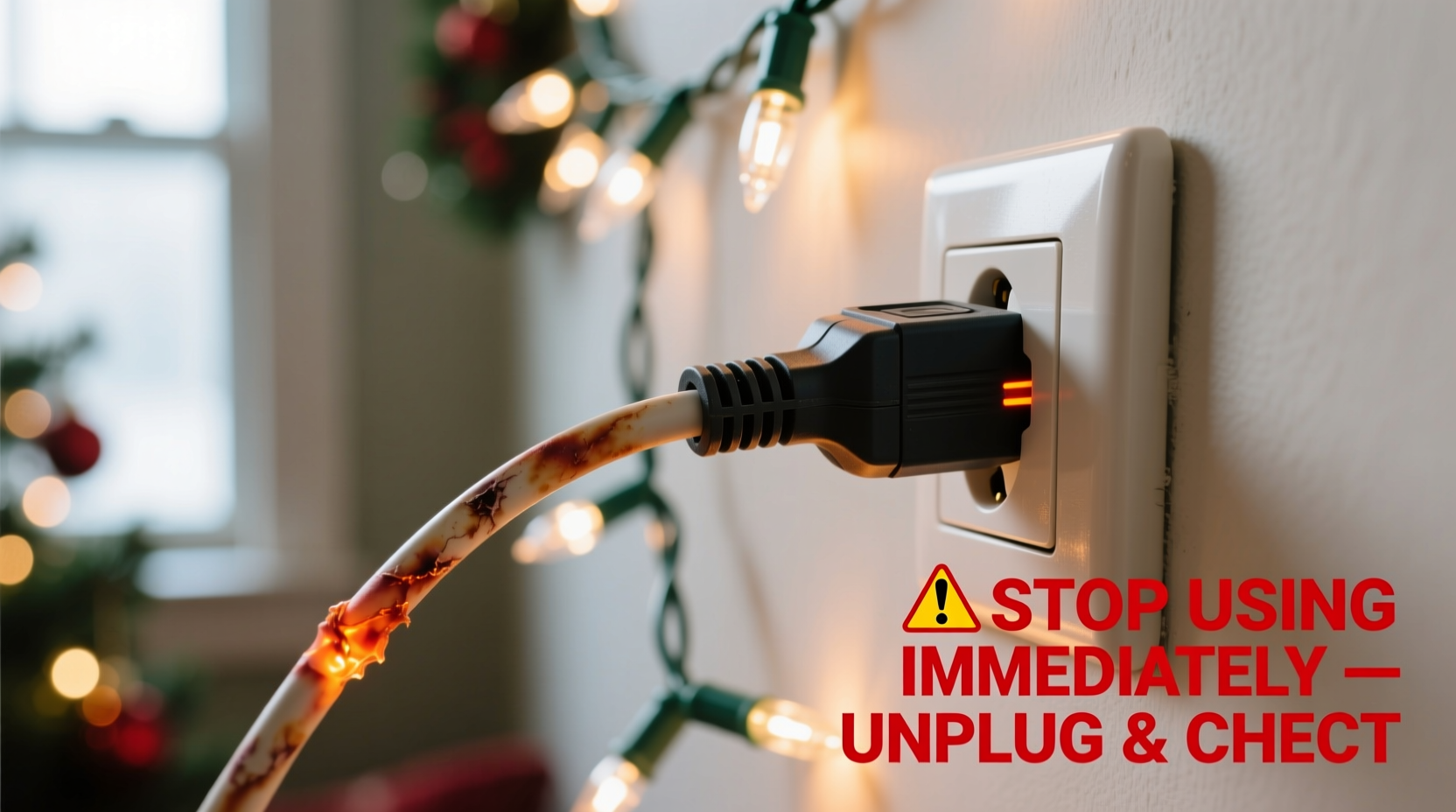
A warm extension cord isn’t just inconvenient—it’s a red flag. When you plug in your holiday string lights and feel warmth radiating from the cord near the outlet, along its length, or especially at the plug or receptacle end, your electrical system is signaling stress. This isn’t normal operation. It’s physics warning you: resistance is generating heat where it shouldn’t—and that heat can escalate rapidly into melted insulation, arcing, or even ignition. Unlike appliances designed for continuous load, most extension cords are temporary-use tools with strict current limits. Yet millions of households overload them every December without realizing the cumulative risk. This article explains precisely why heating occurs—not as theory, but through real-world electrical behavior—and gives you clear, prioritized steps to take *within the next 60 seconds*, followed by deeper diagnostics and long-term prevention. No speculation. No vague advice. Just grounded, code-informed, electrician-vetted guidance.
Why Heating Happens: The Physics Behind the Warmth
Extension cords heat up due to resistive (Joule) heating—a direct consequence of electrical resistance converting energy into heat. Every conductor—even copper—has inherent resistance. When current flows, power dissipation follows the formula P = I² × R, where P is power (in watts), I is current (in amps), and R is resistance (in ohms). Crucially, heat generation rises with the *square* of current. Double the amperage, and heat quadruples.
Christmas light strings compound this effect. A single 100-light incandescent set draws ~0.3–0.5 amps; LED versions draw ~0.02–0.04 amps. But homeowners rarely use one set. They daisy-chain five, ten, or more—often mixing old incandescent strands with newer LEDs on the same circuit and cord. Add in mini-trees, inflatable yard displays, and animated lawn figures, and total load easily exceeds 10–15 amps. Meanwhile, many users deploy lightweight, 16-gauge indoor-rated cords—rated for only 10 amps *at best*, and only when fully unwound and in cool ambient air. In practice, coiled cords trap heat, raising operating temperature by 20–40°F, further increasing resistance and creating a dangerous feedback loop.
Other contributing factors include:
- Poor connections: Corroded, bent, or loose prongs increase contact resistance—creating localized hot spots, often at the plug or outlet.
- Undersized wire gauge: A 16-gauge cord cannot safely carry the same current as a 14- or 12-gauge cord. Gauge number decreases as thickness increases—so 12 AWG is thicker and safer than 16 AWG.
- Overheated outlets: Older homes with worn receptacles or aluminum wiring may have higher-than-normal contact resistance, turning the outlet itself into a heat source that transfers to the cord.
- Environmental stress: Cords run under rugs, pinned behind furniture, or exposed to rain/snow accelerate degradation and impede heat dissipation.
“Any noticeable warmth in an extension cord under load means it’s operating outside its safe thermal envelope. That’s not ‘a little warm’—it’s the first stage of insulation breakdown.” — James L. Rivera, Master Electrician & NFPA 70E Compliance Trainer, 28 years field experience
Immediate Actions: What to Do in the Next 60 Seconds
If you detect warmth—especially if it’s accompanied by a burning smell, discoloration, buzzing, or flickering lights—act decisively. Delaying risks escalation. Follow this sequence without skipping steps:
- Unplug the cord at the wall outlet immediately. Do not yank the cord or pull by the wires. Grip the plug firmly and disconnect it straight out.
- Leave the cord undisturbed for at least 15 minutes. Let it cool completely before handling. Do not wrap it, coil it, or place anything over it during cooling.
- Inspect the plug, cord jacket, and outlet visually. Look for melting, bubbling, charring, cracked insulation, or discoloration (yellowing or browning). Check the outlet faceplate for scorch marks or warping.
- Test the outlet with a different, known-good device (e.g., a lamp). If the lamp doesn’t turn on—or behaves erratically—the issue may be the outlet or circuit breaker, not the cord.
- Label the cord “DO NOT USE” and isolate it. Place it aside in a dry, open area away from flammable materials until you’ve completed full diagnostics.
Diagnostic Checklist: Is Your Setup Safe?
After cooling and initial inspection, use this checklist to assess risk level. Answer “Yes” to any item below? Your setup requires correction before reuse.
- ✅ Cord is coiled or bundled while in use
- ✅ Cord is rated “Indoor Use Only” but used outdoors (even under eaves)
- ✅ Total connected load exceeds cord’s amp rating (check label on cord end or packaging)
- ✅ More than three light strings are daisy-chained together
- ✅ Plug feels warm *after* unplugging (indicates residual heat buildup)
- ✅ Outlet feels warm to the touch or shows discoloration around screw terminals
- ✅ You’re using an older cord with cracked, stiff, or brittle insulation
- ✅ Lights flicker or dim when other appliances (refrigerator, microwave) cycle on
If two or more items apply, assume the cord is compromised and replace it. Do not attempt repair—cord splicing violates NEC Article 400.7 and creates a Class 1 hazardous location.
Safe Load Capacity: Matching Cords to Your Light Load
The most common error is assuming “if it plugs in, it’s fine.” It’s not. Ampacity depends on wire gauge, length, and ambient temperature. Below is a practical reference table for standard UL-listed cords used with seasonal lighting:
| AWG Gauge | Max Length (for safety) | Max Continuous Load (Amps) | Typical Use Case | Risk if Overloaded |
|---|---|---|---|---|
| 16 AWG | ≤ 50 ft | 10 A | Small indoor tree (3–5 LED sets) | Insulation softens at 60°C; melts at 90°C. Fire risk within 8–12 min at 13 A. |
| 14 AWG | ≤ 100 ft | 15 A | Medium outdoor display (8–12 LED sets + 1 inflatable) | Noticeable warmth at 16 A; sustained >17 A causes irreversible copper annealing. |
| 12 AWG | ≤ 150 ft | 20 A | Large residential display (20+ LED sets, multiple controllers, roof line) | Designed for heavy-duty use—but still requires GFCI protection outdoors. |
| 10 AWG | ≤ 200 ft | 30 A | Commercial-grade installations or multi-outlet power distribution | Overkill for home use; expensive and inflexible unless powering >5 kW. |
Note: These ratings assume the cord is fully unwound, in open air, at 77°F (25°C). For every 10°F above ambient, ampacity drops ~5%. In a garage at 95°F? A 14 AWG cord’s safe load drops from 15 A to ~13.5 A. Also, never exceed 80% of breaker rating on a circuit: a 15-amp breaker supports only 12 amps continuous load per NEC 210.20(A).
Real-World Example: The Garage Outlet Incident
In December 2023, a homeowner in Portland, Oregon, plugged six 100-light incandescent strands (totaling ~2.4 amps per set) into a single 16 AWG indoor cord. The cord ran 25 feet across his garage floor, then up a ladder to the roofline—coiled twice near the outlet to “keep it tidy.” After four hours, he noticed a sharp odor. He unplugged it—just as smoke began curling from the plug’s base. Inspection revealed the plug’s brass contacts had fused slightly, the cord’s PVC jacket was blistered at the strain relief, and the outlet’s brass screw terminal showed pitting and carbon tracking. An electrician confirmed the outlet had 18 Ω contact resistance (vs. ideal <0.1 Ω)—caused by decades of thermal cycling and corrosion. The cord wasn’t faulty; it was catastrophically overloaded in a way that masked the true root cause: degraded infrastructure. He replaced the outlet, installed a new 14 AWG outdoor-rated cord (fully unwound), and switched all lights to certified UL 2108 LED sets. His total load dropped from 14.4 amps to 1.1 amps. No more heat. No more risk.
Long-Term Prevention Strategies
Preventing heat starts before the first bulb is hung. Implement these practices annually:
- Use dedicated circuits for high-load displays. Run a temporary 20-amp circuit from your panel (with GFCI/AFCI breaker) to a weatherproof outlet near your display zone. Avoid sharing with refrigerators, sump pumps, or HVAC systems.
- Calculate load *before* plugging in. Add up wattage of every device. Divide total watts by voltage (120 V) to get amps. Compare to cord and circuit ratings. Example: 1,440 W ÷ 120 V = 12 A → requires 14 AWG cord minimum on a 15-amp circuit.
- Go LED—and verify certification. Choose only UL 2108–listed LED lights. Avoid dollar-store or uncertified imports; their drivers often lack overcurrent protection and leak DC onto AC lines, stressing cords.
- Install smart power strips with auto-shutoff. Units like the Belkin Conserve Socket cut power after 30 minutes of inactivity—preventing overnight overheating if timers fail.
- Perform annual cord maintenance. Clean plug blades with isopropyl alcohol and a soft cloth. Check for nicks, kinks, or stiffness. Store flat, not coiled, in climate-controlled space.
FAQ
Can I fix a warm cord by cutting off the plug and replacing it?
No. Replacing the plug does not address internal conductor damage, insulation degradation, or increased resistance along the wire length. UL 817 prohibits field modification of extension cords. A cord that has overheated once is permanently compromised and must be discarded.
Is it safe to use a power strip instead of an extension cord?
Only if the power strip is specifically rated for outdoor/seasonal use (UL 1363 or UL 1449), has built-in circuit breakers, and is plugged directly into a GFCI-protected outlet—not into another extension cord. Daisy-chaining power strips multiplies failure points and voids UL listing.
My cord is cool, but the outlet is hot. What should I do?
Turn off the circuit breaker immediately. A hot outlet indicates high-resistance connections—often caused by loose terminal screws, corroded contacts, or aluminum-to-copper incompatibility. This is an urgent electrician call. Do not reset the breaker until inspected. Arcing at outlets causes ~25,000 U.S. home fires annually (NFPA 2023).
Conclusion
A warm extension cord isn’t a minor quirk of the season—it’s your home’s electrical system sounding an alarm. Ignoring it trades short-term convenience for measurable, preventable risk: property loss, injury, or worse. The good news? Every cause of heating is identifiable, correctable, and avoidable with disciplined habits and informed choices. Start tonight: unplug that warm cord, inspect it honestly, calculate your actual load, and choose the right tool for the job—not the one that fits in your storage bin. Replace outdated cords with properly rated, outdoor-certified models. Audit your outlets. Switch to certified LED lighting. And most importantly—treat electricity with the respect it demands, not the casualness holiday excitement invites. Your peace of mind, your family’s safety, and your home’s integrity depend on decisions made now, not after the first wisp of smoke appears.




 浙公网安备
33010002000092号
浙公网安备
33010002000092号 浙B2-20120091-4
Comments
No comments yet. Why don't you start the discussion?