
Finding your foundation streaking, pilling, or fading by midday can be frustrating—especially when you spent time applying it perfectly in the morning. Separation doesn’t just ruin your look; it signals deeper issues in your skincare, prep routine, or product choices. The good news? Most causes are fixable with the right approach. Understanding why foundation breaks down throughout the day is the first step toward achieving a flawless, long-lasting complexion.
Understanding Foundation Separation
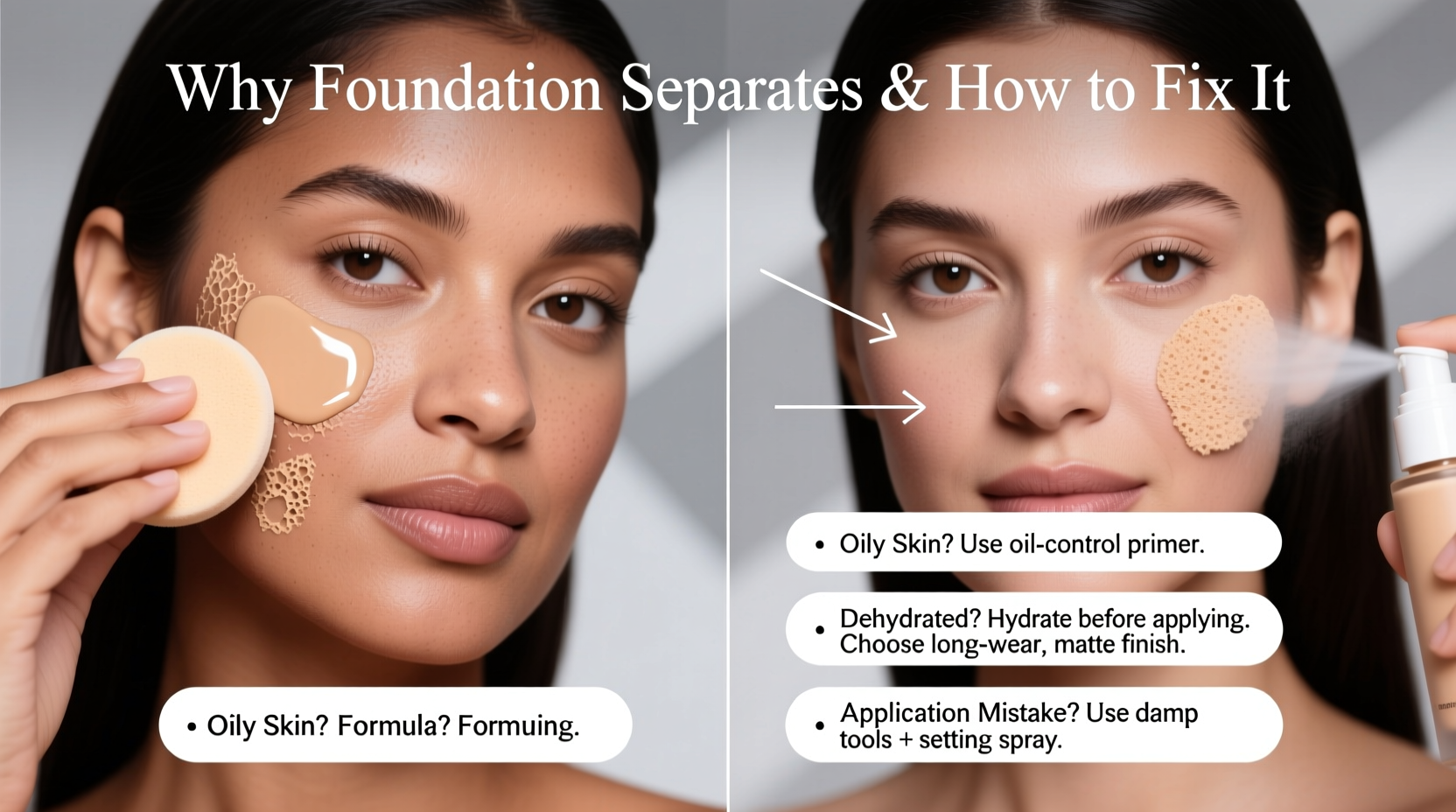
Foundation separation refers to the breakdown of your makeup into visible patches, streaks, or oily areas. It may appear as:
- White or grayish streaks (often called “pilling”)
- Cracking or caking around dry zones
- Shiny patches where oil breaks through
- Inconsistent texture or color shifts
This issue isn't exclusive to any skin type. Whether you're oily, dry, combination, or sensitive, separation can occur due to mismatched products, poor prep, or environmental factors. The key is identifying which factor affects you most and adjusting accordingly.
The Role of Skin Type and Condition
Your skin’s natural behavior plays a major role in how foundation holds up. For example:
- Dry skin lacks moisture, causing foundation to cling to flaky patches and crack.
- Oily skin produces sebum that pushes foundation off the skin over time, especially in T-zone areas.
- Combination skin presents both challenges: dryness in some areas, oiliness in others.
- Sensitive or reactive skin may react poorly to certain ingredients, triggering inflammation or uneven texture.
If your skin barrier is compromised—due to over-exfoliation, harsh products, or dehydration—it becomes less receptive to makeup, increasing the risk of separation.
Common Causes of Foundation Separation
Several interrelated factors contribute to foundation breakdown. Identifying them helps pinpoint the right solution.
1. Incompatible Skincare and Makeup Products
Layering products with conflicting formulations—especially silicones, oils, and water-based serums—can cause repulsion. For instance, applying a silicone-heavy primer under a water-based foundation might lead to pilling because the layers don’t bond properly.
“Mixing too many incompatible ingredients creates a ‘chemical resistance’ effect, where products literally slide off each other.” — Dr. Lena Torres, Cosmetic Chemist
2. Insufficient Skincare Prep
Rushing your skincare routine leads to poor makeup adherence. Skipping moisturizer leaves dry skin prone to flaking. Over-moisturizing or using heavy creams without enough absorption time creates a slippery base.
3. Overlapping Actives and Exfoliants
Using retinoids, AHAs, or vitamin C too close to makeup application can destabilize the skin surface. These ingredients increase cell turnover but may leave behind loose flakes that mix with foundation, causing pilling.
4. Incorrect Foundation Formula for Your Skin Type
A dewy foundation on oily skin will likely slide off by noon. Conversely, a matte, full-coverage formula on dry skin can emphasize texture and crack. Matching your foundation to your skin’s needs is non-negotiable.
5. Application Technique and Tools
Applying too much product, using dirty brushes, or layering without proper blending stresses the skin and increases friction. Buffing foundation aggressively can lift dead skin cells, mixing them into your makeup.
6. Environmental and Lifestyle Factors
Humidity, pollution, sweat, and frequent mask-wearing all contribute to breakdown. High heat softens makeup, while constant friction from masks pulls product away from the skin.
Proven Fixes and Preventative Strategies
Once you understand the root causes, correcting foundation separation becomes a matter of refinement—not reinvention. Implement these evidence-backed strategies to improve longevity and wearability.
Step-by-Step Guide: Building a Stable Base
- Cleanse gently: Use a mild, pH-balanced cleanser to remove impurities without stripping natural oils.
- Exfoliate wisely: Limit chemical exfoliation to 2–3 times per week, preferably at night. Avoid physical scrubs before makeup.
- Hydrate deeply: Apply a lightweight hydrating serum (with hyaluronic acid) followed by a moisturizer suited to your skin type.
- Wait before proceeding: Allow at least 5 minutes for skincare to absorb fully. This prevents mixing and slippage.
- Prime strategically: Choose a primer that addresses your main concern—pore-blurring, mattifying, or hydrating—but avoid overloading.
- Apply foundation correctly: Use a damp sponge for sheer-to-medium coverage or a dense brush for full coverage. Work in thin layers.
- Set with care: Use a translucent powder only in areas prone to oiliness. Avoid heavy dusting on dry zones.
Choosing Compatible Products: The Layering Rule
To prevent ingredient conflict, follow the “thinnest to thickest” rule:
- Water-based serums (e.g., vitamin C, hyaluronic acid)
- Gel or light lotions
- Creams and balms
- Sunscreen (wait 3 minutes before next step)
- Makeup (foundation, concealer)
Avoid mixing high concentrations of silicones (dimethicone, cyclopentasiloxane) with heavy oils unless specifically formulated to work together.
Product Compatibility Checklist
Use this checklist before building your routine:
- ✅ Are all skincare products fully absorbed before makeup?
- ✅ Is my moisturizer non-greasy and appropriate for my skin type?
- ✅ Does my primer match my foundation’s base (silicone, water, oil)?
- ✅ Am I using minimal amounts of each product?
- ✅ Have I cleaned my brushes and sponges recently?
- ✅ Is my foundation expired? (Most last 6–12 months after opening)
- ✅ Am I applying sunscreen early enough in the routine?
Do’s and Don’ts: Foundation Longevity Table
| Do | Don't |
|---|---|
| Use a hydrating mist to refresh makeup midday | Touch up with more foundation without blotting oil first |
| Blot excess oil with tissue paper before reapplying | Layer multiple thick products without waiting |
| Choose fragrance-free, non-comedogenic formulas | Mix too many active ingredients before makeup |
| Store foundation in a cool, dry place away from sunlight | Share makeup tools to avoid bacterial buildup |
| Replace beauty sponges every 4–6 weeks | Apply foundation immediately after using retinol |
Real-Life Example: From Breakdown to All-Day Wear
Sophia, a 32-year-old office worker with combination skin, struggled with her foundation separating by 1 PM. Her routine included a glycolic acid toner in the morning, followed by a rich cream, then a silicone-based primer and liquid foundation. She noticed white streaks forming around her nose and chin.
After consulting a dermatologist, she adjusted her routine:
- Switched her morning exfoliant to a gentler lactic acid serum used only three times a week.
- Replaced her heavy cream with a gel-cream hybrid.
- Allowed 7 minutes between skincare and makeup.
- Changed to a water-based primer compatible with her new foundation.
Within a week, her foundation stayed intact until evening. The pilling disappeared, and her skin looked smoother overall. The change wasn’t about buying expensive products—it was about compatibility and timing.
Frequently Asked Questions
Why does my foundation pill when I apply sunscreen?
This typically happens when either product contains high levels of silicones or emollients that don’t absorb quickly. To prevent pilling, let your moisturizer absorb completely, apply sunscreen in a thin layer, and wait 3–5 minutes before foundation. Alternatively, use a mineral-based sunscreen with a lighter texture.
Can drinking more water help my foundation last longer?
Indirectly, yes. Well-hydrated skin maintains a stronger barrier and appears plumper, allowing makeup to sit evenly. While drinking water alone won’t stop separation, it supports overall skin health, especially when paired with topical hydration.
Is setting spray really necessary?
For most people, yes. A quality setting spray locks in layers, reduces oxidation, and enhances blendability. Look for formulas with humectants (like glycerin) for dry skin or mattifying agents (like silica) for oily complexions. Spray from 8–10 inches away in an “X” and “T” motion for even coverage.
Expert Insight: The Science Behind Makeup Longevity
“Makeup performance starts long before the first drop of foundation. It’s built on a stable, well-balanced skin barrier. If your skin is dehydrated or irritated, no amount of high-end makeup will stay put.” — Dr. Anita Patel, Board-Certified Dermatologist
Dr. Patel emphasizes that modern foundations are engineered to last, but they require cooperation from the skin underneath. She recommends a minimalist morning routine focused on hydration and protection, reserving actives like retinoids and acids for nighttime use.
Conclusion: Achieve Flawless, Long-Lasting Coverage
Foundation separation isn’t inevitable—it’s a signal that something in your routine needs adjustment. Whether it’s incompatible products, rushed prep, or environmental stressors, the solutions are within reach. By refining your skincare-makeup synergy, choosing compatible formulas, and applying with precision, you can enjoy smooth, even coverage from morning to night.
Start small: audit one step of your routine today. Replace a single product, adjust your wait time, or clean your tools. Consistent, mindful changes lead to dramatic improvements in how your foundation performs. Beauty isn’t just about appearance—it’s about understanding your skin and working with it, not against it.




 浙公网安备
33010002000092号
浙公网安备
33010002000092号 浙B2-20120091-4
Comments
No comments yet. Why don't you start the discussion?