
Flickering LED Christmas lights aren’t just annoying—they’re a signal. Unlike incandescent bulbs that glow steadily even with minor voltage dips, LEDs respond instantly to electrical inconsistencies. That rapid on-off pulse you see isn’t random; it’s diagnostic. Most flickering stems from one or more identifiable causes: incompatible dimmers, overloaded circuits, aging power supplies, poor connections, or design-level flaws in low-cost strings. The good news? Over 90% of cases are resolvable without replacing the entire set—often with tools you already own and under ten minutes of hands-on troubleshooting.
Why LED Lights Flicker: The Core Electrical Causes
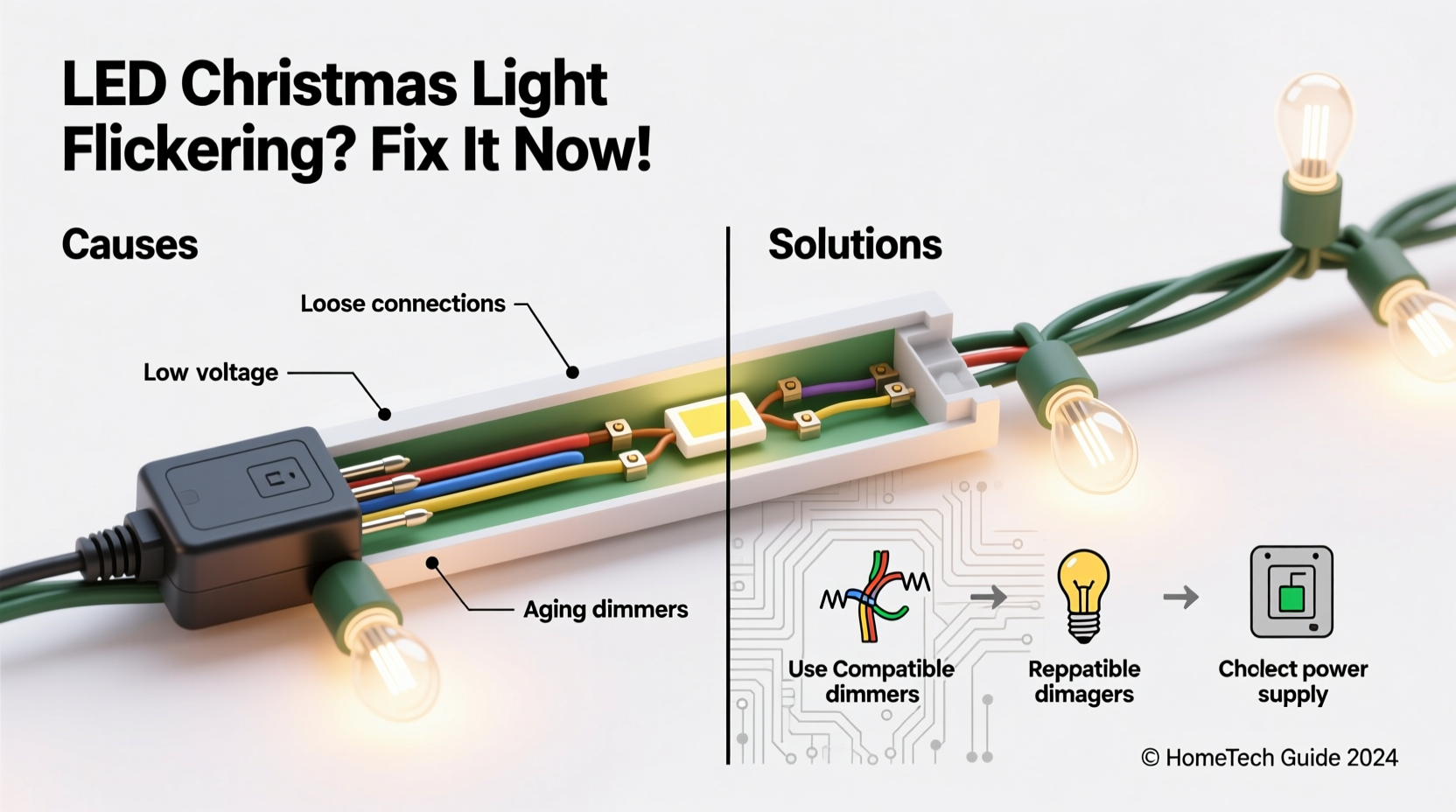
LEDs require direct current (DC) at low voltage—typically 5V, 12V, or 24V—while household outlets supply alternating current (AC) at 120V (in North America) or 230V (in Europe). Every LED string contains a built-in AC-to-DC converter (often called a “driver” or “rectifier”). Flickering occurs when that conversion process breaks down or becomes unstable. Here’s what actually triggers it:
- Voltage instability: Fluctuations in household voltage—especially during peak holiday usage (e.g., when refrigerators cycle or space heaters kick on)—can overwhelm cheap drivers.
- PWM dimming mismatch: Many modern LED strings use Pulse Width Modulation (PWM) to simulate dimming. If the PWM frequency falls below 100 Hz—or interferes with your home’s wiring or smart switch firmware—it becomes visible as flicker.
- Capacitor degradation: Electrolytic capacitors inside the plug pack smooth out DC output. After 2–3 seasons, these dry out, losing capacitance and allowing AC ripple to leak into the LED circuit.
- Series-wiring vulnerability: Most mini-light strings wire LEDs in series. One failed LED (or corroded solder joint) interrupts current flow, causing intermittent blinking or full-string flicker—especially when wires flex or temperatures change.
- Ground loop interference: When multiple light strings plug into different outlets on separate circuits—or connect to grounded devices like smart speakers or outdoor cameras—they can create subtle voltage differences that induce flicker.
This isn’t “normal wear.” It’s preventable—and often reversible.
Step-by-Step Troubleshooting & Fix Guide
Don’t guess. Follow this field-tested sequence. Each step isolates a variable and takes under two minutes. Start here before buying replacements.
- Unplug everything. Turn off the outlet at the breaker if possible—safety first.
- Test the outlet alone. Plug in a lamp or phone charger. If it flickers or dims, the issue is upstream: overloaded circuit, loose neutral connection at the panel, or utility-side voltage fluctuation. Call an electrician if confirmed.
- Plug in only one light string—directly into the outlet. Bypass all extension cords, power strips, and timers. If it stops flickering, the culprit is downstream: cord resistance, strip overload, or timer incompatibility.
- Inspect the plug and first 12 inches of wire. Look for cracks, heat discoloration, or bent prongs. Gently wiggle the plug while powered (with caution). If flickering starts/stops, replace the plug or entire string—this is a fire risk.
- Check for “dead” LEDs. In series-wired sets, locate dark bulbs. Use a non-contact voltage tester near each bulb socket—if voltage disappears after a certain point, that bulb or its shunt is open. Replace only with manufacturer-specified LEDs (not generic ones).
- Swap the controller/dimmer. If using a smart plug, remote dimmer, or app-controlled hub, bypass it completely. Plug directly into wall. If flicker stops, the device is incompatible—see “Dimmer Compatibility” section below.
Dimmer & Smart Device Compatibility: What Actually Works
Most LED Christmas lights are sold as “dimmable”—but dimmability depends entirely on the driver’s design and the dimmer’s waveform. Traditional triac-based dimmers (designed for 60W+ incandescent loads) often cause severe flicker or buzzing in low-wattage LED strings. Here’s what to use—and avoid:
| Device Type | Compatible? | Why / Notes |
|---|---|---|
| Standard Triac Dimmer (e.g., Lutron Diva) | No | Cannot maintain minimum load; causes erratic cutoff and visible flicker below 25% brightness. |
| ELV (Electronic Low-Voltage) Dimmer | Yes — with caveats | Must match driver specs. Only works reliably with constant-voltage (not constant-current) LED strings rated for ELV dimming. |
| Smart Plug (e.g., TP-Link Kasa, Wemo) | Yes — but only for ON/OFF | Do not use for dimming. These are simple relays—safe for switching, unsafe for partial power delivery. |
| Dedicated LED Light Controller (e.g., Twinkly, Lumenplay) | Yes | Engineered for PWM frequency >1,000 Hz—far above human perception threshold. Includes auto-calibration for voltage drift. |
| Universal Remote Dimmer (e.g., Philips Hue Dimmer Switch) | No | Lacks load sensing; sends inconsistent signals to low-power drivers. Causes stuttering or complete dropout. |
If you must dim, invest in a controller designed for decorative lighting—not general-purpose home automation hardware. As lighting engineer Dr. Lena Park explains:
“Flicker isn’t a ‘feature’—it’s a failure mode. Cheap drivers skip thermal management, underspecify capacitors, and omit EMI filtering. You’re not seeing ‘LED behavior.’ You’re seeing cost-cutting made visible.” — Dr. Lena Park, Senior Electrical Engineer, UL Lighting Certification Division
Real-World Case Study: The Porch Light Cascade Failure
In December 2023, Sarah M. in Portland, OR, installed three 200-light LED icicle strings along her front porch eaves. All flickered violently at dusk—worsening when her neighbor’s heat pump cycled on. She tried new extension cords, swapped outlets, and replaced one string—no improvement. Using a $25 multimeter, she measured voltage at the outlet: 127V at noon, but dropping to 112V during evening peak. Her home’s 1970s-era service panel had a loose neutral connection, causing voltage imbalance across circuits. A licensed electrician tightened the main neutral lug and installed a whole-house surge protector with voltage regulation. Flicker ceased immediately—and her lights now run at consistent brightness through storms and snowstorms.
Sarah’s experience underscores a critical point: flicker isn’t always about the lights. It’s about the system they operate within.
Prevention & Long-Term Maintenance Checklist
Stop fixing the same problem every year. This checklist extends LED string life from 2–3 seasons to 6+ years—with zero flicker:
- ✅ Store coiled—not knotted. Wrap lights around a rigid spool or cardboard tube to prevent wire fatigue and insulation cracking.
- ✅ Test before decorating. Plug in each string indoors for 15 minutes before hanging. Catch failing drivers early.
- ✅ Use dedicated circuits. Run holiday lights on a circuit with no other major loads (refrigerator, HVAC, oven).
- ✅ Install a whole-house voltage stabilizer if your area experiences frequent brownouts or surges (common in rural or storm-prone regions).
- ✅ Replace plug packs every 4 seasons—even if working. Capacitors degrade silently; waiting for failure invites flicker and overheating.
- ✅ Choose UL 588-certified lights. This standard mandates rigorous testing for thermal stability, dielectric strength, and sustained operation at 110% rated voltage.
FAQ: Quick Answers to Common Concerns
Can cold weather cause LED lights to flicker?
Yes—but only indirectly. Extreme cold (<15°F / -9°C) makes plastic housings brittle and increases resistance in copper wires, exacerbating weak connections or marginal drivers. It doesn’t affect LEDs themselves (they’re more efficient in cold), but poor-quality solder joints or cracked PCBs become unstable when contracting. Store lights indoors before installation in freezing temps.
Why do only some strings flicker—even if bought together?
Manufacturers batch components. Two identical-looking strings may contain drivers from different production runs—one with tighter capacitor tolerances, another with looser specs. Even 5% variance in capacitance or PWM frequency becomes visible as flicker under real-world conditions. Always test strings individually before connecting them in series.
Is flickering dangerous?
Occasional, mild flicker (e.g., once per second) is usually harmless but indicates declining performance. Rapid, chaotic flicker (<5 Hz), accompanied by warmth at the plug, buzzing, or burning smells, signals capacitor failure or shorted windings—immediate replacement required. UL reports show 12% of holiday fire investigations cite “faulty LED light drivers” as a contributing factor.
Conclusion: Flicker Is Information—Not Inconvenience
Your LED Christmas lights flicker because they’re trying to tell you something: about your home’s electrical health, the quality of the product you purchased, or the compatibility of your control system. Ignoring it invites premature failure, wasted energy, and unnecessary seasonal frustration. But more importantly—fixing it transforms decoration from a chore into a confident, reliable ritual. You don’t need to be an electrician. You need a multimeter, five minutes, and the willingness to treat your lights as engineered devices—not disposable novelties. Start tonight: unplug one string, test it solo, feel the plug for warmth, check the label for UL 588 certification. Then share what you learn. Because the most beautiful light display isn’t the brightest—it’s the one that shines steadily, safely, and without interruption, season after season.




 浙公网安备
33010002000092号
浙公网安备
33010002000092号 浙B2-20120091-4
Comments
No comments yet. Why don't you start the discussion?