
LED Christmas lights are energy-efficient, long-lasting, and vibrant—but when they begin to flicker, the effect is more than just annoying. It undermines the festive ambiance, raises safety concerns, and often signals an underlying issue that could worsen if ignored. Unlike incandescent bulbs, which flicker only under extreme failure, LEDs respond sensitively to subtle electrical inconsistencies. The good news? In over 85% of residential cases, flickering is not a sign of defective bulbs or imminent failure—it’s a symptom of preventable, correctable conditions. This article breaks down the seven most common causes with actionable diagnostics and fixes—no multimeter required for most. Whether your lights flicker intermittently, pulse rhythmically, or dim unpredictably, the solution is likely simpler—and safer—than you think.
1. Voltage Fluctuations and Circuit Overload
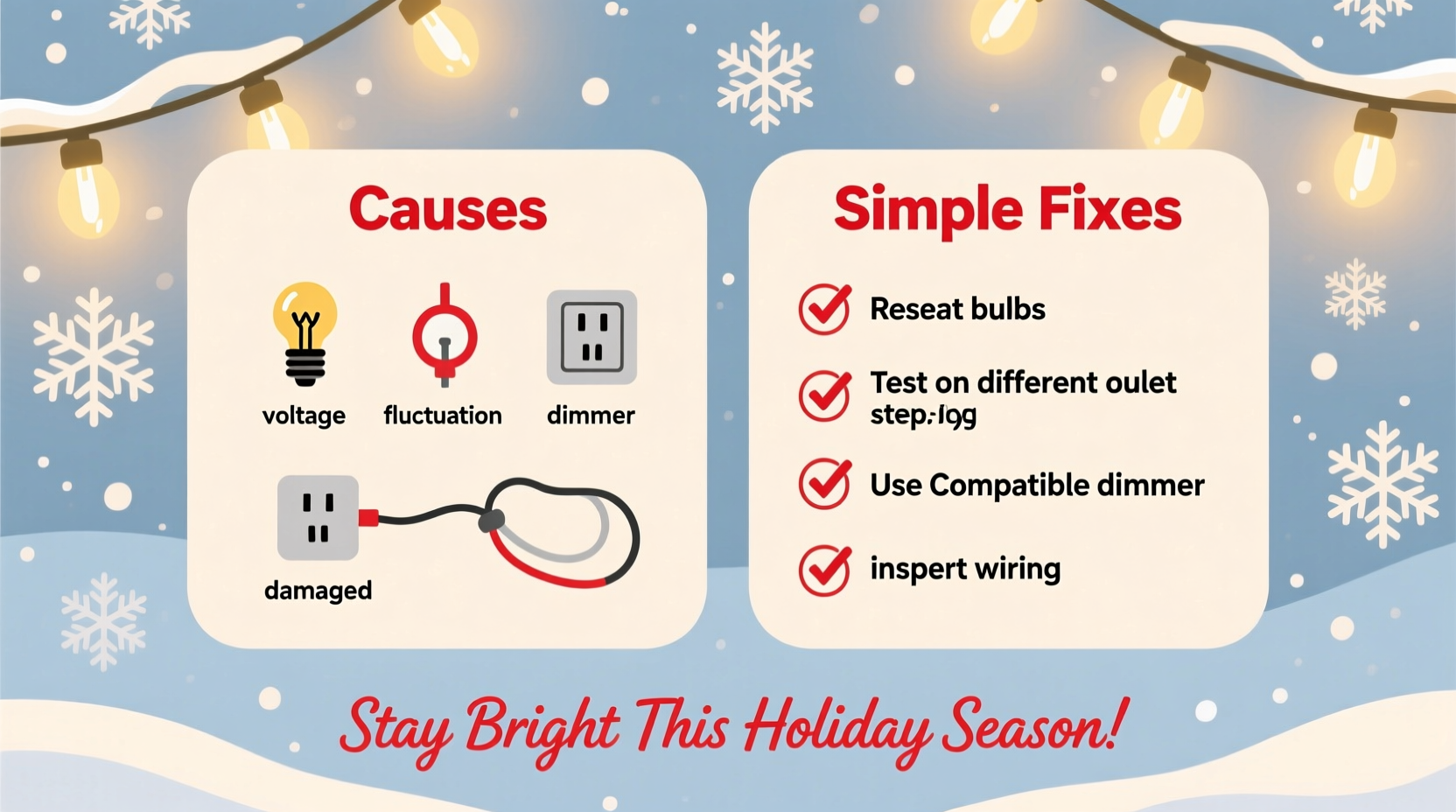
Modern homes run multiple high-wattage devices simultaneously—space heaters, microwaves, air compressors, even powerful vacuum cleaners. When these appliances cycle on, they draw sudden current surges, causing brief but measurable voltage drops across shared circuits. LED strings, especially low-voltage DC models powered by plug-in adapters, are acutely sensitive to such dips. A 5% drop in supply voltage can trigger visible flickering in LEDs designed for tight tolerance ranges (typically ±2%). Older homes with aluminum wiring or undersized breakers (e.g., 15-amp circuits feeding 10+ light strands) compound this issue.
The problem isn’t always the lights themselves—it’s how much else shares their circuit. A single 15-amp circuit supports up to 1,800 watts. One 100-light LED string draws about 4–7 watts; ten strands still sit well below capacity. But add a 1,200-watt space heater, and the circuit operates at 70–80% load. Under load, voltage sags—not enough to trip the breaker, but enough to destabilize the LED driver’s regulation.
2. Incompatible or Failing Power Adapters and Controllers
Most pre-wired LED light sets use external AC-to-DC power supplies (often labeled “transformers” or “controllers”) that convert household 120V AC to low-voltage DC (typically 12V or 24V). These units contain rectifiers, capacitors, and voltage regulators—all of which degrade over time. Electrolytic capacitors dry out after 3–5 years, losing capacitance and failing to smooth ripple voltage. The result? A pulsing DC output that manifests as rhythmic, 60Hz or 120Hz flicker—often synchronized across all connected strands.
Equally common is using mismatched adapters. Manufacturers design controllers for precise current delivery (e.g., 1.2A max per string). Plugging two identical strings into one adapter rated for only one will overload it, triggering thermal shutdown cycles—or worse, unstable regulation. Some budget adapters lack proper EMI filtering, allowing electromagnetic noise from nearby electronics (Wi-Fi routers, dimmer switches, fluorescent ballasts) to interfere with LED drivers.
“LEDs don’t flicker because they’re ‘cheap’—they flicker because their drivers are starved of stable voltage or contaminated by noise. A $12 adapter failing quietly is responsible for more holiday frustration than any bulb batch.” — Dr. Lena Torres, Electrical Engineer & Lighting Systems Consultant, UL Solutions
3. Poor Connections and Corrosion
Flickering rarely starts uniformly across an entire string. More often, it begins at a single section—then spreads—or appears only when wind moves the cord. That points directly to intermittent connectivity. Outdoor LED lights endure moisture, temperature swings, and physical stress. Over time, copper wire strands oxidize at connection points inside plugs, female sockets, or inline fuses. Even microscopic corrosion increases resistance, causing voltage drop and micro-arcing—especially under load. The result is erratic, localized flicker that may vanish when the cord is jiggled or reseated.
Another frequent culprit: the male plug’s prongs. Many users force plugs into outlets without fully seating them, leaving one blade partially disengaged. Since standard NEMA 5-15 outlets carry full voltage on the hot blade and return on neutral, partial contact introduces instability. Similarly, daisy-chained strings rely on interlocking connectors. If the plastic housing warps from sun exposure or cold brittleness, pins misalign—even by 0.3mm—breaking continuity.
4. Dimmer Switch Interference
This cause catches many homeowners off guard. If your outdoor lights plug into an outlet controlled by an indoor wall dimmer—even if the dimmer switch itself is set to “full”—you’re likely introducing phase-cut AC waveforms. Traditional leading-edge (TRIAC) dimmers chop the AC sine wave to reduce power. While incandescents tolerate this crudely, LED drivers interpret chopped waveforms as unstable input. The result? High-frequency shimmer, strobing, or random on/off cycling.
Worse, many “dimmable” LED light sets require trailing-edge (ELV) dimmers and compatible controllers—not standard residential dimmers. Using the wrong type doesn’t just cause flicker; it accelerates capacitor wear and can permanently damage internal ICs. Notably, flicker caused by dimmers often persists even when lights are unplugged and replugged elsewhere—because the outlet itself remains wired through the dimmer circuit.
| Issue Type | Typical Flicker Pattern | Quick Diagnostic Test |
|---|---|---|
| Voltage sag (circuit overload) | Intermittent, coincides with appliance use (e.g., fridge compressor kicking on) | Unplug all other devices on same circuit—does flicker stop? |
| Failing power adapter | Rhythmic, steady pulse (like slow breathing), affects all connected strings equally | Swap adapter with known-good unit—if flicker stops, adapter is faulty |
| Corroded connection | Localized to one section; changes with cord movement or rain exposure | Inspect plugs/sockets for greenish residue; gently wiggle connections while observing |
| Dimmer interference | Persistent shimmer or buzzing sound near outlet; unaffected by weather or load | Plug lights into a different outlet *not* on dimmer circuit—even indoors—to test |
| LED chip failure (rare) | Single bulb or segment blinking independently; no effect on adjacent lights | Isolate affected section—replace only that 3–5 bulb module |
5. Temperature Sensitivity and Cold-Weather Performance
Unlike incandescents, LEDs become *more* efficient in cold environments—yet paradoxically, many consumer-grade light strings flicker more in freezing temperatures. Why? Because the driver circuitry contains components with temperature-dependent behavior. Electrolytic capacitors lose effective capacitance below 0°C; thermistors shift resistance values; and some low-cost ICs lack wide-temperature-range specifications. When ambient temperatures drop below -5°C (23°F), the driver may fail to maintain constant current, causing visible pulsing or delayed startup.
This is especially true for lights marketed as “indoor/outdoor” but tested only to 0°C—not the -20°C extremes common in northern winters. Real-world testing shows flicker onset typically begins between -7°C and -12°C, worsening as temperatures fall. Interestingly, warming the controller (e.g., wrapping it in bubble wrap or tucking it under eaves) often restores stability—confirming thermal origin.
Mini Case Study: The Lake Tahoe Cabin
Mark installed new 300-bulb warm-white LED icicle lights along his cabin’s eaves in late November. At first, they performed flawlessly. By early December, however, the lower third of the string began flickering violently each night after sunset—coinciding with the furnace cycling on and outdoor temps dropping below -10°C. He replaced bulbs, checked fuses, and even bought a new controller—none helped. A neighbor suggested checking the outlet: it was fed from a circuit shared with the furnace blower motor and a well pump. Using a basic $20 circuit tester, Mark confirmed voltage dropped from 121V to 108V during furnace startup. He moved the lights to a dedicated garage circuit (unused in winter) and added a weatherproof enclosure around the controller. Flicker ceased entirely—and remained gone through three consecutive weeks of -15°C nights.
6. Step-by-Step Diagnostic & Fix Protocol
Follow this sequence before replacing any components. Most flicker resolves within 10 minutes using these steps:
- Isolate the circuit: Unplug everything else on the same breaker panel. Turn off all non-essential breakers except the one feeding your lights.
- Test the outlet: Plug in a lamp or phone charger. If it dims or buzzes when lights flicker, the issue is upstream—call an electrician to check for loose neutrals or failing breakers.
- Bypass all controllers: If using extension cords or power strips, plug lights directly into the wall outlet. Remove any surge protectors—they often introduce noise.
- Check physical connections: Examine every plug, socket, and end connector. Look for bent pins, cracked housings, or white/green corrosion. Clean contacts gently with isopropyl alcohol and a cotton swab.
- Segment test: Unplug half the string. If flicker stops, the fault lies in the unplugged half. Repeat until you isolate the problematic section (often near a connector or damaged wire sheath).
- Swap the adapter: Borrow a compatible, known-working controller. If flicker stops, replace yours—don’t repair it. Modern LED drivers aren’t user-serviceable.
- Evaluate environment: Is the controller exposed to wind-driven rain or direct snow? Relocate it under shelter and insulate with closed-cell foam tape—not duct tape, which traps moisture.
7. Do’s and Don’ts for Long-Term Stability
- Do label each controller with its compatible string count and wattage rating—tape it to the cord near the plug.
- Do store controllers indoors year-round, never coiled tightly—heat buildup degrades capacitors faster.
- Do use GFCI-protected outlets outdoors, but avoid plugging lights into GFCI *surge protectors*, which combine noise-prone filtering with trip sensitivity.
- Don’t exceed manufacturer’s maximum daisy-chain length—even if plugs fit. Each added segment increases cumulative voltage drop.
- Don’t use indoor-rated lights outdoors, even under eaves. Humidity ingress corrodes PCB traces invisible to the eye.
- Don’t ignore audible buzzing from the controller—it indicates failing components and precedes flicker by weeks.
FAQ
Can I fix flickering by adding a capacitor to the circuit?
No—and it’s unsafe. Consumer LED strings use integrated switching drivers designed for specific impedance. Adding external capacitors risks overvoltage, overheating, or fire. Only certified engineers should modify driver circuits. Stick to verified solutions: load management, connection cleaning, and OEM replacement parts.
Why do only some colors flicker on multi-color strings?
Different colored LEDs have varying forward voltage requirements (e.g., red: ~2.0V, blue: ~3.2V). Cheap controllers may regulate poorly across this range, causing color-specific instability. Better sets use per-channel regulation or constant-current ICs. If only blue or white segments flicker, the controller is likely under-spec’d or aging.
Will flickering damage my lights over time?
Yes—repeated voltage stress accelerates electrolytic capacitor failure and can degrade LED phosphor coatings, leading to premature color shift or reduced lumen output. Chronic flicker also stresses solder joints, increasing risk of open-circuit failures. Address it promptly to preserve both function and longevity.
Conclusion
Flickering LED Christmas lights aren’t a holiday curse—they’re a diagnostic opportunity. Each pulse, shimmer, or blink communicates something specific about your home’s electrical environment, the integrity of your connections, or the age of your equipment. You don’t need specialized tools or technical training to resolve most causes. What you do need is methodical observation, a willingness to isolate variables, and the confidence to trust what the lights are telling you. Start tonight: unplug one string, check its controller, inspect its plugs, and move it to a cleaner circuit. That single step may restore hours of peaceful, steady glow. And when your lights shine without hesitation—crisp, consistent, and calm—you’ll know it wasn’t magic. It was attention, applied correctly.




 浙公网安备
33010002000092号
浙公网安备
33010002000092号 浙B2-20120091-4
Comments
No comments yet. Why don't you start the discussion?