
Monitor flickering can be more than just a minor annoyance—it can strain your eyes, disrupt productivity, and even signal underlying hardware or software issues. While occasional screen glitches might seem harmless, persistent flickering specifically when using certain applications points to a targeted problem. Whether you're editing video, gaming, or simply browsing with multiple tabs open, understanding the root causes and applying effective solutions is essential.
This guide dives deep into the technical and environmental factors behind app-triggered monitor flickering. From GPU behavior and display settings to driver conflicts and power management, we’ll walk through diagnosing the issue and implementing long-term fixes that restore stability and clarity to your screen.
Understanding Monitor Flicker: Not All Glitches Are Equal
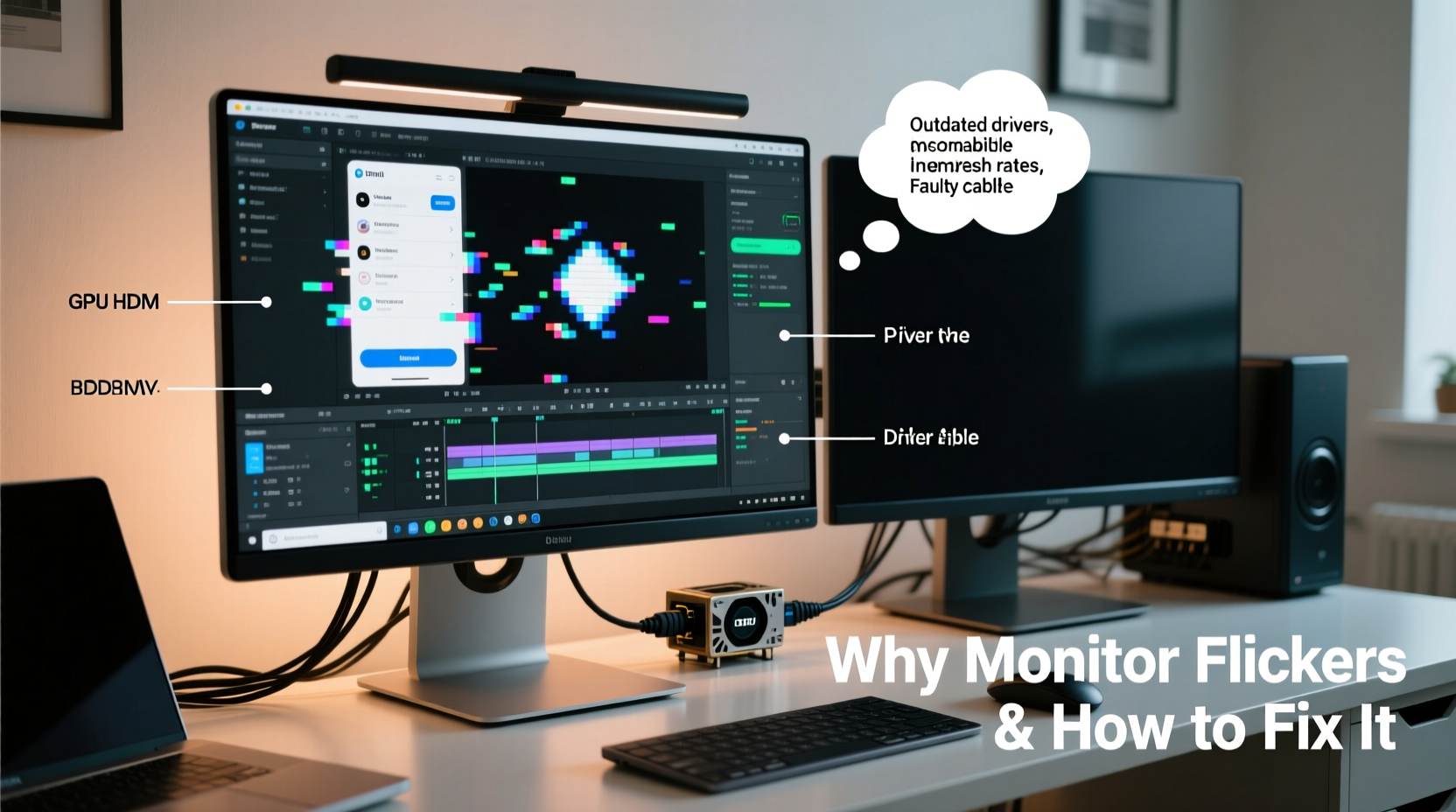
Before jumping into solutions, it’s important to distinguish between different types of flickering. True flickering refers to rapid, repeated changes in brightness or image stability—often visible as a pulsing or shimmering effect across the entire screen. This differs from screen tearing (a visual artifact during motion), ghosting (trailing images), or temporary lag spikes.
Flickering that occurs only with specific apps suggests a context-sensitive trigger. For example:
- A video editor launching may push GPU usage to 90%, causing instability.
- A browser with heavy WebGL content could conflict with outdated drivers.
- A full-screen game might switch refresh rates improperly, leading to strobing.
These scenarios often expose weaknesses in system configuration rather than random hardware failure. Identifying the pattern—what apps cause flickering, under what conditions, and on which displays—is the first step toward resolution.
Common Causes of App-Specific Monitor Flickering
Flickering tied to certain applications typically stems from interactions between software demands and hardware capabilities. Below are the most frequent culprits:
1. GPU Driver Incompatibility or Corruption
Graphics drivers act as translators between your operating system, apps, and GPU. Outdated, corrupted, or mismatched drivers often fail to handle high-performance tasks smoothly. When an app like Adobe Premiere Pro or a modern game starts rendering complex visuals, the driver may struggle to maintain consistent output, resulting in flickering.
2. Refresh Rate Conflicts
Many monitors support variable refresh rates (e.g., via FreeSync or G-Sync), but mismatches between app output and display settings can cause flicker. If an app forces a 60Hz signal on a 144Hz monitor without proper scaling, or if Windows fails to revert cleanly after full-screen mode, flickering may persist.
3. Hardware Acceleration Conflicts
Modern apps use hardware acceleration to offload graphics processing to the GPU. However, this feature can backfire when drivers are unstable or the GPU is overheating. Browsers like Chrome or Edge are notorious for causing flickering due to aggressive GPU compositing.
4. Power Management Settings
Windows and macOS include power-saving features that dynamically scale GPU performance. Under load, these settings may cause voltage fluctuations or clock speed shifts that manifest as screen flicker—especially on laptops or systems with low-quality PSUs.
5. Cable or Port Issues Exposed Under Load
A damaged HDMI or DisplayPort cable might function fine during idle use but fail under high bandwidth demand. When an app increases data throughput (e.g., 4K video playback), signal integrity drops, leading to intermittent flickering.
Step-by-Step Diagnosis and Fixes
Resolving app-specific flickering requires systematic troubleshooting. Follow this sequence to isolate and eliminate the root cause.
- Reproduce the Issue Consistently
Launch the problematic app and note when flickering begins. Is it immediate? Only during full-screen mode? Does it stop when minimized? - Check for Overheating
Use tools like HWMonitor or GPU-Z to track GPU temperature. Sustained temps above 85°C can cause throttling and visual artifacts. - Disable Hardware Acceleration
In the offending app (e.g., Chrome, Discord, Zoom), go to settings and disable hardware acceleration. Restart the app and test. - Update or Reinstall Graphics Drivers
Visit NVIDIA, AMD, or Intel’s website to download the latest driver. Use Display Driver Uninstaller (DDU) in Safe Mode for a clean reinstall if updates don’t help. - Adjust Refresh Rate Manually
Right-click desktop → Display Settings → Advanced Display → Refresh Rate. Set to the native rate of your monitor (e.g., 144Hz). Avoid “Default” options. - Swap Cables and Ports
Try a different DisplayPort or HDMI cable, preferably certified for your resolution/refresh rate. Plug into a different GPU port to rule out connection faults. - Disable Full-Screen Optimizations
Right-click the app executable → Properties → Compatibility → Check “Disable fullscreen optimizations.” Apply and relaunch. - Adjust Power Plan Settings
Go to Control Panel → Power Options → Edit Plan Settings → Change Advanced Settings. Set “PCI Express” → Link State Power Management to “Off,” and set GPU power mode to “Maximum Performance.”
Advanced Fix: Configure Application-Specific GPU Profiles
Using your GPU control panel (NVIDIA Control Panel or AMD Radeon Software), create custom profiles for flickering apps:
- Set preferred refresh rate and resolution.
- Force application to use dedicated GPU (if hybrid system).
- Disable vertical sync or enable adaptive sync based on monitor support.
This prevents apps from defaulting to suboptimal rendering paths.
Tips and Best Practices to Prevent Future Flickering
Prevention is more effective than constant troubleshooting. Implement these habits to maintain stable display performance:
Checklist: Monitor Flicker Prevention Routine
- ✅ Update GPU drivers monthly or after major OS updates.
- ✅ Use high-quality, shielded DisplayPort cables for high-refresh-rate monitors.
- ✅ Disable hardware acceleration in apps known to cause issues (e.g., Slack, Teams).
- ✅ Monitor GPU temperatures during intensive tasks.
- ✅ Keep your operating system updated to ensure compatibility patches are applied.
- ✅ Test external monitors on another device to isolate hardware faults.
Real-World Example: The Case of the Flickering Video Editor
Mark, a freelance video editor, noticed his secondary monitor flickered every time he opened DaVinci Resolve. The primary display remained stable. He initially assumed a hardware fault, but replacing the monitor didn’t help. After testing, he discovered the flickering occurred only when Resolve used GPU acceleration.
He followed these steps:
- Disabled hardware acceleration in Resolve—flickering stopped.
- Updated his NVIDIA drivers using DDU for a clean install.
- Created a custom profile in NVIDIA Control Panel setting the secondary monitor to 60Hz fixed (it was previously auto).
- Disabled desktop compositor in Resolve’s preferences.
The issue resolved completely. Mark now schedules monthly driver checks and avoids mixing refresh rates across extended displays.
“App-specific flickering is rarely about the monitor itself. It’s usually a handshake failure between software, driver, and display timing.” — Lena Torres, Senior Display Systems Engineer at Veridian Tech
Do’s and Don’ts: Quick Reference Table
| Do | Don't |
|---|---|
| Use DisplayPort for high-refresh or high-resolution setups | Use old HDMI 1.4 cables for 1440p@120Hz+ |
| Update GPU drivers regularly | Ignore driver update notifications for months |
| Set consistent refresh rates across multi-monitor setups | Mix 60Hz and 144Hz monitors without app-specific tuning |
| Disable hardware acceleration in problematic apps | Assume all flickering is hardware-related |
| Monitor GPU temperature under load | Run intensive apps on poorly ventilated systems |
Frequently Asked Questions
Why does my screen flicker only in Chrome or Edge?
This is commonly caused by hardware acceleration. Modern browsers use the GPU to render complex pages, animations, and videos. If your GPU drivers are outdated or unstable, this can result in flickering. Try disabling hardware acceleration in browser settings. If the flickering stops, consider updating your graphics drivers or limiting GPU-intensive extensions.
Can a bad power supply cause monitor flickering?
Yes. An insufficient or failing PSU may not deliver stable power to the GPU, especially under load. When an app increases GPU usage, voltage drops can occur, leading to erratic behavior including screen flickering. This is more common in custom-built PCs or older systems. Testing with a higher-wattage, quality-certified PSU can confirm this issue.
Does V-Sync cause flickering?
V-Sync itself doesn’t typically cause flickering, but misconfigured V-Sync settings can. If V-Sync is forced on when your frame rate is unstable or below the refresh rate, it may create stutter or perceived flicker. Use adaptive sync (G-Sync/FreeSync) when available, or let the application manage sync settings unless you’re experiencing screen tearing.
Conclusion: Take Control of Your Display Experience
Monitor flickering under specific app usage isn’t something you have to live with. It’s a solvable issue rooted in the interaction between software demands and system configuration. By methodically testing drivers, cables, settings, and thermal conditions, you can identify and eliminate the cause. Most importantly, maintaining up-to-date drivers and thoughtful display management prevents recurrence.
Don’t accept flickering as normal—even minor visual instability can impact focus and eye comfort over time. Apply the steps outlined here, use the checklist regularly, and reclaim a smooth, reliable viewing experience. Your eyes—and your workflow—will thank you.




 浙公网安备
33010002000092号
浙公网安备
33010002000092号 浙B2-20120091-4
Comments
No comments yet. Why don't you start the discussion?