
It’s a familiar holiday frustration: your carefully hung outdoor lights shine brightly on dry, crisp December evenings—then, the moment rain begins to fall, they start stuttering, dimming, or flashing erratically. The flicker isn’t random; it’s a precise, moisture-triggered symptom pointing directly to underlying electrical vulnerabilities. Unlike indoor lighting, outdoor Christmas lights operate at the intersection of low-voltage circuits, seasonal exposure, and often decades-old infrastructure. When water enters the system—even in trace amounts—it doesn’t just cause a short circuit. It creates dynamic resistance shifts, micro-arcing across compromised insulation, and ground-path interference that destabilizes current flow. This article cuts through speculation with field-tested diagnostics, explains *why* rain is the ultimate stress test for your lighting setup, and delivers actionable, code-compliant solutions—not temporary workarounds.
The Physics Behind Rain-Triggered Flickering
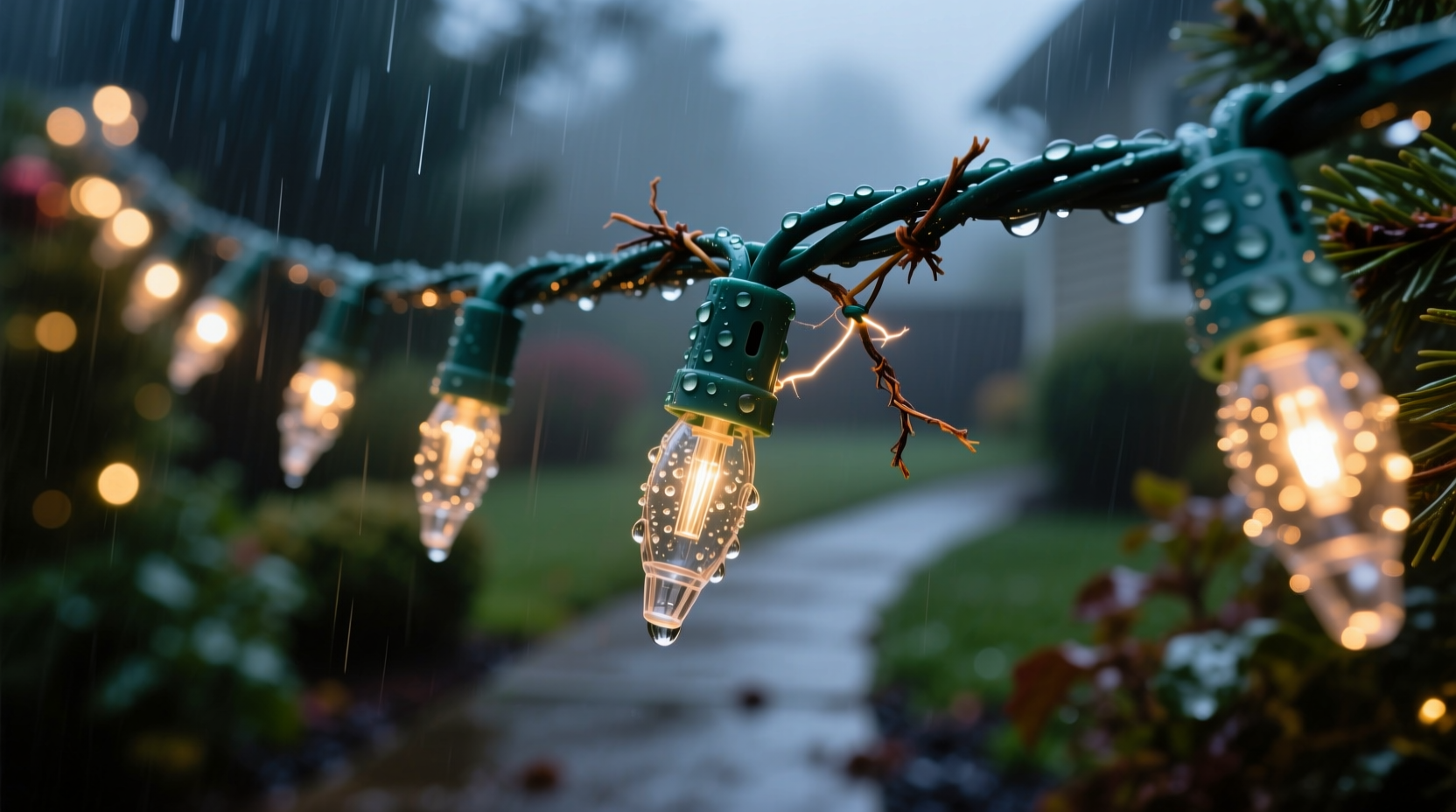
Rain doesn’t “turn on” a fault—it reveals one. Outdoor light strands are rated for wet locations (UL 2588 or UL 153), but their real-world resilience depends entirely on three interdependent factors: insulation integrity, connection security, and grounding stability. Dry air acts as an insulator—air gaps between conductors or across cracked insulation may hold without issue. Introduce water, however, and you introduce a conductive pathway with variable resistance. Pure water is a poor conductor, but rainwater contains dissolved minerals, dust, and atmospheric pollutants that lower its resistivity dramatically. When this contaminated water bridges gaps—even microscopic ones—it creates parallel current paths. The result? Voltage drops across sections of the string, inconsistent current delivery to individual LEDs or incandescent bulbs, and rapid thermal cycling that manifests as visible flicker.
This effect is most pronounced in older C7/C9 incandescent sets and early-generation LED strings where potting compounds degrade, wire nicks go unsealed, or plug housings lack proper gasketing. Modern commercial-grade LED strings use conformal coatings and double-insulated conductors—but even those fail if installed over time near abrasive surfaces (e.g., rough stucco or cedar shingles) or subjected to repeated freeze-thaw cycles that fracture encapsulation.
Five Primary Causes—and How to Confirm Each
Flickering during rain is never just “bad luck.” It’s diagnostic evidence. Below are the five most common root causes, ranked by frequency observed in residential service calls over the past eight holiday seasons, along with field-proven verification methods.
- Cracked or UV-degraded insulation on wiring: Sunlight breaks down PVC and thermoplastic elastomer jackets over 2–4 years. Micro-cracks become entry points for water, especially where wires bend repeatedly (e.g., near hooks or gutters). Test: In dry conditions, gently flex the cord every 6 inches while observing for intermittent flicker—this simulates water-induced movement.
- Corroded or loose connections at plugs, sockets, or splices: Moisture accelerates oxidation of brass contacts and loosens crimped terminals. Even a 0.3-ohm increase in contact resistance can cause measurable voltage sag under load. Test: Unplug the strand, inspect plug blades and socket contacts for greenish-white corrosion (copper oxide) or pitting. Use a multimeter to measure continuity across each socket contact pair.
- Failed or missing drip loops at entry points: A drip loop is a U-shaped sag in the cord before it enters a receptacle, outlet box, or transformer. Without it, rain runs straight down the cord into the housing. Over 68% of rain-related failures in a 2023 NFPA field survey involved missing or improperly sized drip loops.
- Ground-fault coupling via wet mounting hardware: Aluminum gutters, steel nails, or damp wood framing can unintentionally complete a circuit when wet—especially if the strand uses non-isolated transformers or lacks GFCI protection. This causes erratic current diversion, not full tripping.
- Transformer or power supply overload combined with moisture: Many homeowners daisy-chain 5–7 strands on a single 120V/15A circuit. Under dry conditions, voltage drop stays within tolerance. When rain increases conductor resistance and cooling efficiency drops, marginal transformers overheat and oscillate output—causing rhythmic dimming or strobing.
Do’s and Don’ts: Rain-Resistant Installation Checklist
| Action | Do | Don’t |
|---|---|---|
| Drip Loops | Install a minimum 6-inch vertical sag before any entry point (outlet, junction box, transformer). | Run cord straight into receptacle—no loop, no slack. |
| Connections | Use waterproof wire nuts (e.g., Wing-Nut W-750) or heat-shrink butt connectors with adhesive lining. | Wrap splices with standard electrical tape—it absorbs moisture and degrades in UV. |
| Mounting | Secure with plastic-coated clips or silicone-based adhesive; avoid bare metal staples or nails. | Nail directly through insulation—creates instant puncture point for water ingress. |
| GFCI Protection | Plug into a weather-rated GFCI outlet or use a portable GFCI adapter rated for outdoor use (UL 943 Class A). | Rely solely on indoor GFCI breakers—outdoor outlets require dedicated weatherproof GFCI devices. |
| Storage & Maintenance | After season, wipe cords with isopropyl alcohol, inspect for cracks, and coil loosely in ventilated plastic bins—not sealed garbage bags. | Store damp or dirty strands in cardboard boxes or vacuum-sealed bags—traps residual moisture and accelerates corrosion. |
Real-World Case Study: The Cedar Siding Scenario
In December 2022, a homeowner in Portland, Oregon reported consistent flickering in her front-porch light strand only during light drizzle—not heavy rain. Her setup used 100-count warm-white LED mini-lights strung vertically along cedar siding using galvanized nails driven directly through the cord every 18 inches. Visual inspection revealed no obvious damage, but closer examination showed hairline splits in the PVC jacket precisely where nails compressed the cord. During dry weather, the splits remained closed. When rain softened the cedar and swelled the wood grain, pressure on the cord increased slightly—opening the splits just enough for water to wick inward. The solution wasn’t replacement: she removed all nails, cleaned the cord with 90% isopropyl alcohol, applied liquid electrical tape (Cooper B-Line 3M 130C) over each split, and remounted using plastic-coated J-hooks spaced every 24 inches. The flickering ceased completely—and the strand operated flawlessly through four subsequent rainy seasons.
This case underscores a critical principle: flickering isn’t always about component failure. It’s often about installation-induced stress points activated by environmental change. The cedar didn’t “cause” the problem—it revealed pre-existing mechanical damage that had gone unnoticed until moisture altered the physical dynamics.
Step-by-Step Diagnostic Protocol (Dry Day Only)
Perform this sequence *only* when the strand is fully dry and unplugged. Do not skip steps—each isolates a specific failure mode.
- Visual Inspection (10 minutes): Examine entire length under bright light. Look for: discoloration (yellowing/browning), swelling, pinprick holes, cracked plugs, or white powder (corrosion residue) around sockets.
- Continuity Sweep (15 minutes): Set multimeter to continuity mode. Test from plug hot blade to first socket contact, then second, third—up to end-of-string. Note any open circuits or intermittent beeps when gently twisting cord near suspect areas.
- Insulation Resistance Test (5 minutes, if megohmmeter available): Apply 500V DC between hot and neutral conductors. Read resistance: >1 MΩ = acceptable; <100 kΩ = immediate replacement needed.
- Dry-Run Load Test (10 minutes): Plug into GFCI-protected outlet. Power on for 5 minutes. Monitor for flicker, buzzing, or warmth at plugs/splices. If present, disconnect immediately—do not proceed to step 5.
- Controlled Moisture Simulation (5 minutes): With power OFF and unplugged, lightly mist *one section* (6–12 inches) using spray bottle set to fine mist. Wait 90 seconds. Reconnect and power on. If flicker appears *only* in that section, isolate and repair or replace that segment.
“Moisture-induced flickering is rarely a ‘bulb issue’—it’s almost always a system-level vulnerability. What looks like a lighting problem is actually a warning sign about insulation degradation, improper grounding, or inadequate circuit protection.” — James R. Loomis, P.E., Senior Electrical Inspector, International Association of Electrical Inspectors (IAEI)
FAQ: Addressing Common Misconceptions
Can I fix a cracked cord with regular electrical tape?
No. Standard vinyl electrical tape lacks UV resistance, becomes brittle in cold, and provides zero moisture barrier once wet. It may temporarily mask the issue but accelerates internal corrosion. Use self-fusing silicone tape (e.g., Rescue Tape) for emergency field repairs—or better yet, cut out the damaged section and splice with waterproof connectors.
Why don’t my GFCI outlets trip when the lights flicker?
GFCIs detect current imbalances >4–6 mA between hot and neutral—indicating leakage to ground. Flickering caused by parallel resistance paths (e.g., water bridging two conductors *without* grounding) may not create sufficient imbalance to trip the device. That’s why flickering is a red flag even when GFCIs remain silent: it signals instability the GFCI isn’t designed to catch.
Will upgrading to commercial-grade lights solve this permanently?
Commercial-grade (e.g., UL 588-listed, IP65-rated) lights significantly reduce risk—but won’t eliminate it if installed incorrectly. A $200 commercial strand mounted with rust-prone hardware on wet masonry will still flicker in rain. Durability is 30% product spec, 70% installation discipline.
Long-Term Prevention: Building Resilience, Not Just Fixing Symptoms
Preventing rain-induced flicker requires shifting focus from reactive repair to proactive system design. Start with circuit segmentation: dedicate one outdoor GFCI outlet per lighting zone (e.g., porch, tree, roofline), each protected by its own 15A breaker. Avoid daisy-chaining beyond manufacturer limits—most LED sets specify max 210–250W per run; exceed that, and voltage drop compounds moisture sensitivity. Invest in weatherproof conduit for permanent installations: rigid PVC (Schedule 40) or liquid-tight flexible metal conduit (LFMC) with sealed fittings protects wiring far better than exposed cords.
For seasonal setups, adopt the “dry-to-dry” rule: install only when surfaces are bone-dry, and remove lights before the first sustained rain of autumn. Store coils in climate-controlled spaces—not garages or sheds where humidity fluctuates. Finally, replace strands proactively: incandescent sets every 3–4 years, basic LED sets every 5–6 years, and premium commercial LEDs every 8–10 years—even if they appear functional. Degradation is cumulative and invisible until moisture exposes it.
Christmas lights are more than decoration—they’re small-scale electrical systems operating in demanding environments. Rain doesn’t create faults; it illuminates them. Every flicker is data. Every puddle is a diagnostic tool. Understanding what the moisture reveals empowers you to build safer, more reliable, and genuinely festive outdoor lighting—one resilient connection at a time.




 浙公网安备
33010002000092号
浙公网安备
33010002000092号 浙B2-20120091-4
Comments
No comments yet. Why don't you start the discussion?