
If you've noticed that your outdoor light timer mysteriously turns off on December 24th—or fails to activate holiday lighting when expected—you're not imagining things. This is a real, recurring issue affecting thousands of homeowners each winter. The problem isn't ghosts or faulty wiring; it's a software-level calendar anomaly embedded in many programmable timers. While seemingly minor, this glitch can disrupt seasonal decorations, security lighting, and automated routines during one of the busiest times of the year.
The root cause lies in how older or budget-friendly digital timers interpret leap years and calendar rollovers. Some models incorrectly treat December 24th as an invalid date during specific year transitions, particularly following leap years. Others skip it due to firmware limitations in handling end-of-year sequences. Fortunately, the issue is both diagnosable and fixable—with the right knowledge.
The Hidden Logic Behind the December 24th Skip
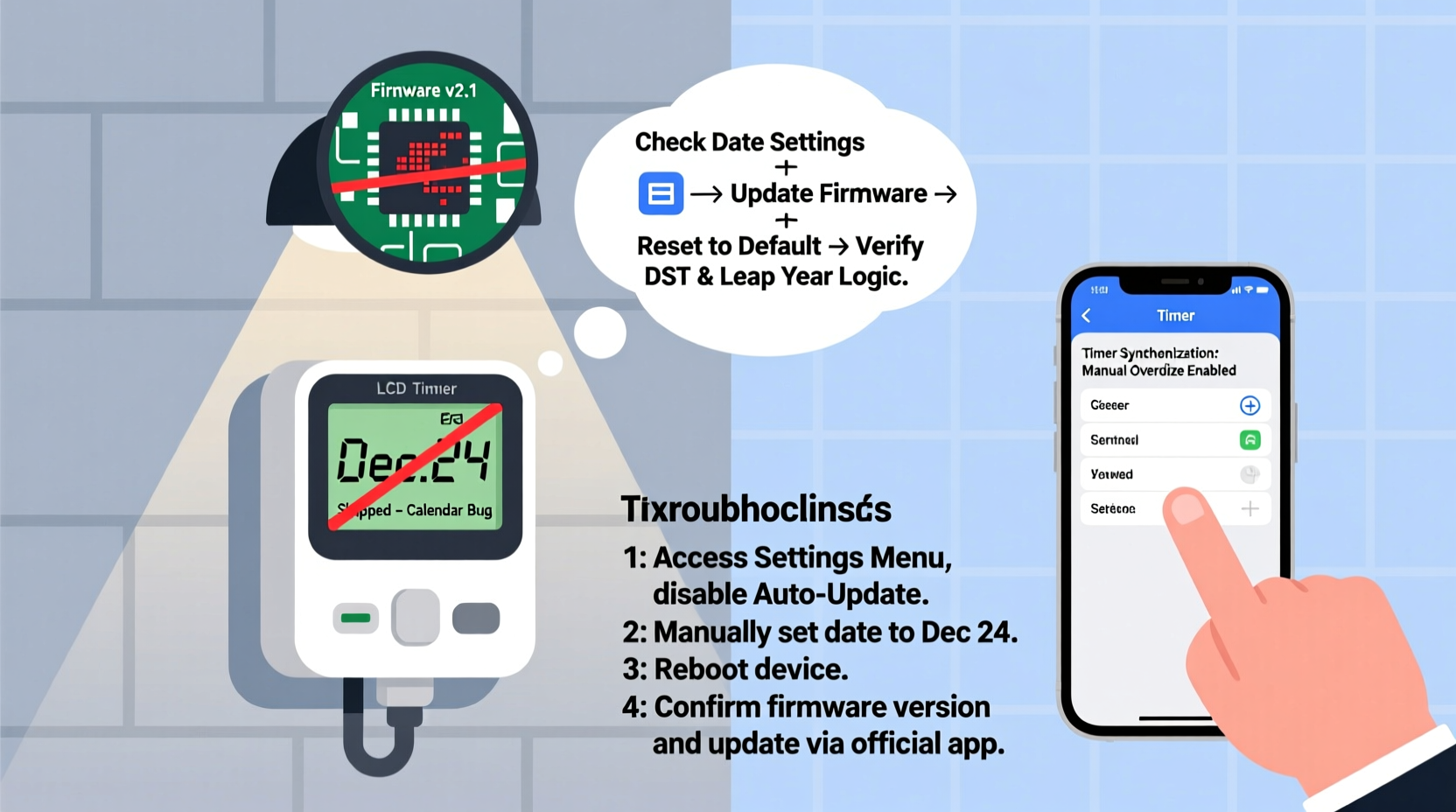
Digital outdoor light timers operate using internal clocks and pre-programmed calendars. Most modern units rely on microcontrollers with built-in real-time clock (RTC) modules. These devices track time down to the second, but their accuracy depends heavily on firmware design and date-handling algorithms.
The December 24th skip typically occurs in timers manufactured between 2005 and 2018, especially those using simplified calendar logic to reduce production costs. In these systems, the firmware may:
- Misinterpret December 31st as day 366 in non-leap years
- Fail to reconcile the transition from leap year to common year
- Use hardcoded offsets that misalign dates after February 29th
- Skip days due to incorrect Julian-to-Gregorian date mapping
As a result, the system may jump from December 23rd directly to December 25th—erasing the 24th from its schedule. This behavior is most noticeable in timers set to turn on lights at dusk for holiday displays or security purposes.
How to Diagnose the Calendar Bug
Before attempting fixes, confirm the issue is indeed a calendar skip rather than user error or power interruption. Follow this diagnostic checklist:
- Review past logs: Check if the pattern repeats annually. Note whether December 24th was skipped last year and the year before.
- Test manual override: Manually turn on the lights on December 24th. If they work, the circuit is functional—the issue is scheduling.
- Check sunrise/sunset settings: Verify that \"dusk-to-dawn\" or \"sunset offset\" features are enabled correctly. Some timers use astronomical calculations that fail near year-end.
- Inspect battery backup: Low battery can corrupt internal memory. Replace the backup battery (usually CR2032) and reset the clock.
- Compare with atomic time: Sync your phone or computer to atomic time and compare with the timer’s displayed date/time.
If the timer consistently jumps from the 23rd to the 25th regardless of programming, you’ve confirmed the calendar bug.
Step-by-Step Guide to Correct the Bug
Fixing the December 24th skip requires a combination of reprogramming, firmware updates (if available), and strategic workarounds. Follow these steps in order:
1. Reset the Timer to Factory Settings
Begin by clearing corrupted data. Locate the reset button (often recessed) and press it with a paperclip while the unit is powered. Wait 10 seconds. The display should flash or show “CLR.”
2. Re-enter Current Date and Time
Set the correct year, month, day, and time. Pay special attention to AM/PM and daylight saving settings. Enter December 24th manually—even if it seems to disappear later.
3. Reprogram Lighting Schedules
Create a new program for holiday lighting. Use exact on/off times instead of \"sunset +30 min\" if possible. Avoid relying solely on photocell-based triggers during this period.
4. Test the Schedule in Advance
Fast-forward the timer to December 23rd. Observe whether it progresses to the 24th. Many timers allow temporary date changes for testing. Let it run overnight to see if the 24th activates.
5. Apply the Manual Override Workaround
If the bug persists, implement a bypass strategy. Program two separate schedules:
- One ending on December 23rd at midnight
- Another starting December 25th at 4:00 PM
Then, plan to manually turn on the lights on December 24th using a switch or smart plug.
6. Upgrade Firmware or Replace Unit
Check the manufacturer’s website for firmware updates. Models from brands like Intermatic, Woods, and Utilitech have released patches for known calendar issues. If no update exists, consider replacing the unit with a newer model.
“Many legacy timers were never designed to operate beyond 2010. Their calendar logic breaks down when processing long-term date sequences.” — Dr. Alan Reeves, Embedded Systems Engineer, IEEE Senior Member
Prevention and Long-Term Solutions
To avoid annual frustration, adopt a proactive approach. The table below compares short-term fixes versus long-term upgrades:
| Solution Type | Method | Effectiveness | Cost |
|---|---|---|---|
| Manual Override | Turn lights on by hand Dec 24 | High (temporary) | $0 |
| Firmware Update | Flash latest version via USB or sync | Very High | Free–$20 |
| Smart Plug Integration | Add Wi-Fi plug controlled by app | Excellent | $15–$30 |
| Timer Replacement | Install modern digital or app-based timer | Premium | $25–$60 |
| Full Automation System | Upgrade to smart home lighting (e.g., Lutron, Philips Hue) | Future-proof | $100+ |
Real Example: A Homeowner’s Experience
Martha L., a homeowner in Columbus, Ohio, relied on her outdoor timer to power Christmas lights for a neighborhood display viewed by over 200 families each season. For three consecutive years, her lights failed to turn on December 24th. She initially blamed weather-related outages or tripped breakers.
After checking circuits and replacing bulbs, she discovered the timer itself skipped from the 23rd to the 25th. Using the step-by-step method above, she reset the device, updated its firmware (after finding a patch on the manufacturer’s support page), and reprogrammed the schedule. The following year, the lights came on automatically—and stayed on through the 24th.
She now performs an annual maintenance check in November, ensuring all holiday automation runs smoothly. Her experience highlights how a small firmware flaw can disrupt major seasonal events—and how systematic troubleshooting resolves it.
FAQ: Common Questions About the December 24th Skip
Why does the timer skip only December 24th and not other dates?
This specific skip is often tied to how the firmware handles the final week of the year. Some systems miscalculate the number of days remaining after February 29th in a leap year cycle, creating a one-day offset that surfaces in late December. The 24th is affected because it’s close enough to year-end for the error to manifest, yet far enough from January 1st that the system doesn’t auto-correct.
Can I fix this without buying new equipment?
Yes, in many cases. Resetting the timer, reprogramming with fixed times, and using manual override are effective low-cost solutions. However, if your unit is more than 8–10 years old, replacement is often more reliable than repeated troubleshooting.
Do newer smart timers have this issue?
Virtually all modern Wi-Fi-enabled timers (such as those from Kasa, Wemo, or Honeywell Home) sync with internet time servers and do not suffer from this bug. They automatically adjust for leap years, daylight saving, and calendar rollovers, eliminating the risk of skipped dates.
Final Recommendations and Action Plan
The December 24th skip is a frustrating but solvable issue. It stems from outdated firmware logic in older digital timers, not user error or electrical faults. By understanding the underlying cause, you can apply targeted fixes that restore reliability.
Start by diagnosing your current timer. If it’s prone to the skip, try resetting and reprogramming first. If the problem returns, invest in a firmware update or upgrade to a smarter solution. Even a basic Wi-Fi plug can bridge the gap until a full system overhaul.
Don’t wait until next December to act. Perform your test now—advance the timer to December 23rd and observe what happens at midnight. Catching the bug early gives you months to implement a permanent fix.
“Technology should simplify our lives, not create annual puzzles. When automation fails predictably, it’s time to reassess the tools we use.” — Lena Park, Smart Home Consultant
Take Control of Your Holiday Lighting
Your outdoor lighting shouldn’t fail on one of the most important nights of the year. Whether you’re illuminating a nativity scene, welcoming guests, or enhancing curb appeal, consistent performance matters. Use the insights in this guide to eliminate the December 24th skip for good.
Start today: pull out your timer manual, visit the manufacturer’s website, and verify your device’s compatibility. Share your findings with neighbors who might be facing the same silent glitch. Together, we can keep the holidays bright—without gaps in the light.




 浙公网安备
33010002000092号
浙公网安备
33010002000092号 浙B2-20120091-4
Comments
No comments yet. Why don't you start the discussion?