
It’s a familiar frustration: you spritz your favorite fragrance in the morning, only to find it nearly gone by midday. You’re not imagining things—your perfume really is fading faster than expected. The reason isn’t just about the scent itself; it’s deeply tied to your skin chemistry, how you apply it, and even environmental factors. Understanding the science behind scent longevity can transform your experience with perfume, turning fleeting notes into an all-day aura.
Fragrance performance varies dramatically from person to person. Two individuals wearing the same eau de parfum may have entirely different experiences—one might enjoy lingering sillage for eight hours, while the other detects almost nothing after two. This discrepancy often comes down to skin type, hydration levels, pH balance, and application habits. By adjusting a few key practices, you can significantly extend the life of your fragrance on your skin.
Skin Type and Its Impact on Fragrance Longevity
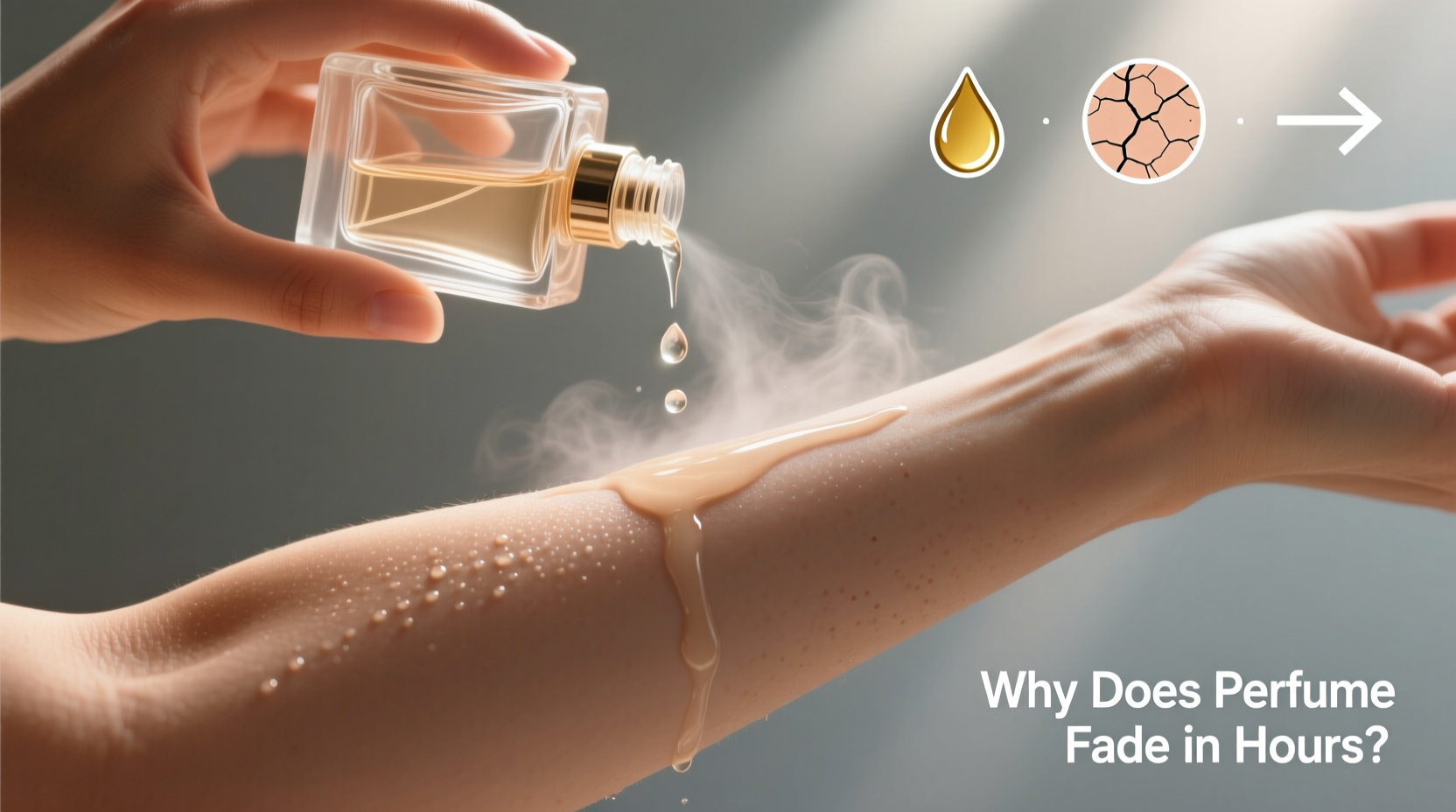
Your skin is more than just a canvas for perfume—it actively interacts with fragrance molecules. The composition of your skin determines how long a scent lingers and how its notes evolve over time. There are three primary skin types that influence how perfumes behave: oily, dry, and combination.
- Oily skin: Naturally retains moisture and has higher sebum production, which helps trap fragrance molecules close to the skin. Perfumes typically last longer on oily skin because oils slow down evaporation.
- Dry skin: Lacks natural oils and tends to absorb fragrance quickly. Without a protective lipid layer, scents evaporate faster, leading to poor longevity. This is one of the most common reasons people report their perfume “disappears” within hours.
- Combination skin: Exhibits both oily and dry areas. Performance depends on where you apply the fragrance. Pulse points like wrists or neck may hold scent better if they're oilier, while drier zones won't retain it as well.
Additionally, your skin's pH level affects how ingredients in perfume react. A slightly acidic pH (around 4.5–5.5) is ideal for scent stability. Alkaline skin can distort or accelerate the breakdown of aromatic compounds, altering both the smell and duration of the fragrance.
The Role of Hydration and Body Chemistry
Well-hydrated skin holds fragrance better. When your skin is dehydrated, it absorbs perfume instead of allowing it to bloom on the surface. Think of dry skin like a sponge—once the scent hits, it soaks in and vanishes. Moisturized skin acts more like a smooth surface, letting the fragrance hover and project.
Hydration starts from within. Drinking enough water daily improves your skin’s ability to retain both moisture and scent. But topical hydration matters too. Using an unscented or lightly scented body lotion creates a neutral base that doesn’t interfere with your perfume’s profile while locking in fragrance.
“Fragrance is not just about the bottle—it’s a collaboration between the formula and the wearer’s biology.” — Dr. Lena Moretti, Cosmetic Chemist and Scent Formulation Expert
Beyond hydration, individual body chemistry—including diet, hormones, and medications—can subtly alter how a scent develops. For example, spicy foods or caffeine may increase body temperature and perspiration, causing faster evaporation. Hormonal shifts during menstruation or pregnancy can also change how certain notes emerge on the skin.
Application Techniques That Make a Difference
Even the best-quality perfume won’t last long if applied incorrectly. Where, when, and how you apply fragrance plays a crucial role in its staying power. Most people spray once on each wrist and call it a day—but small adjustments can yield dramatic improvements.
- Apply to moisturized skin: As mentioned, hydrated skin extends wear time. Use a fragrance-free cream or petroleum jelly on pulse points before spraying.
- Target pulse points wisely: These warm areas—wrists, neck, behind ears, inner elbows—help diffuse scent gradually. Avoid rubbing wrists together after spraying, which breaks down top notes prematurely.
- Layer your fragrance: Use matching body wash, lotion, or oil from the same scent line. This builds a “scent foundation” that supports the perfume’s longevity.
- Spray on clothes or hair (with caution): Natural fabrics like cotton and wool absorb fragrance well. Hair holds scent due to its keratin structure, but avoid direct spraying on colored or treated hair, which may be damaged by alcohol.
- Don’t overspray: Excessive amounts can overwhelm your nose and lead to olfactory fatigue, making you think the scent has faded when it hasn’t.
| Application Method | Longevity Benefit | Caution |
|---|---|---|
| On moisturized skin | High – slows evaporation | Avoid heavily scented lotions that clash |
| Pulse points only | Moderate – uses body heat effectively | Don’t rub after application |
| Clothing (natural fibers) | High – fabric traps scent | May stain delicate fabrics |
| Hair | Moderate – scent lingers through movement | Alcohol can dry out strands |
| Perfume balm or oil base | Very high – oil binds to scent | Requires prep time |
Mini Case Study: Sarah’s Scent Struggle
Sarah, a 32-year-old teacher with naturally dry skin, loved a floral oriental perfume but noticed it barely lasted past her morning commute. She assumed she needed a stronger concentration and upgraded to a parfum version—still no improvement. After consulting a beauty chemist, she realized she was skipping moisturizer and applying perfume directly to bare, dry skin.
She began using a thick, unscented body butter every morning and applied a matching body milk before spraying her fragrance. Within days, she noticed the scent lasted until evening, with distinct layers unfolding throughout the day. The change wasn’t in the perfume—it was in her routine.
Choosing the Right Fragrance Concentration
Not all perfumes are created equal in terms of staying power. The concentration of aromatic compounds directly impacts longevity. Here’s a breakdown of common types:
- Eau de Cologne (EDC): 2–4% fragrance oil – lasts 1–2 hours
- Eau de Toilette (EDT): 5–10% – lasts 2–4 hours
- Eau de Parfum (EDP): 10–15% – lasts 4–6 hours
- Parfum/Extrait: 15–30% – lasts 6–8+ hours
If you struggle with fast-fading scent, switching to a higher concentration like EDP or parfum can make a significant difference. However, even parfum won’t last long on poorly prepared skin. Pairing a strong concentration with proper application is the real key.
Environmental and Lifestyle Factors
External conditions also affect how long your perfume lasts. High humidity can amplify scent projection but may distort notes. In contrast, dry, air-conditioned environments cause faster evaporation. Wind and airflow—like riding a bike or sitting near a fan—disperse fragrance particles more quickly.
Lifestyle choices matter too. Physical activity increases body temperature and sweat, which alters how fragrance interacts with your skin. While this can enhance diffusion, it may also break down delicate notes faster. Urban pollution contains ozone and nitrogen oxides that degrade certain fragrance molecules, particularly citrus and green accords.
Storage is another overlooked factor. Keeping your perfume in direct sunlight or fluctuating temperatures (like a humid bathroom) degrades the formula over time. Heat accelerates oxidation, dulling the scent and reducing shelf life.
“Perfume is a living blend. Store it like wine—cool, dark, and upright—and it will perform better on your skin.” — Antoine Leclair, Master Perfumer at Grasse Institute
Actionable Checklist: How to Make Your Perfume Last Longer
Follow this simple checklist to maximize your fragrance’s lifespan every time you wear it:
- ✅ Shower and pat skin dry (don’t towel-rub excessively)
- ✅ Apply an unscented or matching body lotion to damp skin
- ✅ Focus on pulse points: wrists, neck, behind ears, inner elbows
- ✅ Avoid rubbing wrists together after spraying
- ✅ Consider using a perfume oil or balm as a base layer
- ✅ Reapply midday with a travel atomizer if needed
- ✅ Store your perfume in a cool, dark place away from sunlight
- ✅ Drink plenty of water throughout the day to maintain skin hydration
Frequently Asked Questions
Why does my perfume last longer on some days than others?
Daily variations in hydration, stress levels, hormone fluctuations, and even what you eat can alter your skin’s chemistry. On well-rested, hydrated days, your skin provides a better base for fragrance retention.
Can I make a light eau de toilette last as long as a parfum?
Yes—with proper preparation. Layer with matching products, apply to moisturized skin, and reapply strategically. While it may not match parfum longevity exactly, you can extend EDT wear to 5–6 hours with optimal technique.
Is it bad to spray perfume on clothes every day?
Not inherently, but repeated spraying can stain delicate fabrics or cause discoloration, especially with darker or oil-based perfumes. Use caution with silk, lace, or light-colored clothing. Cotton and wool are generally safe.
Final Thoughts: Turn Fleeting Scents into Lasting Impressions
Your perfume shouldn’t vanish by lunchtime. With the right understanding of your skin type and a few strategic habits, you can transform even the most elusive fragrance into a lasting presence. It’s not about buying more or spraying harder—it’s about working with your body, not against it.
Start by assessing your skin: is it dry, oily, or somewhere in between? Adjust your moisturizing routine accordingly. Then refine your application method—layer, target pulse points, and avoid common mistakes like rubbing your wrists. Over time, these small changes compound into a richer, longer-lasting sensory experience.




 浙公网安备
33010002000092号
浙公网安备
33010002000092号 浙B2-20120091-4
Comments
No comments yet. Why don't you start the discussion?