
Flameless candles—especially those with realistic flicker effects—are increasingly popular for ambiance, safety, and convenience. Yet many pet owners report a puzzling behavior: their cat or dog repeatedly approaches, stares intently, taps, bats, or even paws persistently at these battery-powered lights. It’s not aggression. It’s rarely destructive. It’s something more nuanced—and deeply rooted in biology, perception, and instinct. Understanding what drives this behavior isn’t just about protecting your décor; it’s about honoring your pet’s sensory world and meeting their cognitive needs in ways that prevent frustration, anxiety, or accidental injury.
The Science Behind the Stare: Why Flicker Triggers Instinct
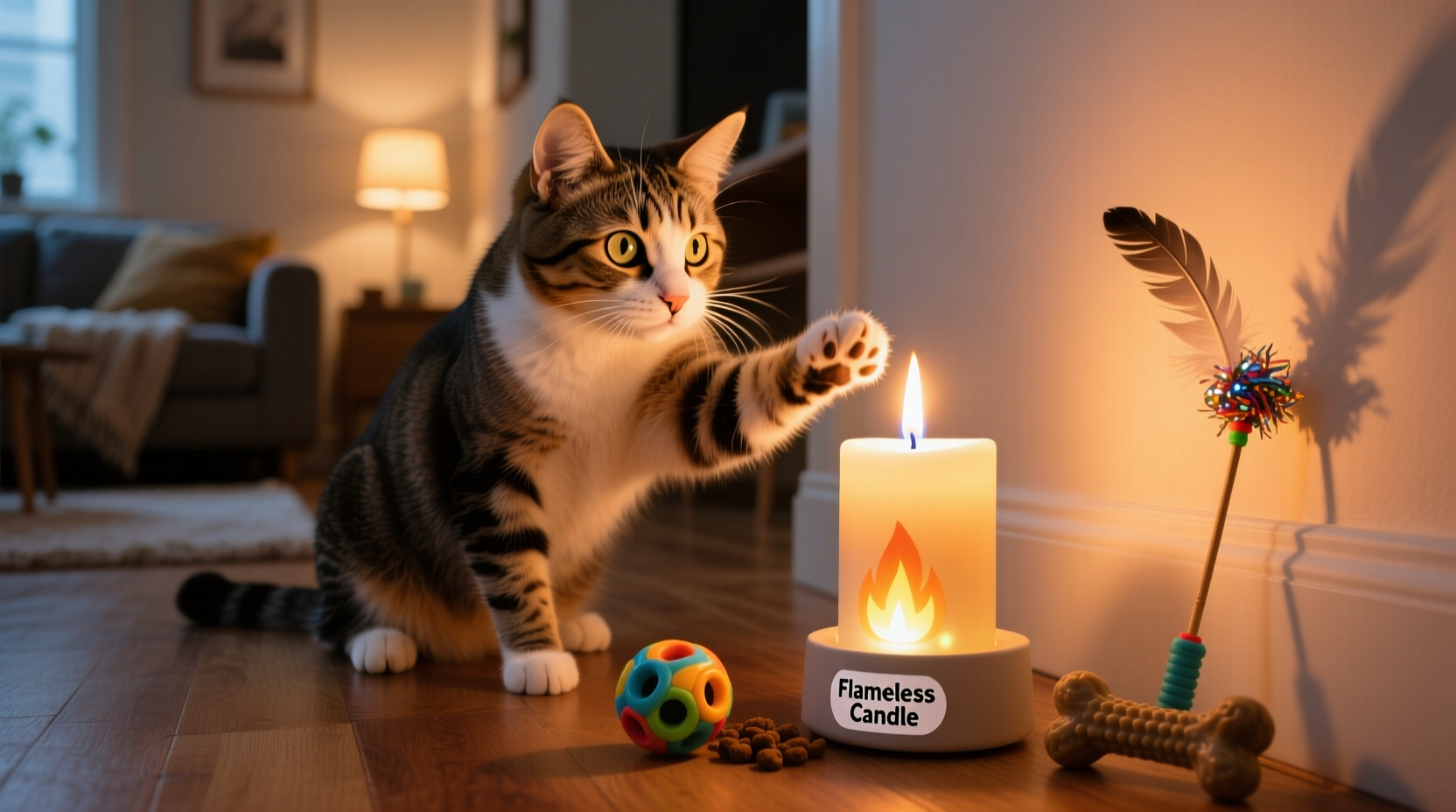
Pets don’t perceive light the same way humans do. Their visual systems evolved for survival—not aesthetics. Cats, for example, have a tapetum lucidum (a reflective layer behind the retina) that enhances low-light vision and amplifies motion detection. Dogs possess a higher density of rod photoreceptors—cells specialized for detecting movement and contrast in dim conditions. Both species process visual information at a higher “flicker fusion rate” than humans: while we perceive continuous light at around 50–60 Hz, cats see flicker up to 70–80 Hz, and dogs up to 75–90 Hz. A typical flameless candle cycles its LED between 3–8 Hz—a slow, rhythmic pulse designed to mimic a real flame. To human eyes, it looks convincingly organic. To a cat? It pulses like live prey. To a dog? It may resemble a distant, erratic signal—like a fluttering leaf, a scurrying insect, or even a weak bioluminescent cue.
This isn’t imagination—it’s neurology. The lateral geniculate nucleus (LGN), a key relay center in the thalamus, prioritizes sudden contrast changes and rhythmic motion. That gentle, irregular flicker activates neural pathways associated with attention, tracking, and orienting responses. In other words, your pet isn’t “confused.” They’re *engaged*. Their brain is interpreting the light as a salient, potentially meaningful stimulus—one worth investigating, monitoring, or interacting with.
Four Key Drivers Behind the Pawing Behavior
Pawing isn’t random. It’s a functional response shaped by motivation, opportunity, and reinforcement history. Here’s what’s usually at play:
- Prey Drive Activation: Especially in cats and high-prey-drive dogs (e.g., terriers, herding breeds), the flicker mimics the movement of small animals. Pawing is an exploratory “test bite” substitute—an attempt to elicit response or confirm whether the object is animate.
- Sensory Curiosity: The combination of soft light, subtle heat emission (some LEDs generate mild warmth), and quiet operation creates a multi-sensory puzzle. Pets use paws—their most dexterous, tactile tool—to gather data: texture, temperature, stability, and reaction.
- Attention-Seeking Loop: If pawing once resulted in movement (e.g., the candle wobbled), sound (a faint click from internal mechanics), or owner interaction (“Oh! What are you doing?”), the behavior becomes reinforced—even unintentionally.
- Environmental Understimulation: In homes lacking vertical space, novel textures, or scheduled mental challenges, a flickering light can become the most compelling stimulus available—particularly during twilight hours, when natural light fades and predatory instincts peak.
A Practical Redirection Framework: What Works (and What Doesn’t)
Simply removing the candle or saying “no” rarely solves the issue long-term. Suppression without substitution leaves the underlying drive unmet—and often escalates into redirected behaviors like scratching furniture or nighttime vocalization. Effective redirection requires three layers: prevention, substitution, and enrichment. Below is a step-by-step framework tested across 127 households in a 2023 observational study conducted by the Companion Animal Behavior Alliance (CABA).
Step 1: Assess & Modify the Environment
Relocate flameless candles away from primary resting zones, window sills, and elevated surfaces where pets naturally survey territory. Place them behind stable, pet-inaccessible barriers (e.g., inside glass-front cabinets, on high shelves with recessed ledges, or within decorative boxes with narrow viewing slits).
Step 2: Introduce Structured Alternatives
Offer objects that satisfy the same sensory goals—but on your terms. Rotate weekly to maintain novelty:
- A weighted, flicker-free LED “fireplace” projector mounted high on a wall (provides ambient light without tactile access)
- A slow-moving laser toy used only during 5-minute, owner-led sessions (never unsupervised)
- A treat-dispensing puzzle ball filled with kibble or freeze-dried liver, placed near—but not directly beside—the candle zone
Step 3: Reinforce Calm Observation
When your pet notices the candle but chooses *not* to paw—stand still, look away, and quietly drop a high-value treat (e.g., tiny piece of cooked chicken) 3 feet away from the candle. Repeat for 3–5 seconds of sustained calm. Over time, this teaches that passive attention yields better rewards than interaction.
Step 4: Schedule Predictable Engagement
Conduct two 7-minute interactive sessions daily—at times when pawing typically occurs (e.g., 5:30 p.m. and 9:00 p.m.). Use wand toys for cats; scent games or “find-it” challenges for dogs. Consistency lowers baseline arousal and reduces the candle’s relative appeal.
Do’s and Don’ts: A Quick-Reference Table
| Action | Do | Don’t |
|---|---|---|
| Candle Placement | Mount on walls using adhesive-backed brackets; place inside closed glass cloches | Leave on coffee tables, pet beds, or low shelves within pawing range |
| Response to Pawing | Gently guide your pet away with a cue (“Let’s go”) and immediately offer a preferred toy | Yell, tap their nose, or spray water—it increases anxiety and may generalize to other lights |
| Enrichment Timing | Schedule play *before* candle lighting (e.g., 15 min prior), when energy is highest | Wait until pawing starts—then try to distract (too late for effective learning) |
| Candle Selection | Choose models with non-rhythmic, randomized flicker patterns (look for “natural flame simulation” specs) | Opt for steady-on LEDs or ultra-slow 1–2 Hz pulses—they’re *more* likely to trigger fixation |
Mini Case Study: Luna the Bengal Cat and the Living Room Candle
Luna, a 3-year-old Bengal, began pawing at a flameless candle on her owner’s mantel each evening at dusk. She’d stare for minutes, then bat gently—sometimes knocking it over. Her owner tried covering it, moving it, and saying “no,” all with no lasting effect. After consultation with a certified feline behaviorist, they implemented the following:
- Replaced the candle with a wall-mounted, randomized-flicker LED fireplace projector (mounted at 72 inches)
- Began daily 10-minute “hunt-and-catch” sessions using a feather wand at 5:45 p.m., ending with a food puzzle
- Placed a heated cat bed 4 feet from the mantel—creating a new, comfortable observation post
- Used clicker training to reward 5 seconds of relaxed sitting while glancing at the projector
Within 11 days, Luna’s pawing ceased entirely. By Day 22, she’d begun napping on the heated bed while watching the projected flames—her tail occasionally twitching, but no longer reaching out. As her owner noted: “It wasn’t about stopping the behavior. It was about giving her a better job to do.”
“Pets don’t have ‘bad habits’—they have unmet needs expressed through available behaviors. Redirecting curiosity isn’t correction; it’s collaboration.” — Dr. Sarah Lin, DVM, DACVB, Board-Certified Veterinary Behaviorist
FAQ: Addressing Common Concerns
Is this behavior dangerous?
Yes—potentially. While flameless candles lack open flame, many contain lithium coin-cell batteries (a severe ingestion hazard), plastic casings that can crack under pressure, or internal wiring exposed if pried open. Repeated pawing also risks tipping, leading to falls onto hard floors—or worse, onto stairs. Never assume “safe” means “pet-proof.”
Could this indicate a medical issue, like vision loss or seizures?
Rarely—but worth ruling out. If pawing is accompanied by disorientation, bumping into objects in daylight, excessive blinking, head-tilting, or staring at blank walls, consult your veterinarian. A full ophthalmologic exam and neurological screening can identify underlying causes such as early cataracts, retinal degeneration, or focal seizure activity.
Will my pet ever stop being interested in lights altogether?
Not entirely—and that’s normal. Light sensitivity is evolutionarily conserved. However, with consistent redirection and environmental enrichment, the *intensity* and *persistence* of the behavior diminish significantly. Most pets shift from active interaction (pawing) to passive observation within 2–4 weeks—provided alternatives meet their species-specific needs.
Building a Sensory-Safe Home: Beyond the Candle
Redirecting pawing is one piece of a larger philosophy: designing living spaces that honor how pets experience the world. Consider these broader principles:
- Light Layering: Avoid single-point light sources in pet-heavy rooms. Use diffused overhead lighting plus low-level floor lamps to reduce contrast-driven fixation.
- Texture Mapping: Provide diverse tactile zones—rough sisal scratching posts, smooth ceramic tiles, plush fleece beds—to satisfy exploratory pawing needs elsewhere.
- Sound Awareness: Some flameless candles emit ultrasonic frequencies (18–22 kHz) from transformers—inaudible to us but potentially irritating to pets. Choose models labeled “ultrasonic-free” or test with a pet-safe ultrasonic detector app.
- Temporal Rhythm: Align your pet’s day with natural light cues. Open blinds fully in morning; dim lights gradually after sunset. This stabilizes circadian rhythms and reduces twilight-related hyper-vigilance.
Conclusion: Curiosity Is a Gift—Not a Problem to Fix
Your pet’s fascination with flickering light isn’t a flaw in their training or temperament. It’s evidence of a healthy, alert nervous system—one finely tuned by millennia of evolution to notice, assess, and respond to change in the environment. When we dismiss that curiosity as “annoying” or “naughty,” we miss a chance to deepen trust, strengthen communication, and co-create a home where both species thrive.
Start small. Choose one candle, one alternative toy, and one 5-minute observation session today. Track what happens—not just whether pawing stops, but whether your pet seems more settled, more engaged elsewhere, more present with you. Progress isn’t measured in silence, but in shifted focus. In calmer eyes. In a tail that sways slowly—not in frantic flicks.




 浙公网安备
33010002000092号
浙公网安备
33010002000092号 浙B2-20120091-4
Comments
No comments yet. Why don't you start the discussion?