
It’s a common experience: you glance in the mirror and feel confident, only to see a photo of yourself and think, “That doesn’t even look like me.” The face staring back from your phone screen seems unfamiliar—perhaps less symmetrical, more awkward, or simply wrong. This dissonance isn't just about camera angles or poor lighting; it's rooted in deep psychological processes that shape how we perceive ourselves. Understanding why your reflection looks different in photos involves exploring neuroscience, cognitive biases, and the subtle distortions created by technology. This article unpacks the science behind this phenomenon and offers practical insights for reconciling your internal self-image with external reality.
The Mirror vs. The Camera: A Fundamental Mismatch
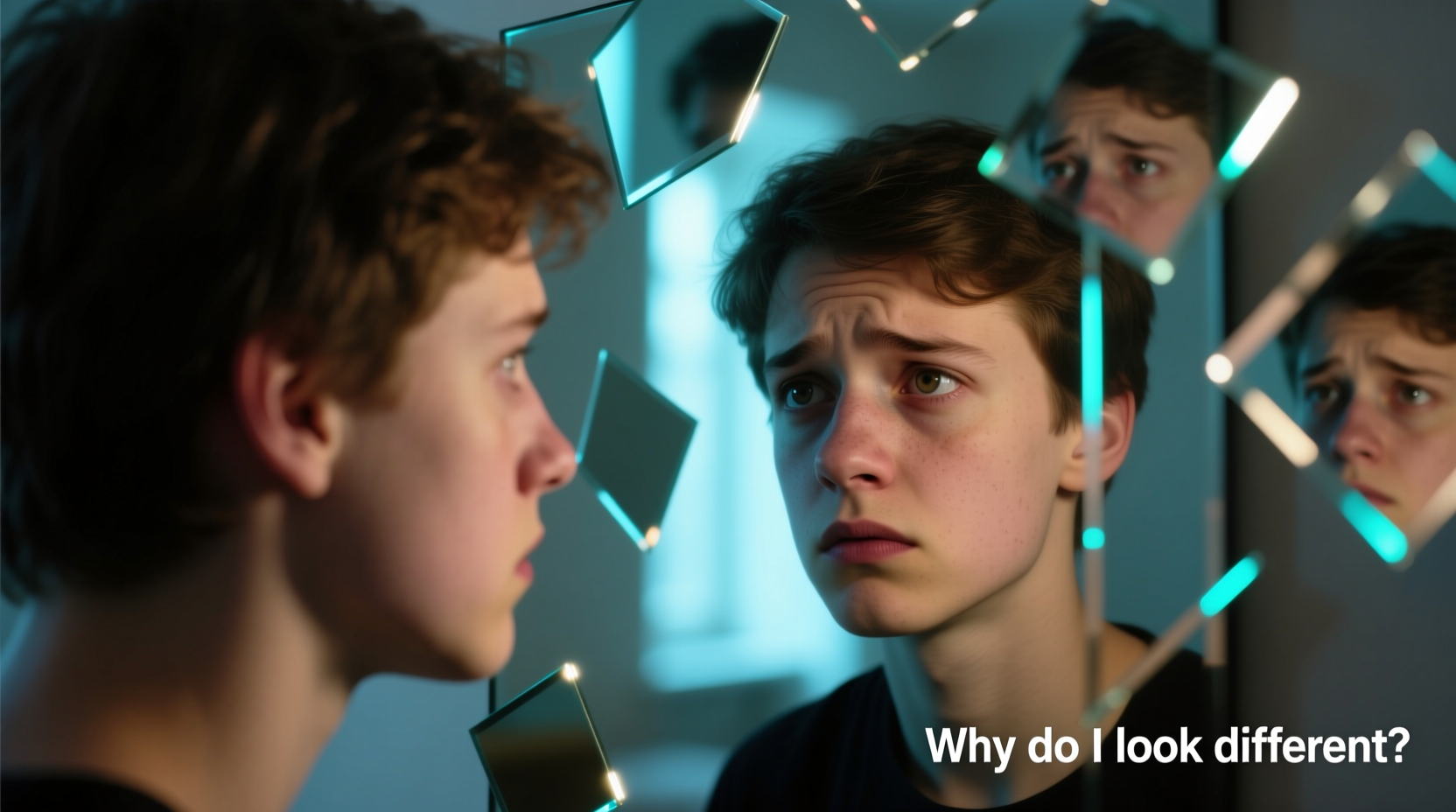
The most immediate reason your reflection appears different in photos lies in the difference between mirrors and cameras. When you look in a mirror, you see a reversed image of yourself—one that you've grown accustomed to over years of daily grooming, adjusting, and self-scrutiny. This mirrored version becomes your mental baseline for what you believe you look like.
In contrast, photographs capture your face as others see it—a non-reversed, objective representation. Because facial asymmetry is nearly universal, this flipped version can appear subtly off to you. Features that seem balanced in the mirror may now look skewed. For example, if your left eye is slightly larger or your nose tilts to the right, the unmirrored photo will highlight these traits in a way that feels unfamiliar.
This reversal effect creates an uncanny valley between expectation and reality. You're not seeing a distorted image; you're seeing the real one. But because your brain has spent decades adapting to the mirror’s flip, the truth feels false.
Cognitive Biases and Self-Perception
Human perception is not neutral. It’s filtered through layers of cognitive bias, especially when it comes to self-image. Two key psychological mechanisms are at play: the mere exposure effect and self-enhancement bias.
The mere exposure effect, first described by psychologist Robert Zajonc, suggests that people develop a preference for things they encounter frequently. Since you see your mirrored reflection daily, you’ve developed a subconscious fondness for that version of your face. When confronted with the non-mirrored photograph, your brain registers it as novel—and therefore less appealing—even if objectively it’s no different.
Meanwhile, self-enhancement bias leads individuals to view themselves in a more favorable light than others do. You may mentally smooth over imperfections, remember your best angles, or unconsciously edit your appearance in memory. Photos, being impartial, don’t offer that courtesy. They capture moments without emotional context, sometimes freezing expressions mid-blink, mid-sentence, or mid-frown—moments you’d never fixate on in the mirror.
“We are the only species that forms a persistent self-image based on repeated visual feedback. That image becomes a psychological anchor—sometimes more real than reality.” — Dr. Lena Torres, Cognitive Psychologist, Stanford University
Camera Distortion and Lens Physics
Beyond psychology, technical factors contribute significantly to the disconnect. Most smartphone and digital cameras use wide-angle lenses, especially in front-facing (selfie) mode. These lenses exaggerate features closest to the lens—typically the nose—making it appear larger relative to the rest of the face. This is known as lens distortion.
Additionally, the distance between you and the camera matters. Holding a phone 12 inches from your face produces a very different perspective than standing three feet from a mirror. Close-up shots compress depth and alter proportions, making eyes seem smaller, cheeks flatter, and jawlines less defined.
Lighting further complicates the issue. Mirrors usually reflect ambient room light, which tends to be soft and multidirectional. Cameras, however, often rely on single-source flash or overhead lighting, creating harsh shadows, unflattering highlights, and loss of detail in darker skin tones.
| Factor | Mirror Experience | Photo Experience |
|---|---|---|
| Image Orientation | Reversed (familiar) | True-to-life (unfamiliar) |
| Distance | ~3 feet (natural perspective) | ~1–2 feet (distorted perspective) |
| Lighting | Ambient, diffuse | Direct, often harsh |
| Lens Type | Flat reflection (no distortion) | Wide-angle (nose enlargement) |
| Temporal Element | Real-time motion & expression | Single frozen moment |
How Social Media Amplifies the Effect
The rise of social media has intensified the psychological tension between self-perception and photographic reality. Platforms like Instagram, TikTok, and Snapchat encourage constant self-documentation, often through heavily edited or filtered images. Filters smooth skin, enlarge eyes, slim faces, and even reshape bone structure—all while reinforcing the idea that this altered version is desirable.
Over time, users begin to internalize these enhanced versions as their ideal self. When confronted with an unfiltered photo—especially one taken by someone else—the gap between fantasy and reality widens, leading to discomfort, disappointment, or even body dysmorphia symptoms.
A 2022 study published in the Journal of Eating Disorders found that frequent selfie-takers were significantly more likely to report dissatisfaction with their appearance and seek cosmetic procedures. The researchers attributed this to “Snapchat dysmorphia”—a condition where patients request surgery to resemble their filtered selves.
Mini Case Study: Sarah’s Self-Image Shift
Sarah, a 28-year-old graphic designer, had always considered herself average-looking but generally comfortable in her skin. After starting a personal branding project on LinkedIn and Instagram, she began taking professional headshots and posting weekly selfies. Over six months, she noticed growing unease every time she reviewed new photos.
“I kept thinking my nose looked huge, or my smile was forced,” she said. “But when I asked friends, they said I looked great. I started avoiding photos altogether.”
Upon consulting a therapist specializing in body image, Sarah learned that her discomfort stemmed not from her appearance, but from the mismatch between her mirror-based self-image and the unflattering angles and lens distortions in her photos. Her therapist recommended a simple exercise: spend five minutes each day looking at unedited photos of herself without judgment. After three weeks, Sarah reported feeling more at ease. “I realized the photo version wasn’t ugly—it was just different. And it’s still me.”
Step-by-Step Guide to Reconcile Your Photo Self With Your Mirror Self
If you struggle with how you look in photos, consider adopting a structured approach to rebuild a healthier relationship with your image. Follow these steps over several weeks:
- Collect Unedited Photos: Gather 10–15 recent photos of yourself taken by others or in natural settings. Avoid selfies or filtered images.
- Observe Without Judgment: Spend 5 minutes daily reviewing one photo. Note features without labeling them “good” or “bad.” Just observe.
- Compare to Mirror: Stand in front of a mirror and compare the photo to your current reflection. Identify similarities, not differences.
- Ask Trusted Others: Show the photos to close friends or family. Ask what they see. Their input can counteract negative self-bias.
- Practice Neutral Language: Replace phrases like “I hate how I look” with “This is how I appear from another angle.”
- Repeat Regularly: Continue the process for 4–6 weeks. Track shifts in comfort level.
This method helps desensitize the brain to the unfamiliarity of photographic images and strengthens alignment between self-perception and external reality.
Checklist: How to Feel More Comfortable in Photos
- ✔ Understand that lens distortion affects everyone—not just you
- ✔ Use rear-facing camera for selfies (less wide-angle distortion)
- ✔ Shoot in natural light whenever possible
- ✔ Avoid excessive filters that warp your real appearance
- ✔ Practice posing in front of a mirror, then replicate in photos
- ✔ Review old photos to see consistency in your features over time
- ✔ Focus on expression rather than perfection—authenticity resonates more
Frequently Asked Questions
Why do I look worse in photos than in the mirror?
You don’t necessarily look worse—you look different. The mirror shows a reversed, familiar version of your face under consistent lighting. Photos capture the true orientation with potential lens distortion, harsh lighting, and split-second expressions that may not reflect your usual appearance.
Is it normal to dislike how I look in pictures?
Yes, it’s extremely common. Studies show that up to 90% of people report some level of discomfort with their photographed appearance. This stems from psychological familiarity with the mirror image and societal pressures around beauty standards.
Can therapy help with photo-related self-image issues?
Absolutely. Cognitive-behavioral therapy (CBT) and body image counseling can help reframe negative thought patterns. Therapists often use techniques like perceptual retraining and exposure to reduce distress around photographic images.
Conclusion: Embracing the Full Spectrum of Your Appearance
Your reflection in the mirror is not the whole truth, nor is the photo. Each is a fragment of a multidimensional identity shaped by perspective, light, movement, and mind. The discomfort you feel isn’t a flaw in your appearance—it’s a signal of the complex relationship between self and perception.
By understanding the psychological and technical forces at play, you can begin to see photos not as betrayals of your identity, but as alternate viewpoints—equally valid, equally you. The goal isn’t to love every photo, but to recognize that none of them, including the mirror’s, tell the entire story.




 浙公网安备
33010002000092号
浙公网安备
33010002000092号 浙B2-20120091-4
Comments
No comments yet. Why don't you start the discussion?