
Shadows are often assumed to be simple—dark silhouettes cast when an object blocks light. But if you’ve ever noticed your shadow appearing not black, but faintly purple or even bluish, you’re not imagining things. This subtle color shift defies everyday expectations and reveals a fascinating interplay between light, atmosphere, and human vision. Far from being a trick of the eye, the purple hue in shadows is grounded in real optical physics and atmospheric science.
The phenomenon occurs under specific lighting conditions and involves the scattering of sunlight, ambient skylight, and the way our eyes interpret color contrasts. Understanding why shadows can appear purple requires exploring the full spectrum of visible light, the role of Rayleigh scattering, and the brain’s interpretation of color in low-light areas.
The Nature of Shadows: Not Always Black
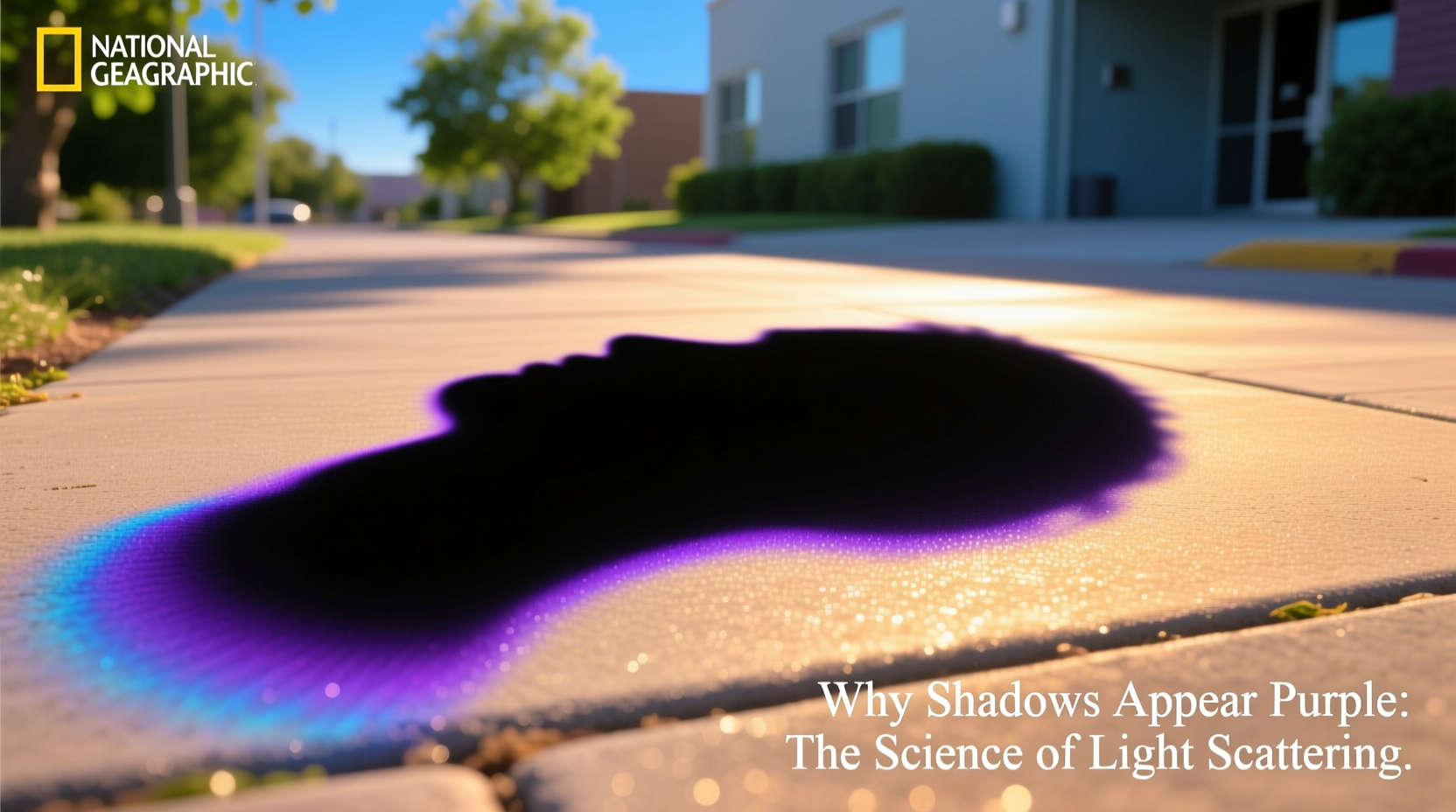
A shadow forms when an opaque object obstructs a source of light. In ideal conditions—such as under a single bright spotlight in a dark room—the shadow appears nearly black because little to no light reaches that area. However, outdoors during daylight, shadows are rarely pure black. Ambient light from the sky, reflections from surrounding surfaces, and multiple light sources all contribute to the appearance of a shadow.
In natural daylight, even in shadowed regions, some light still reaches the surface. This light isn’t just residual sunlight—it often comes from the blue sky itself. When sunlight passes through the atmosphere, shorter wavelengths (blue and violet) scatter more than longer ones (red and yellow), a process known as Rayleigh scattering. This scattered blue light fills the sky and becomes a secondary light source.
Rayleigh Scattering and Skylight Influence
Rayleigh scattering explains both why the sky is blue and why shadows can take on a bluish or purplish tint. When sunlight enters Earth’s atmosphere, air molecules scatter shorter-wavelength light (blue and violet) much more efficiently than red or yellow light. While our eyes are less sensitive to violet, the dominant perception is blue—hence the blue sky.
This scattered blue light doesn’t just illuminate the sky; it acts as a diffuse overhead light source. When you stand in direct sunlight, your body blocks the direct beam, creating a shadow. But the scattered blue light from the rest of the sky still reaches the shadowed area. As a result, the shadow is illuminated by this cool-toned ambient light rather than being completely dark.
Meanwhile, the sunlit areas around the shadow are bathed in direct white sunlight, which contains all visible wavelengths. The contrast between warm, full-spectrum light and the cooler, blue-rich ambient light in the shadow creates a perceptual effect: the shadow appears darker and often takes on a bluish or purplish hue.
“Shadows aren’t just absences of light—they’re filled with information about the quality and direction of ambient illumination.” — Dr. Lena Patel, Atmospheric Optics Researcher, University of Colorado
Color Contrast and Human Vision
The human visual system plays a crucial role in perceiving colored shadows. Our brains don’t see colors in isolation; they interpret them relative to their surroundings. This phenomenon, known as simultaneous contrast, causes a neutral gray area to appear tinged with the complementary color of its background.
In the case of shadows, the surrounding sunlit areas reflect warm, yellowish-white light. When the brain compares this warmth to the cooler, blue-lit shadow, it exaggerates the difference. Since the complement of yellow-orange is blue-purple, the shadow may appear distinctly purplish—even if the actual light difference is subtle.
This effect is enhanced in certain environments. For example, on a snowy day, the high reflectivity of snow amplifies both the brightness of the lit areas and the visibility of ambient skylight in shadows. Snow reflects nearly all wavelengths evenly, increasing overall scene brightness and making color contrasts more apparent. As a result, footprints or body shadows on snow often display a striking blue or purple tone.
Real-World Example: Winter Photography
Photographers frequently encounter purple shadows when shooting in daylight, especially in winter landscapes. A common scenario involves capturing a subject standing on fresh snow under a clear blue sky. The photographer notices that while the person is brightly lit by the sun, their shadow on the snow has a distinct lavender tint.
At first glance, one might assume a camera white balance error. However, upon inspection, the color is present across multiple shots and consistent with lighting conditions. The explanation lies in the combination of direct sunlight (warm white, ~5500K) and skylight (cool blue, ~10,000–12,000K) illuminating the shadow. The camera records this accurately, and post-processing adjustments often confirm that the purple hue is real—not a digital artifact.
This case illustrates how environmental conditions amplify the visibility of colored shadows and underscores the importance of understanding ambient light in visual arts and photography.
The Role of Surface and Surroundings
The color of a shadow isn’t solely determined by light—it also depends on the surface it falls on and nearby objects. A shadow cast on a white wall will appear differently than one on green grass or red brick. Surfaces reflect their own color back into the shadow, subtly altering its tone.
For instance, a shadow on yellow sand may appear slightly purple due to the contrast between the warm sand and cool skylight. Similarly, a shadow near a green tree may pick up slight magenta tones, as green’s complement is purple-red. These interactions demonstrate that shadows are dynamic and context-dependent.
Additionally, multiple light sources can create overlapping shadows with varying hues. If artificial lighting (like sodium vapor lamps) is present during twilight, it can introduce orange or pink tints into shadows, competing with the blue skylight and producing complex color gradients.
| Condition | Shadow Color Tendency | Primary Cause |
|---|---|---|
| Clear sky, snow-covered ground | Pronounced purple-blue | Strong skylight + high surface reflectivity |
| Overcast day | Gray or neutral | Diffuse, uniform lighting from clouds |
| Sunset/sunrise | Deep red or orange-tinted | Warm direct light vs. cooler ambient |
| Urban environment with artificial lights | Multicolored or inconsistent | Mixed light sources and reflections |
| Dense forest | Greenish or brownish | Filtered light and leaf reflection |
Step-by-Step: How to Observe Purple Shadows Yourself
You don’t need special equipment to witness this phenomenon. With careful observation, you can see purple shadows in everyday settings. Follow these steps to enhance your chances of spotting them:
- Choose the right time: Midday on a clear day provides strong direct sunlight and intense blue skylight, maximizing contrast.
- Select a reflective surface: Look for light-colored, non-absorbent surfaces like concrete, white walls, or snow.
- Position yourself correctly: Stand so that sunlight hits you directly from one side, casting a sharp shadow.
- Compare adjacent areas: Look at the transition between sunlit ground and your shadow. Focus on the edge where the shadow begins.
- Squint slightly: Reducing overall brightness can help your eyes detect subtle color differences.
With practice, you’ll begin to notice that the shadowed paper appears cooler—often with a distinct blue or purple cast—while the sunlit one looks warmer and brighter.
Common Misconceptions About Shadow Color
Many people assume that shadows should be black or gray, leading to confusion when they observe purple hues. Some common misconceptions include:
- \"It’s a camera glitch\": Digital cameras don’t invent colors. If a shadow appears purple in a photo, especially across multiple devices, it’s likely real.
- \"Only happens in cold weather\": While more noticeable in winter due to snow, purple shadows occur year-round on reflective surfaces.
- \"My eyes are playing tricks\": The effect is rooted in measurable physics and perceptual science, not illusion.
- \"All shadows should match the light source\": Shadows are influenced by indirect light, not just the primary source.
Understanding these myths helps demystify the phenomenon and reinforces the scientific basis behind what we see.
Frequently Asked Questions
Why don’t all shadows look purple?
Not all shadows appear purple because the effect depends on several factors: the presence of a bright blue sky, a reflective surface, and sufficient contrast between direct and ambient light. On overcast days, under artificial lighting, or on dark surfaces, the color difference is minimized or absent.
Can shadows appear other colors besides purple?
Yes. Shadows can appear greenish near vegetation, reddish during sunrise/sunset, or even orange under streetlights. The perceived color depends on the dominant ambient light and surrounding reflective surfaces.
Is the purple color in shadows stronger at higher altitudes?
Often, yes. At higher elevations, the atmosphere is thinner and scatters blue light more efficiently, resulting in a deeper blue sky. This increases the intensity of skylight, making purple or blue shadows more pronounced.
Action Checklist: Enhance Your Observation Skills
To consistently notice and understand colored shadows, follow this practical checklist:
- ✅ Observe shadows on clear days with high sky clarity
- ✅ Choose light-colored, reflective surfaces (snow, sand, concrete)
- ✅ Compare shadow color directly with adjacent sunlit areas
- ✅ Use a neutral object (white paper, gray card) to test color shifts
- ✅ Take photos with controlled white balance for comparison
- ✅ Note changes throughout the day—from morning to midday to dusk
- ✅ Experiment in different environments: urban, forest, beach, mountain
Conclusion: Embracing the Complexity of Light and Shadow
The next time you see your shadow tinged with purple, remember: you’re witnessing a quiet masterpiece of physics and perception. What seems like a simple absence of light is actually a rich interplay of scattered sunlight, atmospheric conditions, and the human brain’s interpretation of color. Shadows are not merely dark voids—they are canvases painted by ambient light.
By paying closer attention to these subtle visual cues, you gain a deeper appreciation for the complexity of everyday phenomena. Whether you're a photographer, artist, scientist, or simply a curious observer, recognizing the science behind purple shadows opens a window into the invisible forces shaping what we see.




 浙公网安备
33010002000092号
浙公网安备
33010002000092号 浙B2-20120091-4
Comments
No comments yet. Why don't you start the discussion?