
Smoothies are a staple in modern healthy eating—quick, nutrient-dense, and endlessly customizable. Yet one frustrating issue persists: no matter how thoroughly you blend, your smoothie often separates within minutes. The once-uniform drink splits into layers, with liquid pooling at the bottom and pulp or foam rising to the top. While this doesn’t ruin the taste, it can make for an inconsistent texture and less appealing appearance. Understanding the science behind separation—and how to prevent it—can transform your smoothie experience from messy to seamless.
This phenomenon isn’t a flaw in your blender or technique; it’s rooted in food science. From density differences to emulsion stability, multiple factors determine whether your smoothie holds together. More importantly, there are practical, evidence-based strategies you can use to create a stable, homogeneous blend every time.
The Science Behind Smoothie Separation
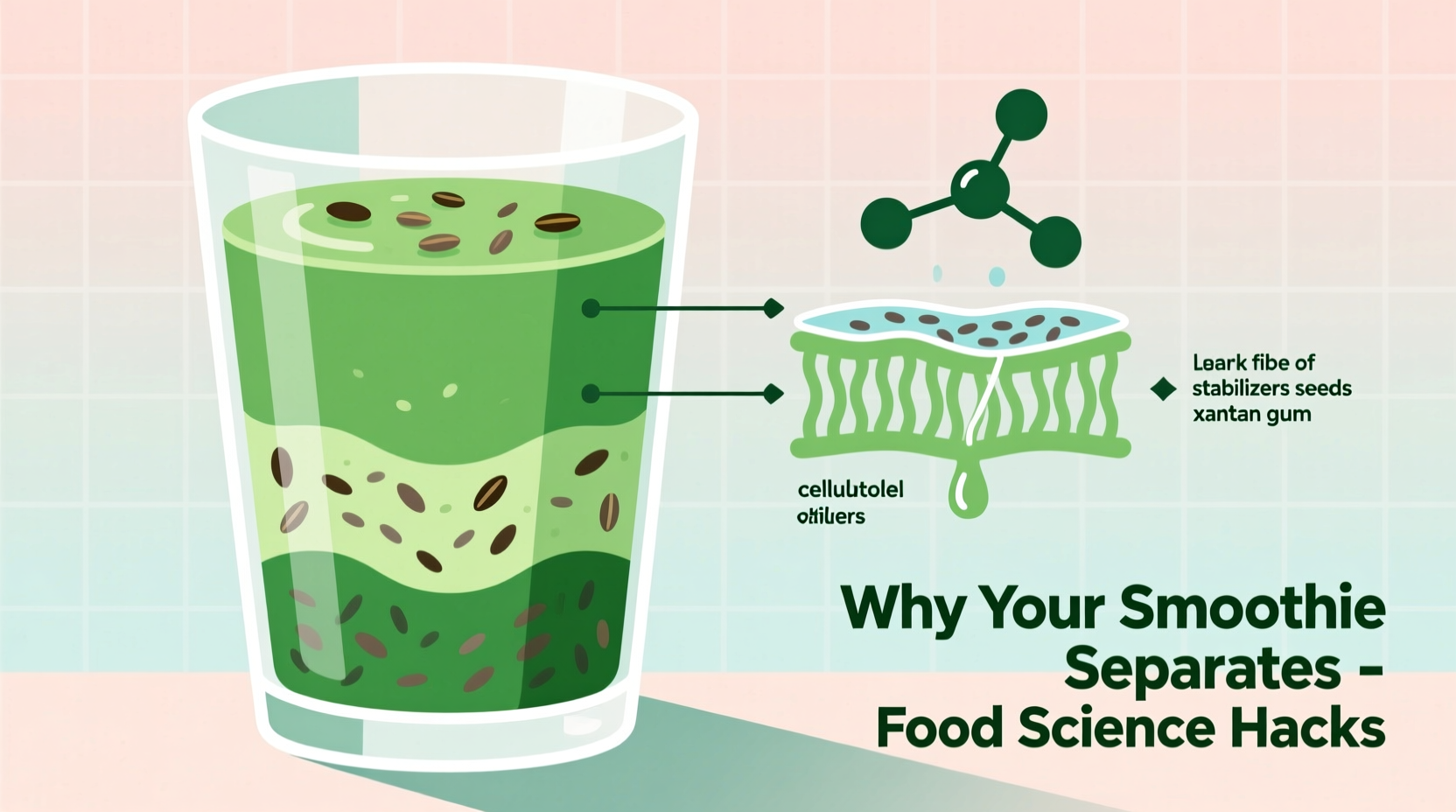
When ingredients are blended, they form a temporary mixture called a colloidal suspension—a dispersion of tiny particles throughout a liquid medium. In smoothies, this includes plant fibers, fruit pulp, ice shards, and fat droplets suspended in water-rich liquids like almond milk or juice. However, most smoothies are not true emulsions or gels, meaning they lack the structural integrity to resist separation over time.
Separation occurs due to several physical principles:
- Density differences: Heavier components (like banana chunks or spinach) sink, while lighter ones (such as air bubbles or oils) rise.
- Lack of stabilizers: Unlike commercial smoothies that contain gums or thickeners, homemade versions often rely on raw ingredients without natural binding agents.
- Aeration during blending: High-speed blenders introduce air, creating foam that eventually collapses and contributes to layering.
- Enzymatic activity: Fruits like pineapple and papaya contain proteolytic enzymes (bromelain and papain) that can break down proteins and alter texture over time.
As soon as blending stops, gravity and molecular motion begin working against homogeneity. Without sufficient viscosity or intermolecular bonding, the mixture naturally stratifies.
“Smoothie separation is inevitable unless you engineer stability through ingredient balance and functional additives.” — Dr. Lena Torres, Food Scientist at the Institute of Nutritional Biochemistry
Key Ingredients That Prevent Separation
The secret to a stable smoothie lies in selecting ingredients that either increase viscosity, promote emulsification, or form gels. These components act as natural stabilizers, helping maintain a uniform texture for longer periods.
Here are some of the most effective functional ingredients:
- Chia seeds and flaxseeds: Rich in soluble fiber, these seeds form a hydrophilic gel when soaked, acting as a thickener and suspension agent.
- Avocado: Provides healthy fats and natural emulsifiers that help bind water and oil phases together.
- Bananas: High in pectin and starch, which contribute to viscosity and creaminess.
- Oats: Rolled oats contain beta-glucan, a soluble fiber that increases thickness and slows sedimentation.
- Yogurt or kefir: Contain milk proteins (casein and whey) and lactic acid, which stabilize emulsions and lower pH to inhibit enzymatic breakdown.
- Nut butters: Peanut or almond butter introduces lecithin, a natural emulsifier that helps disperse fat evenly.
Conversely, certain ingredients accelerate separation. Juices high in water content (like apple or watermelon juice) dilute the mixture, reducing overall viscosity. Similarly, excessive ice can melt and create a watery base, especially if the smoothie sits for more than 10–15 minutes.
Blending Techniques for Maximum Stability
How you blend matters just as much as what you blend. Even with the right ingredients, poor technique can undermine stability.
Follow this optimized sequence for best results:
- Add liquids first to ensure even flow and prevent blade jamming.
- Layer soft ingredients next (yogurt, nut butter, avocado).
- Place fibrous or dense items (spinach, kale, frozen fruit) on top.
- Blend in stages: Start low, then ramp up to high speed for 30–60 seconds.
- Pause and scrape down sides if needed, then blend again briefly to incorporate any settled material.
Over-blending should be avoided. Extended high-speed blending incorporates too much air, leading to foaming. When the foam deflates, it leaves behind a dense bottom layer and separated top. Aim for smoothness, not froth.
| Technique | Effect on Stability | Recommendation |
|---|---|---|
| Layering ingredients properly | Ensures consistent blending and reduces clumping | Always follow liquid → soft → dense order |
| Using a tamper (if available) | Pushes ingredients into blades for uniform texture | Use with high-powered blenders only |
| Blending duration > 90 seconds | Increases aeration and heat, destabilizing emulsions | Limits to 60 seconds max |
| Adding ice last or pre-chilling ingredients | Reduces thermal shock and melting-induced dilution | Freeze fruit instead of using ice cubes |
Real-World Example: The Morning Commute Smoothie
Sarah, a busy marketing executive, prepares her green smoothie each morning before heading to work. Her typical recipe includes spinach, banana, mango, almond milk, and a scoop of protein powder. She blends it thoroughly and pours it into a travel bottle—but by the time she reaches the office 20 minutes later, the smoothie has visibly separated: a thin, yellowish liquid at the bottom and a thick green layer on top.
After researching the issue, Sarah modifies her approach. She replaces half the almond milk with plain Greek yogurt, adds one tablespoon of chia seeds soaked in advance, and swaps out ice for frozen banana chunks. She also invests in a vacuum-sealed bottle to minimize oxidation and shaking-induced layering.
The result? Her smoothie remains uniformly blended for over 45 minutes—long enough to enjoy it at her desk without stirring or re-blending. The texture is creamier, and she feels more satisfied due to the added protein and fiber.
Sarah’s case illustrates how small, science-informed changes can solve a common problem without sacrificing convenience or nutrition.
Step-by-Step Guide to a Non-Separating Smoothie
Follow this actionable routine to consistently make smoothies that stay blended:
- Choose a thickening agent: Select one from chia seeds, flaxseed, oats, avocado, or banana.
- Pre-soak seeds (if using): Mix chia or flax with your liquid base and let sit for 10 minutes.
- Use frozen fruit instead of ice: This cools the smoothie without diluting it as it melts.
- Incorporate a protein source: Greek yogurt, cottage cheese, silken tofu, or a scoop of protein powder adds structure.
- Add a natural emulsifier: Include a teaspoon of nut butter or tahini to bind fat and water.
- Layer ingredients correctly: Liquid first, then soft items, then fibrous or frozen ones.
- Blend efficiently: Pulse to combine, then blend on high for 45–60 seconds. Avoid over-processing.
- Transfer immediately: Pour into a sealed container and shake gently before drinking if stored.
For best shelf stability, consume within 1–2 hours. If storing longer, refrigerate in an airtight jar with minimal headspace to reduce oxidation.
Frequently Asked Questions
Can I add xanthan gum to prevent separation?
Yes. Xanthan gum is a powerful food-grade thickener used in commercial beverages. Just 1/8 to 1/4 teaspoon per smoothie can dramatically improve stability by increasing viscosity and preventing particle settling. It’s flavorless and dissolves easily when blended.
Why do store-bought smoothies stay mixed longer?
Commercial smoothies often contain stabilizers like pectin, guar gum, or cellulose gel. They’re also produced using industrial homogenizers that create finer particle dispersion and more stable emulsions than home blenders can achieve.
Does temperature affect separation?
Absolutely. Cold temperatures slow molecular movement and delay separation. However, freezing a smoothie and thawing it later can worsen texture due to ice crystal formation breaking cell walls. For optimal results, serve immediately or keep chilled—not frozen.
Checklist: Build a Stable Smoothie in 7 Steps
- ✅ Use at least one thickening ingredient (e.g., chia, banana, oats)
- ✅ Pre-soak chia or flaxseeds for better gel formation
- ✅ Replace ice with frozen fruit to avoid dilution
- ✅ Include a protein source (yogurt, protein powder, tofu)
- ✅ Add a natural emulsifier (nut butter, avocado, tahini)
- ✅ Blend in proper order: liquids → soft → frozen/fibrous
- ✅ Limit blending time to under 60 seconds to reduce aeration
Final Thoughts and Action Plan
Smoothie separation isn't a sign of failure—it's a predictable outcome of physics and chemistry. But with a deeper understanding of ingredient functionality and blending dynamics, you can turn instability into consistency. The goal isn’t perfection; it’s progress toward a smoother, more satisfying experience.
Start by tweaking one variable in your current recipe: swap ice for frozen banana, add a spoonful of chia, or try layering your ingredients differently. Observe the results. Then refine further. Over time, you’ll develop an intuitive sense of balance that keeps your smoothies unified, creamy, and ready to go.




 浙公网安备
33010002000092号
浙公网安备
33010002000092号 浙B2-20120091-4
Comments
No comments yet. Why don't you start the discussion?