
Vocal instability—especially cracking during singing—is one of the most common frustrations among singers at every level. Whether you're just starting out or have been performing for years, an unexpected break in your tone can undermine confidence and disrupt performance. The good news is that voice cracking is rarely a permanent flaw. More often, it’s a sign of muscular imbalance, poor breath support, or transitional shifts between vocal registers. Understanding the root causes and applying targeted techniques can dramatically improve your vocal control and eliminate unwanted breaks.
The Science Behind Vocal Cracking
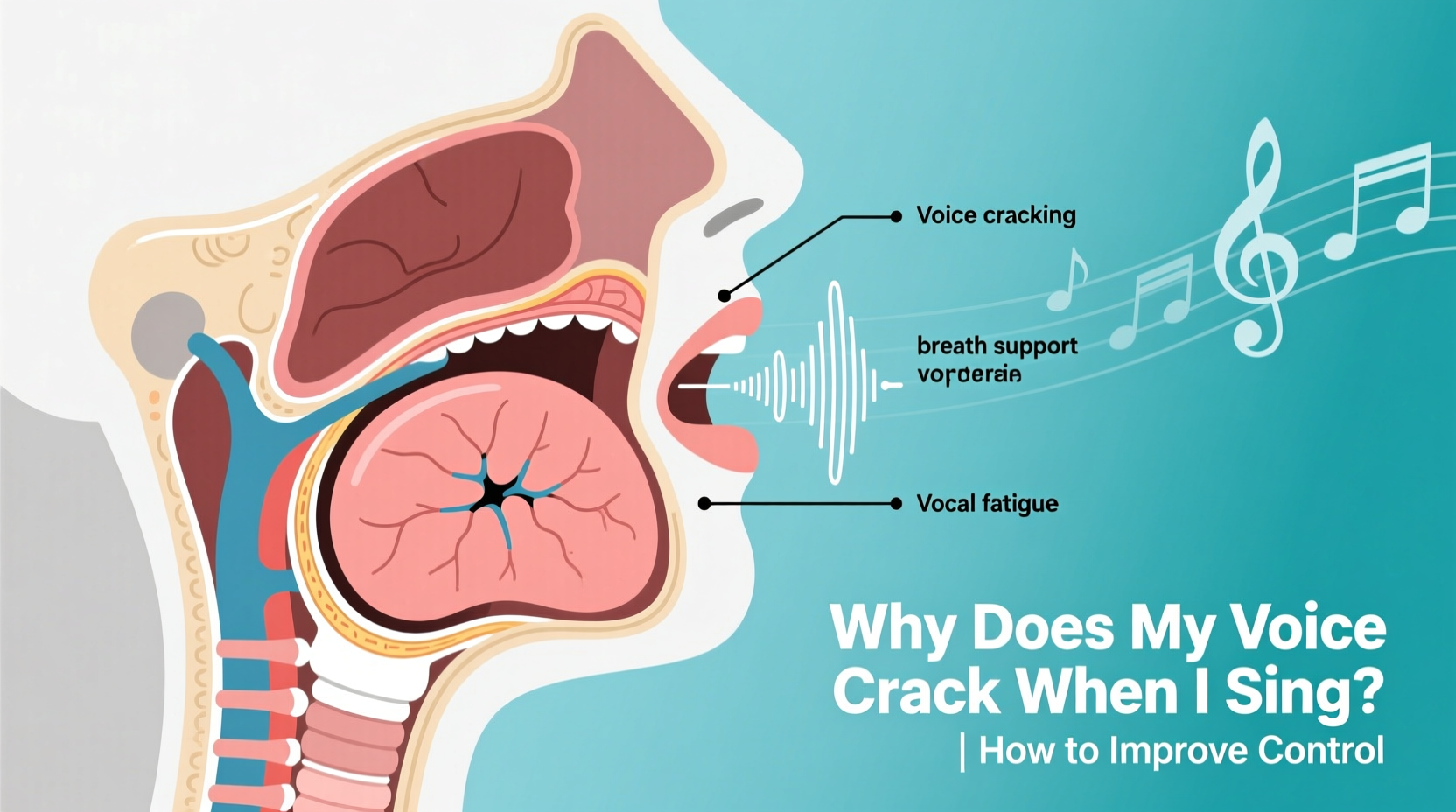
Your voice is produced by the vibration of the vocal folds within the larynx. As air passes from the lungs through the trachea, it causes these folds to oscillate, creating sound. The pitch you produce depends on the tension, length, and mass of the vocal folds—all controlled by small muscles in the larynx. When these muscles don’t coordinate smoothly, especially during transitions between lower and higher pitches, the result can be a sudden crack or break in tone.
This phenomenon is particularly common in the “passaggio”—the transitional zone between vocal registers such as chest voice and head voice. In this area, the laryngeal muscles must shift their dominance: from the thyroarytenoid (TA) muscles, which dominate in chest voice, to the cricothyroid (CT) muscles, which stretch the vocal folds for higher notes. If this shift isn’t balanced, the voice may crack as it struggles to maintain consistent resonance.
“Vocal breaks are not signs of weakness—they’re signals from your instrument telling you where coordination needs refinement.” — Dr. Ingo Titze, Voice Scientist and Director, National Center for Voice and Speech
Common Causes of Voice Cracking While Singing
Understanding what triggers vocal instability is the first step toward correcting it. Below are the primary contributors:
- Lack of breath support: Inadequate airflow forces the vocal folds to work harder, increasing strain and reducing control.
- Poor registration balance: Failing to blend chest and head voice leads to abrupt shifts and cracks at register boundaries.
- Tension in the throat or jaw: Excess tension restricts free movement of the larynx, making smooth transitions difficult.
- Inconsistent vocal fold closure: Air leakage due to incomplete closure results in breathy tones or sudden drops in volume and pitch.
- Fatigue or overuse: Singing beyond your current stamina weakens muscle coordination and increases the likelihood of breaks.
- Dehydration: Dry vocal folds vibrate less efficiently, increasing friction and instability.
Step-by-Step Guide to Smoother Vocal Transitions
Improving vocal control isn't about forcing your voice to behave—it's about training neuromuscular coordination so that transitions happen naturally. Follow this structured approach to build consistency across your range.
- Warm Up Thoroughly (5–10 minutes)
Begin with gentle lip trills and humming scales from your lowest comfortable note to your highest. This activates the vocal folds without strain and promotes even airflow. - Identify Your Passaggio Zones
Sing ascending and descending scales using a neutral vowel like “ah” or “uh.” Note where your voice feels strained or begins to crack. These are your transition zones—typically around E4–G4 for men and A4–C5 for women. - Use Semi-Occluded Vocal Tracts (SOVT)
Practice lip trills, straw phonation, or tongue trills. These exercises create backpressure that stabilizes the vocal folds and reduces effort during registration shifts. - Bridge the Registers with Mixed Voice
Gradually lighten your chest voice as you ascend and add more resonance as you enter head voice. Use syllables like “ng” (as in “sing”) or “wee” to encourage a balanced mix. - Strengthen Breath Support
Practice diaphragmatic breathing: inhale deeply into the lower abdomen, then sustain a hiss or a sustained “ss” for 20+ seconds. Apply this support when singing challenging phrases. - Record and Analyze Weekly
Use audio recordings to monitor progress. Listen specifically for smoothness in transitions and reductions in cracking frequency.
Do’s and Don’ts for Vocal Stability
| Do | Don’t |
|---|---|
| Warm up before extended singing | Sing loudly without preparation |
| Stay hydrated with room-temperature water | Consume caffeine or alcohol before singing |
| Use light onset for high notes | Push or yell to hit high pitches |
| Practice daily for short durations (15–30 min) | Practice for hours without rest |
| Work with a qualified vocal coach | Rely solely on online tutorials for technique |
Mini Case Study: Overcoming Vocal Breaks in a Pop Singer
Jessica, a 26-year-old pop vocalist, struggled with cracking on the chorus of her original song, particularly on sustained G#4 notes. During live performances, she would either avoid the note or push through it with noticeable strain. After consulting a vocal therapist, she discovered that her issue stemmed from excessive laryngeal tension and inadequate mixed voice development.
Over six weeks, Jessica followed a regimen focused on SOVT exercises, breath management, and gradual glides (portamento) through her passaggio. She replaced belted vowels with softer “oo” and “wee” sounds during practice and recorded herself three times per week. By week five, her cracks had reduced by over 80%, and she was able to belt the G#4 with clarity and control. Her breakthrough came not from power, but from precision in coordination.
Expert Techniques to Improve Vocal Control
Professional singers and voice teachers use several advanced methods to refine vocal stability. Incorporating even one of these into your routine can yield significant improvements.
1. Resonance Tuning
Adjusting the shape of your vocal tract (pharynx, mouth, tongue) can amplify certain harmonics, making high notes easier to produce. Try narrowing the pharynx slightly and raising the soft palate—imagine the feeling of a quiet yawn—to enhance resonance without strain.
2. Forward Placement
Directing sound toward the “mask” (the area around the nose and upper teeth) improves projection and reduces throat tension. Humming with a bright, nasal quality can help locate this sensation.
3. Dynamic Onset Training
There are three types of vocal onsets: hard (glottal), breathy, and balanced. Aim for a balanced onset—where airflow and vocal fold closure occur simultaneously. Practice saying “hung” gently, then transition to “ha” on pitch.
4. Vowel Modification
Slightly altering vowels as you ascend prevents overcrowding of formants. For example, change “ah” to a more “uh”-like sound around the passaggio. This keeps resonance optimal and reduces strain.
“The key to seamless singing isn’t avoiding the break—it’s learning to glide across it with intention and ease.” — Seth Riggs, Founder of Speech Level Singing
Checklist: Daily Routine for Better Vocal Control
Follow this checklist every day to build strength, flexibility, and consistency in your voice:
- ✅ Hydrate upon waking and continue sipping water all day
- ✅ Perform 5 minutes of diaphragmatic breathing exercises
- ✅ Warm up with 5 minutes of lip trills and humming
- ✅ Sing 2–3 octaves of 5-note scales using “me,” “may,” “moo,” “mah,” “meh”
- ✅ Practice 2 minutes of straw phonation in water (straw submerged in a glass)
- ✅ Sing your problem passage slowly, focusing on smooth transitions
- ✅ Cool down with gentle descending sirens on “woo”
- ✅ Record yourself weekly and track progress
Frequently Asked Questions
Is voice cracking a sign of vocal damage?
No, occasional cracking during challenging phrases is normal and usually indicates coordination issues, not injury. However, persistent hoarseness, pain, or loss of range should be evaluated by an ENT or voice specialist.
Can adults still develop better vocal control?
Absolutely. The vocal mechanism remains adaptable throughout life. With consistent, correct practice, singers in their 30s, 40s, and beyond can achieve greater control and expand their range.
How long does it take to stop voice cracking?
Most singers notice improvement within 2–4 weeks of daily practice. Significant reduction in cracking typically occurs within 6–12 weeks, depending on the individual’s starting point and consistency.
Conclusion: Take Control of Your Voice
Voice cracking isn’t a flaw—it’s feedback. It tells you where your technique needs refinement and offers a roadmap for growth. With targeted exercises, proper breath support, and mindful practice, you can smooth out transitions, strengthen your mixed voice, and sing with confidence across your entire range. Progress doesn’t come from perfection, but from persistence. Start today with one simple exercise, stay consistent, and listen closely to your voice’s evolving strength.




 浙公网安备
33010002000092号
浙公网安备
33010002000092号 浙B2-20120091-4
Comments
No comments yet. Why don't you start the discussion?