
In the world of anime, visual language often supersedes realism. Few characters exemplify this better than Naruto Uzumaki, whose instantly recognizable running pose—arms held stiffly behind him, torso leaning forward, legs churning in exaggerated motion—has become a cultural icon. At first glance, this stance appears to defy basic human biomechanics. Why would anyone run with their arms pinned behind them? From a physics standpoint, it makes no sense. Yet, within the context of animation and narrative design, Naruto’s running form is not only intentional—it’s masterful. This article explores the confluence of artistic choice, animation efficiency, and symbolic storytelling that explains why Naruto runs the way he does.
The Visual Signature: Styling Over Realism
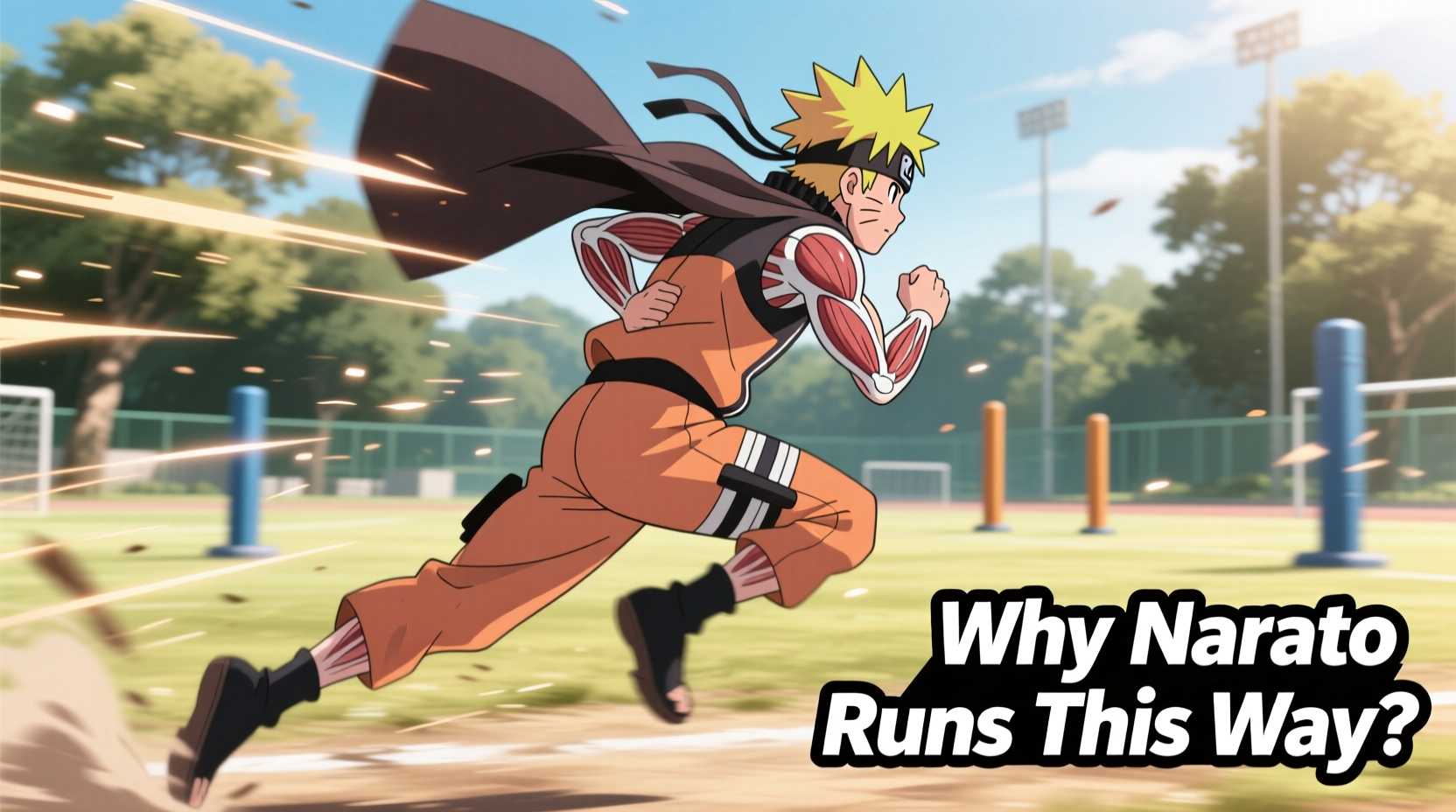
Anime thrives on stylization. Unlike Western animation, which often leans toward naturalistic movement, Japanese animation frequently prioritizes expressiveness and symbolic clarity over physical accuracy. Naruto’s running posture is a prime example of this philosophy. The character sprints with his arms straight back, palms open or slightly curled, elbows locked, and shoulders pulled tight. His body forms a near-horizontal line, evoking speed and urgency even when the background remains static.
This stylized sprint isn’t exclusive to Naruto. Other shonen protagonists—like Ichigo from *Bleach* or Gon from *Hunter x Hunter*—adopt similar postures during high-speed sequences. However, Naruto’s version is the most exaggerated and consistently used, making it a signature element of his identity. The pose transcends mere movement; it becomes a visual metaphor for relentless forward momentum, both literally and thematically.
Animation Efficiency and Production Practicality
One of the most practical reasons for Naruto’s distinctive run lies in animation production constraints. Traditional hand-drawn animation is labor-intensive. Every frame must be drawn, checked, and assembled into fluid motion. To reduce workload, animators use \"cycles\"—repeating sequences of movement that can be reused across scenes. A simplified running cycle allows studios to maintain consistent pacing without redrawing complex arm swings repeatedly.
Naruto’s arms-back posture minimizes joint articulation. With arms extended and mostly static, animators avoid drawing detailed shoulder, elbow, and wrist movements frame by frame. This creates a streamlined workflow, especially during long chase scenes or montages where Naruto dashes across vast distances. The pose also eliminates the need for precise hand positioning or shadow work, further cutting down on detail time.
Moreover, the horizontal body angle simplifies perspective rendering. Instead of rotating limbs through multiple planes, the character moves primarily along a single axis, reducing parallax complexity. This technique was particularly valuable during the early 2000s when *Naruto* premiered, and digital assistance in animation was less advanced.
Animation Trade-offs: Simplicity vs. Realism
| Aspect | Realistic Running Animation | Naruto-Style Running Animation |
|---|---|---|
| Arm Movement | Full swing, coordinated with legs | Arms fixed behind, minimal motion |
| Frame Count per Cycle | 8–12 frames | 4–6 frames (reusable) |
| Production Time | High (detailed articulation) | Low (limited limb variation) |
| Visual Impact | Naturalistic, subtle | Dynamic, exaggerated, iconic |
| Use Case | Dramatic close-ups, grounded scenes | Action sequences, transitions, fast pacing |
This table illustrates how stylistic choices directly influence production efficiency. While realistic running offers anatomical fidelity, Naruto’s version optimizes for speed, repetition, and recognizability—key assets in a weekly television series with tight deadlines.
Physics of Human Locomotion: Why It Shouldn’t Work
From a biomechanical perspective, Naruto’s running style violates fundamental principles of human motion. In real-world sprinting, arm swing counterbalances leg movement, stabilizes the torso, and contributes up to 10% of forward propulsion. The arms move opposite the legs—left arm forward with right leg, and vice versa—creating rotational equilibrium around the spine.
Running with arms locked behind the body would severely impair balance and efficiency. It increases torsional stress on the lower back, reduces stride coordination, and limits oxygen intake due to restricted thoracic expansion. Sprinters like Usain Bolt rely on powerful, synchronized arm drive to achieve peak velocity. Without it, acceleration drops significantly.
Furthermore, Naruto’s near-horizontal posture contradicts optimal sprinting angles. Elite runners begin at a 45-degree incline during acceleration but quickly rise to an upright position. Sustained horizontal lean creates excessive air resistance and shifts center of gravity too far forward, increasing fall risk. Naruto maintains this angle indefinitely, even at supposed superhuman speeds, which would be physically unsustainable.
“Anime doesn’t aim to replicate reality—it amplifies emotion through distortion. Naruto’s run isn’t about physics; it’s about conveying unstoppable will.” — Dr. Kenji Tanaka, Animation Studies Scholar, Tokyo University of the Arts
Symbolism and Narrative Function
Beyond production logistics and biomechanics, Naruto’s running style serves a deeper narrative purpose. The character is defined by perseverance, defiance of limits, and constant forward motion. Orphaned, ostracized, and underestimated, Naruto’s entire arc revolves around pushing beyond boundaries—both personal and physical.
His running pose visually embodies this ethos. By rejecting natural human gait, the animation suggests that Naruto operates outside conventional rules. He doesn’t just run—he surges ahead, unburdened by doubt or limitation. The arms-back stance resembles a projectile more than a person, reinforcing his role as a force of nature within the story.
This symbolism intensifies during key moments. In episodes where Naruto unlocks new powers—Nine-Tails chakra, Sage Mode, or Six Paths abilities—his run often becomes even more exaggerated, sometimes leaving afterimages or distorting the background. These visual cues signal transformation and transcendence, using motion as a narrative device.
Mini Case Study: The Sasuke Retrieval Arc
During the climactic Sasuke Retrieval Arc, Naruto sprints across rugged terrain to stop his friend from leaving the village. The sequence features prolonged shots of his arms-back run, intercut with flashbacks and internal monologue. Despite injuries and exhaustion, his posture never changes. This consistency isn’t accidental—it underscores his determination.
Animators could have shown fatigue through slumped shoulders or uneven strides. Instead, they maintain the rigid sprint throughout, turning the run into a visual mantra: *I will bring you back.* The unrealistic physics amplify the emotional stakes, making the journey feel epic rather than merely physical.
Evolution Across the Series: From Cartoonish to Cinematic
As *Naruto* progressed into *Shippuden* and later *Boruto*, animation quality improved significantly. Digital tools allowed for smoother motion, dynamic camera angles, and more anatomically accurate sequences. In high-budget fight scenes, Naruto is often shown with proper arm swing, especially during taijutsu combat or short bursts of movement.
Yet, the classic arms-back run persists. It reappears during transitions, training montages, and moments of symbolic importance. Its recurrence acts as a callback to Naruto’s origins—a reminder of the scrappy Genin who never gave up. Even in adulthood, when he assumes the role of Hokage, brief flashes of the old run appear in nostalgic sequences, linking past and present.
This duality reflects a broader trend in modern anime: blending stylized tradition with cinematic realism. The arms-back run survives not because it’s accurate, but because it’s meaningful. It has evolved from a production shortcut into a cultural motif.
Frequently Asked Questions
Is Naruto’s running style based on any real martial arts technique?
No, there is no known martial art or athletic discipline that uses arms-back running. Some speculate it may loosely resemble certain kendo stances or sprint starts, but these comparisons are superficial. The pose is purely a product of anime aesthetics, not functional combat training.
Do other anime characters run the same way?
Yes, many shonen protagonists adopt variations of this style. Goku from *Dragon Ball*, for instance, often runs with arms low and slightly back during flight or high-speed travel. Similarly, Luffy from *One Piece* uses exaggerated forward leans. However, Naruto’s version remains the most rigid and widely imitated.
Has the animation team ever explained the reason for this running style?
While no official statement explicitly confirms the rationale, interviews with animators from Studio Pierrot suggest that simplicity and recognizability were key factors. In commentary tracks and fan events, staff have referred to the run as “Naruto’s dash” — a deliberate branding choice meant to make him instantly identifiable even in silhouette.
Step-by-Step: How Animators Achieve the Effect
Understanding how Naruto’s run is created helps appreciate its blend of artistry and practicality. Here’s a breakdown of the process:
- Storyboarding: Directors decide when to use the arms-back run—typically during long-distance travel or emotional sequences.
- Keyframe Creation: Lead animators draw the primary poses: full extension forward, mid-stride, and push-off.
- Limb Simplification: Arms are kept straight and behind, minimizing joint detail. Hands are often left open or slightly spread.
- Background Motion: Scrolling or blurred backgrounds simulate speed without requiring complex character animation.
- Cycle Reuse: The completed sequence is looped and applied across multiple scenes, adjusted for pace and perspective.
- Embellishment: In dramatic moments, dust trails, afterimages, or chakra effects are added to enhance intensity.
This method ensures consistency while allowing flexibility for emotional tone. A slow, determined run might use longer frames and heavier footfalls, while a frantic chase employs rapid cycling and shaky cam effects.
Conclusion: Motion as Identity
Naruto’s arms-back running style is more than a quirk—it’s a convergence of artistic necessity, narrative symbolism, and cultural resonance. While it defies the laws of physics, it adheres to the deeper logic of storytelling: that form follows function, and in anime, function is often emotional truth.
What began as a pragmatic solution to animation constraints has become one of the most recognizable silhouettes in global pop culture. It reminds viewers that Naruto isn’t bound by ordinary rules—neither in movement nor in spirit. His run isn’t about how humans move; it’s about how dreams propel us forward, against all odds.




 浙公网安备
33010002000092号
浙公网安备
33010002000092号 浙B2-20120091-4
Comments
No comments yet. Why don't you start the discussion?