
Popcorn is more than just a movie-night staple—it’s a marvel of food physics. The transformation from a small, rock-hard kernel to a light, airy puff happens in seconds, accompanied by a satisfying snap. But what makes this happen? The answer lies not in magic, but in the precise interplay of moisture, heat, steam, and pressure. Understanding this process reveals how nature and chemistry come together to create one of the most universally loved snacks.
Unlike other grains, popcorn kernels possess a unique structure that allows them to explode under heat. This phenomenon isn’t random; it’s governed by thermodynamics and material science. By exploring the anatomy of the kernel, the role of water, and the buildup of internal pressure, we gain insight into a natural mini-explosion that occurs in millions of homes every day.
The Anatomy of a Popcorn Kernel
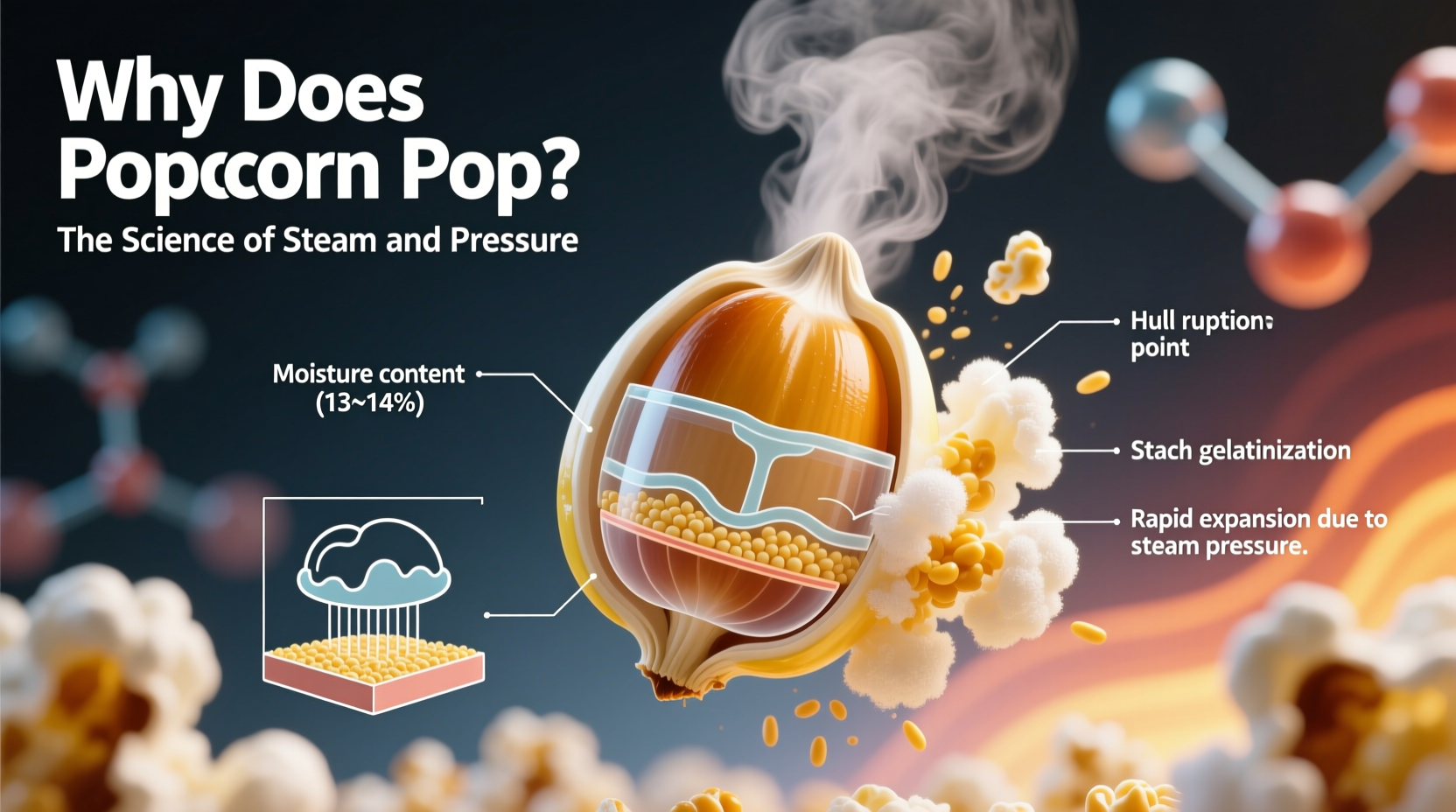
To understand why popcorn pops, you must first understand its structure. A popcorn kernel consists of three main parts: the outer hull (or pericarp), the starchy endosperm, and a small amount of moisture trapped inside.
- Hull: This tough, fibrous shell protects the inner components. It's composed primarily of cellulose and is strong enough to contain high internal pressure until the critical moment.
- Endosperm: This dense core contains starch and proteins. When heated, the starch gelatinizes and expands.
- Moisture: Each kernel contains about 13–14% water. This trapped water is essential for popping—it turns into steam when heated, creating the pressure needed for explosion.
Not all corn can pop. Only the variety Zea mays everta has the right combination of a dense endosperm and a moisture-sealing hull. Other types of corn, like sweet or field corn, lack the structural integrity to build up sufficient pressure and simply burn or shrivel when heated.
From Heat to Explosion: The Physics of Popping
The popping process begins when the kernel is exposed to heat—typically between 350°F and 400°F (175°C to 205°C). As the temperature rises, the water inside the kernel begins to turn into steam. Because the hull is nearly impermeable, the steam cannot escape, causing pressure to build rapidly within the confined space.
At around 180°C (356°F), the internal pressure reaches approximately 135 pounds per square inch (psi)—nearly nine times the atmospheric pressure at sea level. At this point, the hull can no longer withstand the stress and ruptures suddenly. The release is explosive.
When the hull breaks, the pressurized steam escapes instantly, causing the superheated starch and water mixture to expand outward. The starch rapidly cools and solidifies into a foam-like structure—the familiar white, fluffy part of popped popcorn. This entire process takes less than 1/10th of a second.
“Popcorn is a perfect example of a phase transition driven by pressure and heat. The rapid expansion of steam forces the starch matrix to inflate like a balloon before freezing in place.” — Dr. Rebecca Lin, Food Physicist, MIT
Why Some Kernels Don’t Pop: The Mystery of “Old Maids”
If you’ve ever made popcorn, you’ve likely encountered unpopped kernels at the bottom of the bowl. These are commonly called “old maids,” and they fail to pop due to one of several reasons:
- Inadequate moisture: If a kernel has lost too much water over time, there won’t be enough steam to generate pressure.
- Cracked hull: Even a tiny fissure in the hull allows steam to leak out gradually, preventing pressure buildup.
- Uneven heating: In microwave or stovetop methods, some kernels may not receive consistent heat, stalling the popping process.
Studies have shown that popcorn stored in dry environments for extended periods loses popping efficiency. The ideal moisture content is 13.5%—any lower, and the likelihood of failure increases significantly.
| Mechanism | Effect on Popping | Solution |
|---|---|---|
| Low moisture | No steam buildup → no pop | Store in sealed container; rehydrate slightly if stale |
| Cracked shell | Steam leaks → insufficient pressure | Inspect kernels; avoid rough handling |
| Overheating | Burning before popping completes | Use medium heat; monitor closely |
| Underheating | Not enough energy to reach popping point | Ensure consistent, adequate heat source |
Optimizing Your Pop: A Step-by-Step Guide
Whether you're using a stovetop, air popper, or microwave, maximizing the number of popped kernels requires attention to detail. Follow this timeline to achieve near-perfect results:
- Select fresh kernels: Purchase from a reputable source with a recent production date. Avoid pre-packaged microwave bags if you want control over ingredients.
- Test moisture (optional): If kernels are old, place them in a sealed jar with a damp paper towel for 1–2 days to restore moisture.
- Preheat oil (for stovetop): Use a heavy-bottomed pot. Add 2–3 tablespoons of oil (e.g., coconut, canola) and heat to 350°F.
- Add kernels in a single layer: Use enough kernels to cover the bottom of the pan without overcrowding—about 1/3 cup for a standard pot.
- Cover and shake: Put on a lid and gently shake the pot every 10–15 seconds to prevent burning and ensure even heating.
- Listen for the pops: Popping starts within 2–3 minutes. When pops slow to 2–3 seconds between each, remove from heat.
- Let sit briefly: Allow the pot to rest off the burner for 30 seconds. Residual heat may pop a few more kernels.
- Season immediately: Transfer to a bowl and add salt, butter, or spices while still warm for better adhesion.
Real-World Example: The Theater vs. Home Popcorn Dilemma
Movie theaters often boast perfectly popped, uniformly fluffy popcorn. How do they achieve such consistency? Consider the case of a regional cinema chain that switched from microwave bags to commercial hot-air poppers. After the change, customer complaints about unpopped kernels dropped by 78% within two months.
The reason? Controlled environment. Commercial machines use calibrated heating elements and continuous airflow to maintain a steady 400°F. Kernels move through a heated chamber where each one receives equal exposure. Combined with high-quality, freshly stored kernels, the result is a near-100% popping rate.
This real-world scenario illustrates that while the science of popping is universal, execution matters. Home users can replicate this success by mimicking these conditions: consistent heat, good airflow, and optimal kernel quality.
Expert Tips and Best Practices Checklist
Maximize your popcorn experience with these proven strategies:
- ✅ Store kernels in an airtight glass jar away from sunlight and humidity.
- ✅ Use a heavy-bottomed pot to distribute heat evenly and prevent scorching.
- ✅ Avoid overcrowding the pan—this leads to uneven popping and steaming instead of cracking.
- ✅ Choose oils with high smoke points (like avocado or refined coconut oil) for stovetop popping.
- ✅ Never leave popping unattended—burnt popcorn develops acrid flavors and harmful compounds.
- ✅ Experiment with seasoning timing—some spices burn easily, so add after popping.
- ✅ Rehydrate old kernels if fewer than 80% are popping.
“Popcorn is 100% whole grain and naturally low in calories—when air-popped and lightly seasoned, it’s one of the healthiest snack options available.” — Dr. Naomi Feldman, Nutrition Scientist, Harvard T.H. Chan School of Public Health
Frequently Asked Questions
Can you pop popcorn without oil?
Yes. Air poppers use heated air to pop kernels without added fat. You can also use a brown paper bag in the microwave—fold the top and heat for 2–3 minutes. Results are lower in calories and fat, though some find the texture drier.
Why does popcorn sometimes taste chewy?
Chewiness usually means steam wasn’t allowed to escape. When popcorn is covered too soon after popping or left in the pot, moisture gets trapped and softens the crisp texture. Always transfer popped corn to a wide bowl immediately.
Is microwave popcorn safe?
Most commercial microwave popcorn is safe when consumed occasionally. However, some brands contain diacetyl (linked to “popcorn lung”) or high levels of sodium and artificial flavors. Look for brands with simple ingredients: popcorn, oil, and salt. Better yet, make your own.
The Science Behind the Snap: What Happens in Slow Motion
High-speed camera studies have revealed fascinating details about the popping process. Researchers at Purdue University recorded popcorn explosions at 2,000 frames per second, capturing stages invisible to the naked eye.
First, the kernel shakes as internal pressure builds. Then, a small fracture forms at the weakest point of the hull—usually near the tip. Within milliseconds, the hull splits open, and the starchy interior erupts outward in a shape resembling a blooming flower. The center flips inside out, expanding up to 40 times its original volume.
Interestingly, the popping sound isn’t caused by the hull breaking. Instead, it’s the rapid release of steam into the air—a mini sonic boom created when vapor escapes at supersonic speeds. This was confirmed using acoustic sensors synchronized with video footage.
Moreover, the final shape of the popped kernel depends on how quickly the starch sets. Faster cooling produces a denser, crisper texture, while slower cooling can lead to a softer, chewier bite.
Conclusion: Harness the Power of Steam and Pressure
The next time you hear the first pop in a hot pan, remember—you’re witnessing a miniature scientific event. The humble popcorn kernel demonstrates fundamental principles of physics and chemistry in action: phase changes, pressure dynamics, and structural failure—all leading to a delicious reward.
By understanding the science, you’re not just making a snack; you’re conducting a controlled experiment. With the right conditions—moisture, heat, and patience—you can consistently achieve light, fluffy results and minimize those frustrating unpopped leftovers.




 浙公网安备
33010002000092号
浙公网安备
33010002000092号 浙B2-20120091-4
Comments
No comments yet. Why don't you start the discussion?