
When people hear that evolution is “just a theory,” they often assume it’s uncertain, speculative, or unproven. This misunderstanding stems from a confusion between how the word \"theory\" is used in everyday conversation versus its precise meaning in science. In reality, calling evolution a \"theory\" does not diminish its validity—it underscores its strength. Evolution is one of the most robust, well-supported frameworks in modern biology, backed by overwhelming evidence from genetics, paleontology, geology, and comparative anatomy. Understanding why evolution remains a \"theory\" requires a closer look at scientific terminology, the nature of evidence, and how science builds knowledge over time.
What Does “Theory” Mean in Science?
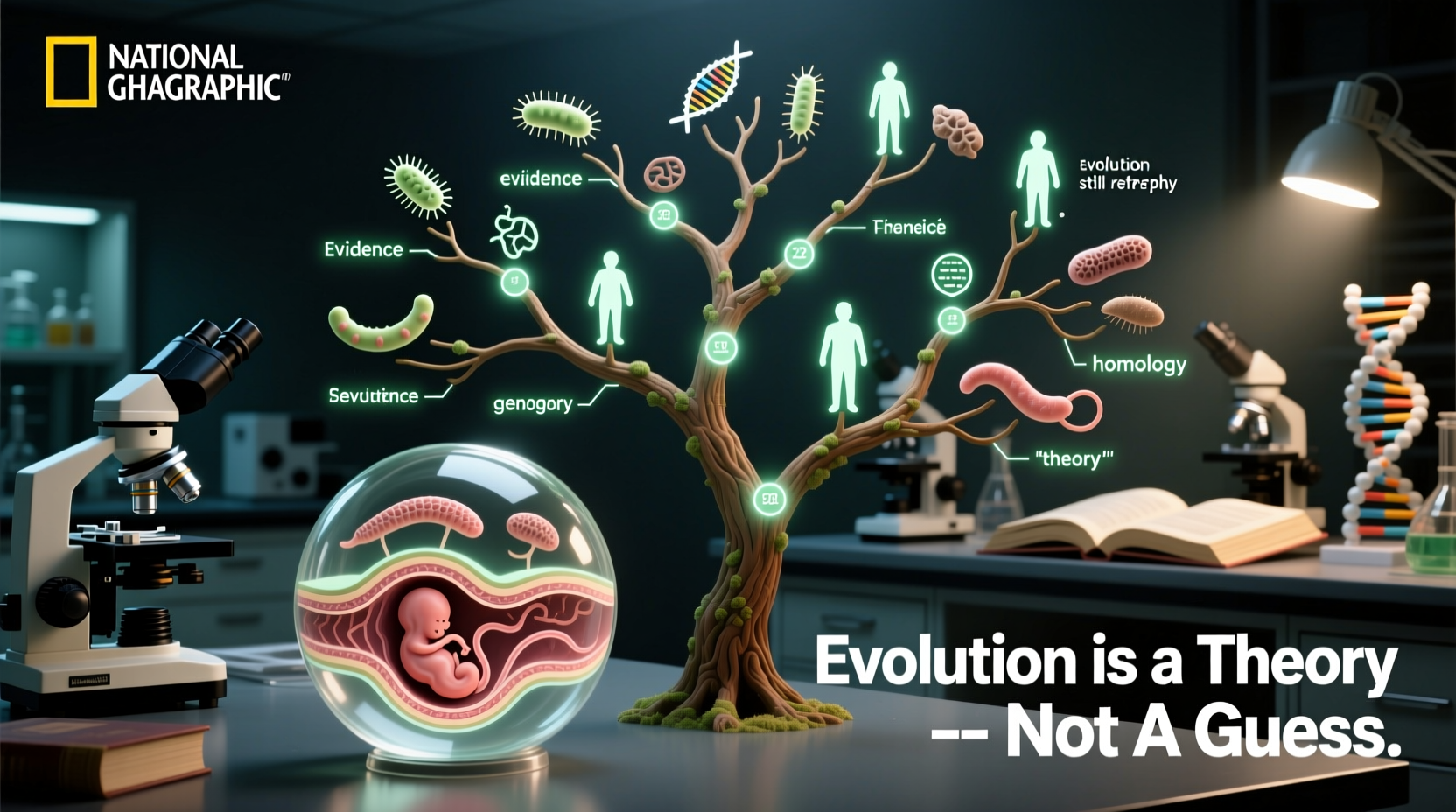
In casual speech, people often use “theory” to mean a guess or hunch—something unproven. For example, someone might say, “I have a theory about why the traffic was bad today.” But in science, a theory is far more rigorous. A scientific theory is a well-substantiated explanation of some aspect of the natural world that is based on a body of evidence and has stood up to repeated testing and scrutiny.
Theories do not become facts; rather, they explain facts. The fact of evolution—the observation that species change over time—is supported by fossil records, DNA analysis, and observable changes in populations. The *theory* of evolution explains *how* these changes occur, primarily through mechanisms like natural selection, genetic drift, and mutation.
“Evolution is both a fact and a theory. It is a fact that organisms have changed over time. It is a theory that natural selection is the primary mechanism driving those changes.” — Douglas J. Futuyma, evolutionary biologist
Why Isn’t Evolution Called a “Law” Instead?
Some wonder why evolution isn't elevated to the status of a \"law,\" like Newton's laws of motion. But scientific laws and theories serve different purposes. Laws describe *what* happens under certain conditions (e.g., gravity pulls objects toward each other), while theories explain *why* and *how* phenomena occur.
For instance, the law of gravity describes the attraction between masses, but Einstein’s theory of general relativity explains how gravity works through the curvature of spacetime. Similarly, evolution is not a simple rule that can be condensed into a single equation—it’s a complex explanatory framework that integrates vast amounts of data across disciplines. That complexity is precisely why it qualifies as a theory, not a shortcoming.
Evidence Supporting Evolutionary Theory
The theory of evolution is supported by multiple independent lines of evidence that converge on the same conclusion. These include:
- Fossil Record: Shows transitional forms and chronological changes in species over millions of years.
- Comparative Anatomy: Reveals homologous structures (like the similar bone layout in human arms, bat wings, and whale flippers) indicating common ancestry.
- Genetics: DNA sequencing shows shared genes across species, with closer relatives having more similar genomes.
- Biogeography: Distribution of species aligns with geological history, such as marsupials predominantly in Australia.
- Observed Evolution: Real-time examples like antibiotic resistance in bacteria and changes in finch beak size during droughts.
Each of these fields independently supports evolutionary theory, and together they form an interlocking web of evidence so strong that no credible alternative exists within the scientific community.
Real Example: The Evolution of Whales
A compelling case study is the evolutionary transition of whales from land-dwelling mammals to fully aquatic creatures. Fossils like *Pakicetus*, *Ambulocetus*, and *Dorudon* show a clear progression: animals with limbs capable of walking on land, then amphibious forms, and finally streamlined, ocean-going whales with vestigial hind limbs. Genetic studies confirm that whales are most closely related to even-toed ungulates like hippos. This convergence of fossil, anatomical, and genetic evidence exemplifies how evolutionary theory makes accurate predictions and ties together diverse data.
Common Misconceptions About Evolution as a Theory
Several myths persist about why evolution is “only” a theory. Below is a table clarifying misconceptions versus scientific reality:
| Misconception | Scientific Reality |
|---|---|
| “It’s just a theory, so it’s not proven.” | In science, theories are explanations supported by extensive evidence. Evolution is as well-supported as germ theory or atomic theory. |
| “If it were true, it wouldn’t still be a theory.” | Theories don’t graduate into facts. They explain facts. No amount of evidence turns a theory into something “bigger.” |
| “Scientists are unsure about evolution.” | Over 99% of actively publishing biologists accept evolution as the foundation of life sciences. |
| “Gaps in the fossil record disprove evolution.” | Gaps are expected due to the rarity of fossilization. Many transitional forms have been found, and new discoveries continue to fill in the picture. |
How Scientific Knowledge Evolves
Science is inherently self-correcting. Theories are not static—they grow and refine as new evidence emerges. For example, Darwin’s original theory did not include genetics, since DNA was unknown in the 19th century. Today, the modern evolutionary synthesis combines natural selection with genetic principles, making the theory stronger and more comprehensive.
This adaptability is a strength, not a weakness. When scientists say evolution is a theory, they are acknowledging that it is a living framework—one that welcomes new data, allows for refinement, and remains open to testing. Unlike dogma, scientific theories must survive constant challenge.
Step-by-Step: How Scientists Evaluate a Theory
- Observe natural phenomena (e.g., variation in beak size among Galápagos finches).
- Form a hypothesis (e.g., beak size changes with food availability).
- Test through experiments or observations (measure beak changes before and after drought).
- Analyze results and determine if they support the hypothesis.
- Replicate findings across studies and researchers.
- Integrate into broader theory if consistently supported (in this case, natural selection).
- Revise or expand the theory as new data emerges (e.g., adding epigenetic influences).
Frequently Asked Questions
Does calling evolution a theory mean scientists doubt it?
No. In science, “theory” signifies a well-tested explanation, not uncertainty. Scientists don’t doubt evolution any more than engineers doubt the theory of electromagnetism when building circuits.
Can a theory be replaced?
Yes, but only by a better explanation that accounts for all existing evidence and makes more accurate predictions. No such alternative to evolution exists. Creationism and intelligent design lack testable hypotheses and empirical support, so they are not scientific theories.
Has the theory of evolution changed over time?
Yes—and that’s a good thing. Since Darwin, the theory has incorporated genetics, molecular biology, and developmental biology. These additions have strengthened, not weakened, the core principle that life evolves through natural processes.
Conclusion: Embracing Scientific Literacy
Understanding why evolution is called a theory is essential to scientific literacy. It reflects not uncertainty, but depth—a comprehensive, evidence-based explanation for the diversity of life on Earth. Confusing colloquial and scientific meanings of “theory” leads to unnecessary skepticism about one of humanity’s greatest intellectual achievements.
Evolution is not a guess, a belief, or a controversy within science. It is the foundational concept of biology, guiding research in medicine, agriculture, and conservation. Recognizing its status as a theory affirms its power and reliability.




 浙公网安备
33010002000092号
浙公网安备
33010002000092号 浙B2-20120091-4
Comments
No comments yet. Why don't you start the discussion?