
Evolution remains one of the most robustly supported theories in modern science, underpinning biology, genetics, paleontology, and medicine. Yet, despite overwhelming evidence, public skepticism persists. Many people question its validity based on misunderstandings, philosophical concerns, or religious beliefs. This article examines the most frequently cited objections to evolution—not to discredit science, but to clarify misconceptions, address legitimate questions, and present the current scientific understanding with clarity and respect.
Common Objections and Scientific Responses
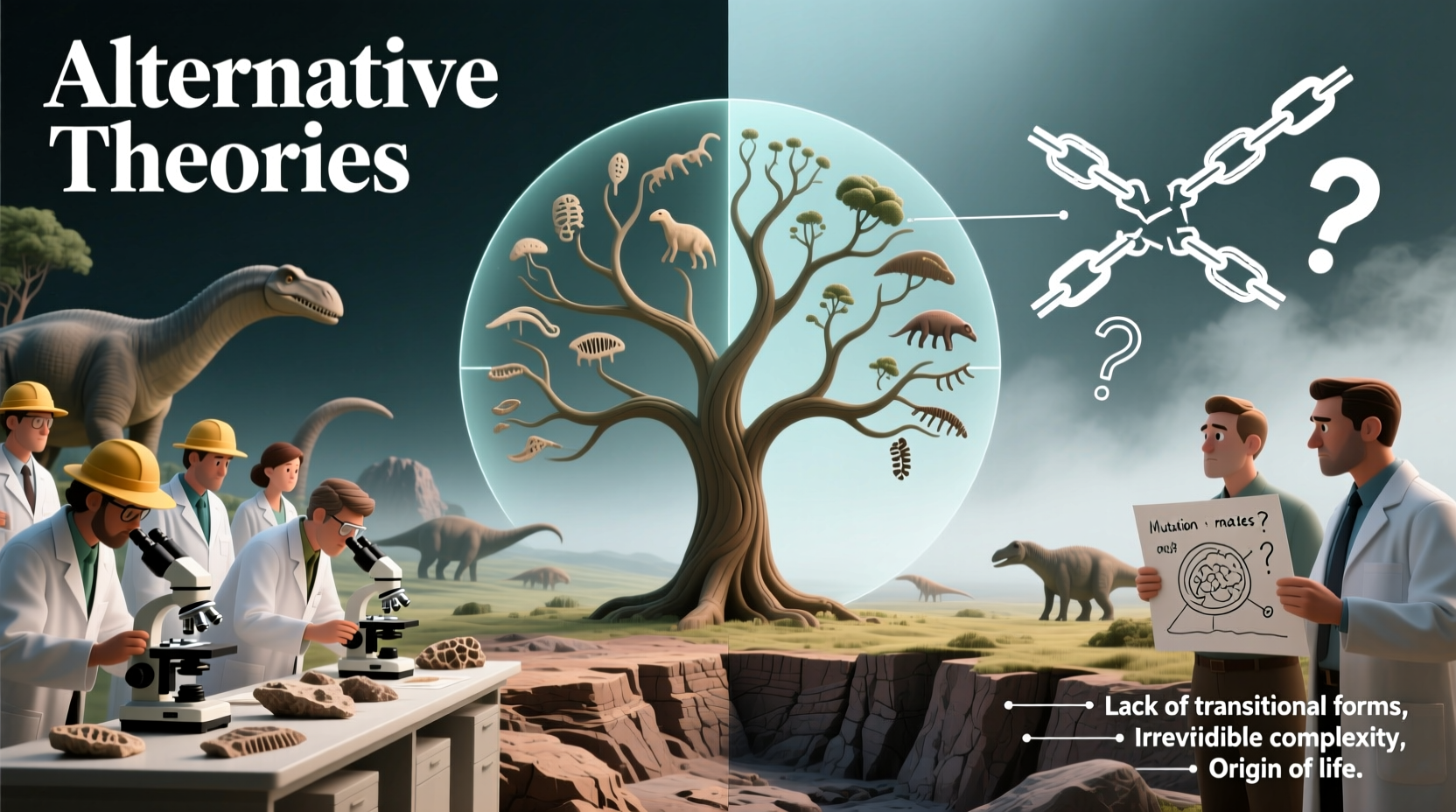
Critics often argue that evolution is “just a theory,” lacks observable evidence, contradicts religious texts, or cannot explain complex biological systems. While these concerns are sincerely held by many, they typically stem from confusion about what evolution actually claims and how science operates.
Scientifically, \"theory\" does not mean guesswork. In science, a theory is a well-substantiated explanation of natural phenomena, supported by vast amounts of evidence—like the germ theory of disease or the theory of gravity. Evolution is no different. It explains how species change over time through mechanisms like natural selection, genetic drift, and mutation.
The Misconception of \"Just a Theory\"
A frequent objection is that evolution is “only a theory.” This reflects a misunderstanding of scientific terminology. In everyday language, “theory” implies uncertainty. In science, however, a theory is the highest level of explanatory power—a framework repeatedly confirmed through observation and experimentation.
“Evolution is both a fact and a theory. It is a fact that organisms have changed over time; it is a theory that natural selection is a primary mechanism driving that change.” — Douglas J. Futuyma, evolutionary biologist
Lack of Observable Evidence?
Skeptics often claim that no one has ever seen evolution happen. But observable examples exist across multiple fields:
- Bacteria developing antibiotic resistance within days.
- Peppered moths shifting color during the Industrial Revolution due to pollution.
- Fruit flies evolving new traits in laboratory settings over generations.
- Petri dish experiments showing E. coli adapting to digest new food sources after tens of thousands of generations.
These are real-time observations of evolutionary processes. While speciation (the formation of new species) usually occurs over longer timescales, transitional fossils—such as Tiktaalik (a fish with limb-like fins)—bridge major evolutionary gaps and support gradual change.
Irreducible Complexity: Can Evolution Explain Complex Organs?
One prominent argument against evolution is \"irreducible complexity\"—the idea that certain biological systems (like the human eye or bacterial flagellum) could not function if any part were removed, implying they couldn’t have evolved step-by-step.
This argument has been thoroughly examined and refuted. For example, simpler light-sensitive cells exist in flatworms and jellyfish, showing intermediate stages in eye evolution. Computer models and genetic studies demonstrate how complex systems can evolve through functional intermediates, each providing a survival advantage.
The bacterial flagellum, often cited as irreducibly complex, shares components with the Type III Secretion System—a simpler molecular syringe used by pathogens. This suggests the flagellum evolved from a pre-existing structure, not from scratch.
Religious and Philosophical Concerns
For many, the conflict isn’t scientific but philosophical. Some believe evolution undermines human uniqueness or contradicts sacred texts. However, numerous religious groups—including the Catholic Church, mainstream Protestant denominations, and many Jewish and Muslim scholars—accept evolution as compatible with faith.
Pope Francis stated in 2014: “God is not a magician, with a magic wand able to do everything. … He created beings and allowed them to develop according to internal laws that he gave to each one, so they would reach their fulfillment.” This view, known as theistic evolution, reconciles divine creation with natural processes.
| Objection | Scientific Response |
|---|---|
| Evolution violates the Second Law of Thermodynamics | No—Earth is an open system receiving energy from the Sun, allowing increased complexity locally. |
| There are no transitional fossils | Fossils like Archaeopteryx (dinosaur-bird), Ambulocetus (whale ancestor), and Tiktaalik show clear transitions. |
| Humans came from monkeys | No—humans and modern apes share a common ancestor from ~6–7 million years ago. |
| Evolution promotes immoral behavior | Science describes how things are, not how they ought to be. Morality is a separate domain. |
Step-by-Step: How Scientists Study Evolutionary Change
Understanding how researchers validate evolution helps demystify the process. Here’s a simplified timeline of how evolutionary hypotheses are tested:
- Observe variation in traits among populations (e.g., beak size in finches).
- Identify selective pressures such as climate, predators, or food availability.
- Track changes over time through field studies or lab experiments.
- Analyze DNA sequences to determine genetic relationships between species.
- Compare fossil records to establish chronological progression.
- Build phylogenetic trees showing evolutionary relationships.
- Test predictions—for example, predicting where transitional fossils might be found.
In one famous case, scientists predicted that a transitional form between fish and land animals should appear in late Devonian rock layers around 375 million years old. They searched in Ellesmere Island, Canada—where the right strata were exposed—and discovered Tiktaalik in 2004, exactly matching expectations.
Mini Case Study: The Evolution of HIV Resistance
In the 1990s, researchers noticed some individuals exposed to HIV never became infected. Genetic analysis revealed a mutation in the CCR5 gene—CCR5-Δ32—that prevents the virus from entering immune cells. This mutation is more common in Northern Europeans, suggesting historical exposure to a similar pathogen (possibly smallpox or plague) favored its spread.
This is evolution in action: a random mutation provided a survival advantage, increased in frequency due to natural selection, and now protects a subset of the population. Medical researchers have used this insight to develop gene therapies for HIV.
Checklist: Evaluating Evolutionary Claims Critically
When encountering arguments against evolution, use this checklist to assess their validity:
- ✅ Does the objection rely on a definition of “theory” as mere speculation?
- ✅ Is there confusion between evolution and abiogenesis (origin of life)?
- ✅ Does it ignore transitional fossils or misrepresent the fossil record?
- ✅ Is the argument based on outdated science or discredited sources?
- ✅ Does it assume evolution must be purposeless or atheistic?
- ✅ Has the claim been peer-reviewed or published in credible scientific journals?
Applying critical thinking helps distinguish genuine scientific debate from misinformation.
Frequently Asked Questions
Does accepting evolution mean rejecting religion?
No. Millions of religious people accept evolution as the method through which life developed. Science addresses natural mechanisms; religion often addresses meaning, purpose, and morality. These domains can coexist.
If we evolved from apes, why are there still apes?
This misunderstands evolution. Humans didn’t evolve from modern apes—we share a common ancestor with chimpanzees and bonobos. Think of cousins: you didn’t descend from your cousin, but you share grandparents. Similarly, humans and chimps branched off from a shared lineage millions of years ago.
Can evolution be tested or falsified?
Yes. Evolution makes testable predictions. If we found rabbit fossils in Precambrian rock layers, or if DNA evidence showed no relationship between species despite anatomical similarities, the theory would face serious challenges. No such contradictions have been verified.
Conclusion: Embracing Understanding Over Division
Questioning established ideas is essential to science and intellectual growth. But effective critique requires engagement with accurate information. The objections to evolution often arise from sincere curiosity or deeply held beliefs—but they rarely withstand scrutiny when examined alongside empirical evidence.
Understanding evolution doesn’t diminish wonder; it enhances it. Recognizing our connection to all life, shaped by billions of years of adaptation, offers a profound perspective on existence. Whether viewed through a scientific, spiritual, or philosophical lens, the story of life is richer when grounded in truth.




 浙公网安备
33010002000092号
浙公网安备
33010002000092号 浙B2-20120091-4
Comments
No comments yet. Why don't you start the discussion?