
Hawaii’s journey from an independent kingdom to the 50th state of the United States is a complex story shaped by geopolitics, economic interests, cultural transformation, and decades of advocacy. Unlike other states that evolved from territories or settlements, Hawaii’s path involved the overthrow of a sovereign monarchy, strategic military importance, and a long struggle for legitimacy and self-determination. Understanding why Hawaii became a state requires examining pivotal moments spanning over half a century — from annexation to full statehood in 1959.
The Overthrow of the Hawaiian Kingdom (1893)
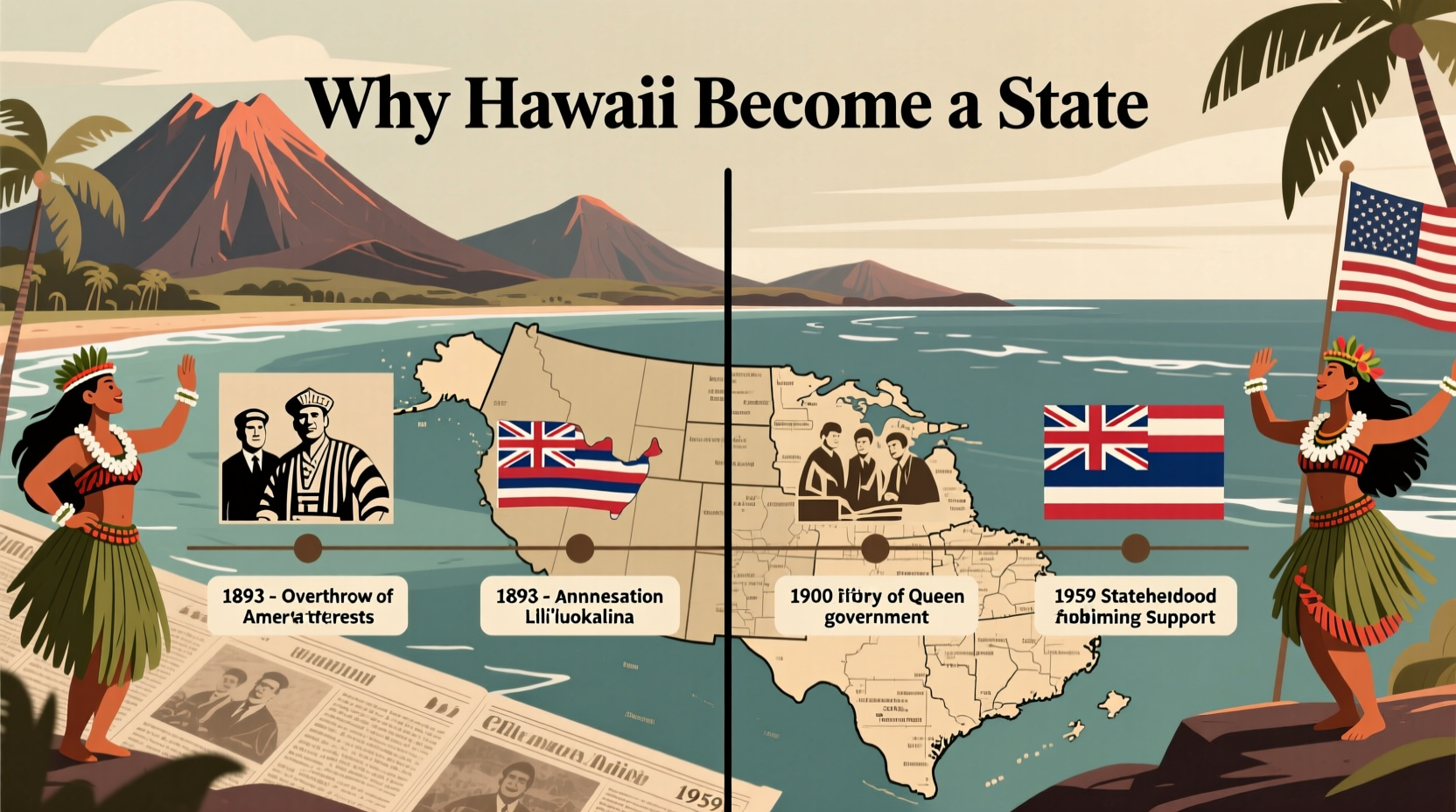
In the late 19th century, Hawaii was an independent constitutional monarchy with strong trade ties to the United States. American businessmen, primarily sugar plantation owners, had gained significant influence over the islands’ economy. When Queen Liliʻuokalani attempted to restore power to the monarchy by proposing a new constitution in 1893, these interests conspired with U.S. diplomatic and military representatives to depose her.
A group of American and European residents, backed by U.S. Marines from the USS Boston, forced the queen from power. Though President Grover Cleveland condemned the coup and called it an “act of war,” no action was taken to restore the monarchy. Instead, a provisional government was established, paving the way for eventual annexation.
“American business interests saw Hawaii not as a nation, but as an asset too valuable to leave independent.” — Dr. Jon Kamakawiwoʻole Osorio, Historian and Native Hawaiian Scholar
Annexation and Territorial Status (1898–1900)
The Spanish-American War in 1898 heightened U.S. interest in Pacific expansion. Hawaii’s strategic location made it ideal for naval operations, particularly Pearl Harbor on Oahu. With growing military and commercial pressure, Congress passed the Newlands Resolution, which formally annexed Hawaii as a U.S. territory without a vote from the Hawaiian people.
In 1900, the U.S. Congress enacted the Organic Act, establishing a territorial government with limited self-rule. While Hawaiians were granted U.S. citizenship, they could not vote for president and had only a non-voting delegate in Congress. The territorial legislature was subject to federal oversight, limiting true autonomy.
World War II and Shifting Perceptions (1941–1945)
The Japanese attack on Pearl Harbor in December 1941 transformed Hawaii’s role in American consciousness. Overnight, the islands became a critical military hub in the Pacific theater. Over 16,000 Native Hawaiians and local residents served in the U.S. armed forces, including the famed 442nd Regimental Combat Team, composed largely of Japanese Americans from Hawaii who fought with distinction in Europe.
Their loyalty and sacrifice helped dismantle stereotypes about ethnic minorities in Hawaii, especially those of Japanese descent, who previously faced suspicion due to ancestry. After the war, returning veterans demanded equal rights and greater representation, fueling momentum for statehood.
Timeline: Key Events Leading to Statehood
- 1893: Overthrow of Queen Liliʻuokalani by American-backed forces.
- 1898: U.S. annexes Hawaii via the Newlands Resolution.
- 1900: Hawaii becomes an organized U.S. territory under the Organic Act.
- 1941: Pearl Harbor attacked; martial law imposed during WWII.
- 1946: Hawaii’s first post-war governor appointed; calls for statehood grow.
- 1959: Congress approves statehood; President Eisenhower signs proclamation.
- August 21, 1959: Hawaii officially becomes the 50th state.
Political Struggles and the Road to Statehood
For decades, statehood faced resistance in Washington. Critics cited Hawaii’s geographic isolation, racial diversity, and perceived lack of \"American\" identity. Some lawmakers feared that admitting a majority non-white population would shift political balances. Others questioned whether islanders were truly loyal, especially before World War II.
However, Hawaii’s leaders, including Delegate Joseph Farrington and later Senator Hiram Fong, lobbied persistently. Labor movements, led by figures like union leader John A. Burns, united diverse ethnic communities — Native Hawaiians, Japanese, Filipinos, Portuguese, and others — around shared goals of fairness and inclusion.
In 1959, after multiple failed attempts, Congress finally passed the Hawaii Admission Act. A referendum was held in June 1959, in which over 94% of voters in Hawaii supported statehood. On August 21, 1959, President Dwight D. Eisenhower signed the official proclamation making Hawaii the 50th state.
| Factor | Impact on Statehood |
|---|---|
| Military Significance | Increased strategic value after Pearl Harbor; justified federal investment. |
| Economic Ties | Sugar, pineapple, and tourism industries aligned with U.S. markets. |
| Civil Rights Movement | Pressure for equality influenced support for full citizenship rights. |
| Racial Diversity | Initially a barrier; later celebrated as part of national pluralism. |
| Public Support | Overwhelming local approval in 1959 referendum sealed the decision. |
Legacy and Ongoing Debates
While statehood brought benefits like federal funding, voting rights, and infrastructure development, it also intensified debates about sovereignty and cultural preservation. Many Native Hawaiians view the annexation and statehood process as illegitimate, citing the illegal overthrow and lack of consent.
In 1993, the U.S. Congress passed the Apology Resolution (Public Law 103-150), formally acknowledging the role of the U.S. government in the overthrow of the Kingdom of Hawaii. This has fueled modern sovereignty movements advocating for self-governance or independence.
“The apology didn’t restore the nation, but it opened the door for truth-telling and reconciliation.” — Noenoe Silva, Professor of Political Science, University of Hawaiʻi
Mini Case Study: The 1959 Referendum
In June 1959, residents of Hawaii voted in a federally authorized referendum on statehood. Despite fears of low turnout or division, participation was high. Of the nearly 140,000 votes cast, more than 132,000 favored admission to the Union. The result crossed ethnic lines — Japanese Americans, who made up nearly 30% of the population, overwhelmingly supported statehood as a path to full civic inclusion.
This moment marked a turning point: Hawaii was no longer seen as a distant colony but as a community ready for equal partnership within the United States. The peaceful, democratic nature of the vote helped silence remaining opposition in Congress.
Frequently Asked Questions
Was Hawaii ever a country?
Yes. Before 1893, Hawaii was the Kingdom of Hawaii, a recognized independent nation with formal diplomatic relations with countries like the United States, Britain, and Japan. It had a constitution, monarchy, and international treaties.
Why did it take so long for Hawaii to become a state?
Several factors delayed statehood: racial prejudice, concerns about loyalty (especially among Japanese Americans before WWII), geographic distance, and political resistance in Congress. It wasn’t until after World War II, when Hawaii’s strategic and patriotic contributions were undeniable, that support grew strong enough.
Do Native Hawaiians support statehood?
Opinions are divided. While many Native Hawaiians are U.S. citizens and participate fully in state and federal systems, others reject the legitimacy of U.S. rule and advocate for restoration of sovereignty. The 1959 vote did not include a separate option for independence, which remains a point of contention.
Checklist: Understanding Hawaii’s Path to Statehood
- Recognize that Hawaii was once an independent kingdom.
- Understand the role of American business interests in the 1893 overthrow.
- Know that annexation occurred in 1898 for strategic military reasons.
- Acknowledge how World War II changed perceptions of Hawaii’s loyalty and value.
- Learn that statehood required decades of advocacy and a 1959 public referendum.
- Respect ongoing Native Hawaiian sovereignty movements and historical grievances.
Conclusion: Reflecting on History, Looking Toward the Future
Hawaii’s statehood was not inevitable. It was forged through conflict, resilience, and a deep desire for equality and recognition. The islands’ admission into the Union reflected broader shifts in American values — toward inclusion, civil rights, and global engagement.
Yet the story doesn’t end in 1959. The legacy of colonization, cultural survival, and indigenous rights continues to shape Hawaii’s identity. To truly understand why Hawaii became a state, one must listen to all voices — from those who celebrate statehood to those who still seek justice for the past.




 浙公网安备
33010002000092号
浙公网安备
33010002000092号 浙B2-20120091-4
Comments
No comments yet. Why don't you start the discussion?