
In today’s competitive business environment, consistency, reliability, and continuous improvement are not optional—they’re essential. Organizations across industries are turning to Quality Management Systems (QMS) to standardize processes, reduce errors, and enhance performance. A QMS is a structured framework that defines policies, procedures, and responsibilities for achieving quality objectives. Whether you're in manufacturing, healthcare, technology, or services, implementing a QMS can transform how your organization operates. The benefits go far beyond compliance; they touch every aspect of business success.
Improved Operational Efficiency
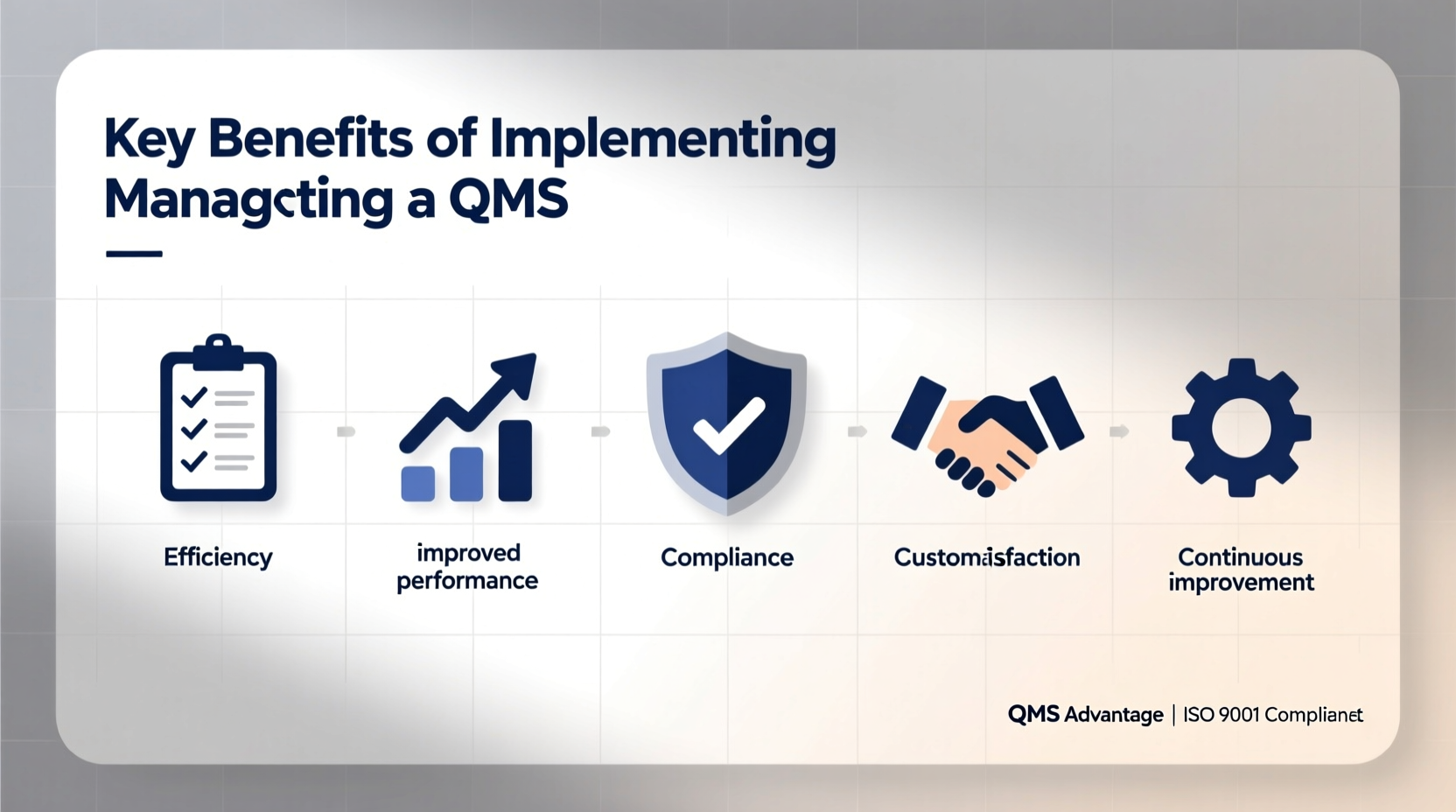
One of the most immediate impacts of a well-implemented QMS is increased operational efficiency. By documenting workflows and standardizing best practices, organizations eliminate redundant tasks, reduce bottlenecks, and minimize waste. Employees follow clear guidelines, which reduces confusion and rework. Over time, this leads to faster turnaround times, lower operational costs, and better resource utilization.
For example, a manufacturing firm that integrates ISO 9001 standards into its production line often sees a measurable drop in defect rates. With predefined inspection points and corrective action protocols, issues are caught earlier—before they escalate into costly recalls or customer complaints.
Enhanced Customer Satisfaction and Trust
A robust QMS places customer needs at the center of operations. It includes mechanisms for collecting feedback, analyzing satisfaction trends, and acting on insights. When customers see consistent product quality, timely delivery, and responsive support, trust builds—and loyalty follows.
Consider a software development company using a QMS to track bug resolution times and user experience metrics. By systematically addressing pain points and improving release cycles, they not only reduce churn but also generate positive word-of-mouth referrals.
According to the American Society for Quality, organizations with mature quality systems report up to 30% higher customer retention rates compared to those without formalized approaches.
“Quality is not an act, it is a habit.” — Aristotle Modern businesses apply this principle through systematic quality management that turns excellence into routine.
Regulatory Compliance and Risk Mitigation
In regulated industries such as pharmaceuticals, aerospace, or food production, non-compliance can result in fines, legal action, or shutdowns. A QMS provides a proactive way to meet regulatory requirements by embedding compliance into daily operations.
For instance, a medical device manufacturer adhering to ISO 13485 ensures that every design change, supplier audit, and testing protocol is documented and traceable. This level of control not only satisfies auditors but also protects patients and the company’s reputation.
Beyond regulation, a QMS helps identify potential risks before they become crises. Through risk assessments, root cause analysis, and preventive actions, organizations build resilience against supply chain disruptions, cybersecurity threats, and operational failures.
Key Regulatory Standards Supported by QMS
| Industry | Standard | Purpose |
|---|---|---|
| General Manufacturing | ISO 9001 | Quality management fundamentals |
| Medical Devices | ISO 13485 | Safety and regulatory compliance |
| Automotive | IATF 16949 | Defect prevention and supply chain consistency |
| Food Production | FSSC 22000 | Food safety and hazard control |
Employee Engagement and Organizational Alignment
A common misconception is that a QMS is solely about processes and paperwork. In reality, its greatest strength lies in fostering a culture of accountability and continuous improvement. When employees understand their role in quality outcomes, they take greater ownership of their work.
Training modules, internal audits, and performance reviews built into the QMS help align team efforts with strategic goals. Departments that once operated in silos begin collaborating more effectively, sharing data and solving problems collectively.
A mid-sized engineering firm reported a 40% increase in employee-initiated improvement suggestions within one year of launching its QMS. Workers felt empowered knowing their input was valued and could lead to real change.
Real-World Impact: Mini Case Study
A regional beverage bottler was facing rising customer complaints about inconsistent fill levels and labeling errors. After conducting a gap analysis, leadership decided to implement an ISO 9001-aligned QMS.
The first step was mapping all production and packaging processes. Teams identified three critical failure points: calibration drift in filling machines, inadequate label verification, and poor shift handover communication.
Solutions included automated sensor checks, digital checklists for operators, and monthly cross-functional quality meetings. Within nine months, customer complaints dropped by 68%, internal rework costs fell by $120,000 annually, and the company passed its first external audit with zero major non-conformities.
This transformation wasn’t driven by new equipment alone—it was the discipline of the QMS that enabled sustained improvement.
Step-by-Step Guide to Implementing a QMS
Starting a QMS doesn't require overhauling everything overnight. Follow this phased approach for lasting results:
- Assess Current State: Review existing processes, documentation, and pain points.
- Define Objectives: Align quality goals with business strategy (e.g., reduce defects by 25%).
- Select a Framework: Choose a recognized standard like ISO 9001 based on industry needs.
- Document Procedures: Create clear, accessible SOPs for key workflows.
- Train Employees: Ensure everyone understands their role in maintaining quality.
- Implement & Monitor: Roll out the system gradually and use KPIs to track progress.
- Audit Internally: Conduct regular reviews to identify gaps and opportunities.
- Seek Certification (Optional): Engage a third party to validate compliance.
- Continuously Improve: Use feedback loops and data to refine the system over time.
Essential QMS Implementation Checklist
- ✅ Leadership commitment secured
- ✅ Core team assigned (quality manager, department reps)
- ✅ Gap analysis completed
- ✅ Quality policy and objectives defined
- ✅ Process maps developed
- ✅ Documentation system established (digital or physical)
- ✅ Training plan delivered
- ✅ Internal audit schedule set
- ✅ Corrective action process in place
- ✅ Management review meetings planned quarterly
Frequently Asked Questions
What is the difference between a QMS and ISO 9001?
A Quality Management System (QMS) is a comprehensive approach to managing quality across an organization. ISO 9001 is an internationally recognized standard that specifies requirements for a QMS. While you can have a QMS without ISO 9001, adopting the standard provides a proven framework and enables certification.
Can small businesses benefit from a QMS?
Absolutely. Small organizations often experience even greater relative improvements because a QMS introduces structure where informal practices may have led to inconsistency. The scalability of frameworks like ISO 9001 makes them suitable for teams of any size.
How long does it take to implement a QMS?
Typically, 6 to 12 months for full deployment, depending on organizational complexity. Smaller companies may see initial benefits within 3–4 months. Ongoing improvement continues indefinitely.
Conclusion: Turn Quality Into a Competitive Advantage
Implementing a Quality Management System is not just about ticking boxes or passing audits—it's about building a foundation for sustainable success. From streamlining operations and satisfying customers to ensuring compliance and empowering teams, the benefits are both tangible and transformative.
Organizations that treat quality as a strategic priority don’t just survive market changes—they lead them. Whether you're aiming for certification or simply seeking better consistency, starting your QMS journey today positions your business for long-term growth, resilience, and trust.




 浙公网安备
33010002000092号
浙公网安备
33010002000092号 浙B2-20120091-4
Comments
No comments yet. Why don't you start the discussion?