
At first glance, the idea that multiplying two negative numbers results in a positive seems counterintuitive. After all, how can “less than nothing” times “less than nothing” give you something more? Yet this rule is foundational in mathematics, appearing everywhere from algebra to physics. The good news: it’s not arbitrary. There’s deep logic behind it—one that makes perfect sense once broken down with clear examples and consistent reasoning.
This article explains why a negative times a negative equals a positive, using everyday analogies, number patterns, and mathematical consistency. No advanced math required—just curiosity and a willingness to think step by step.
The Intuition Behind Negative Numbers
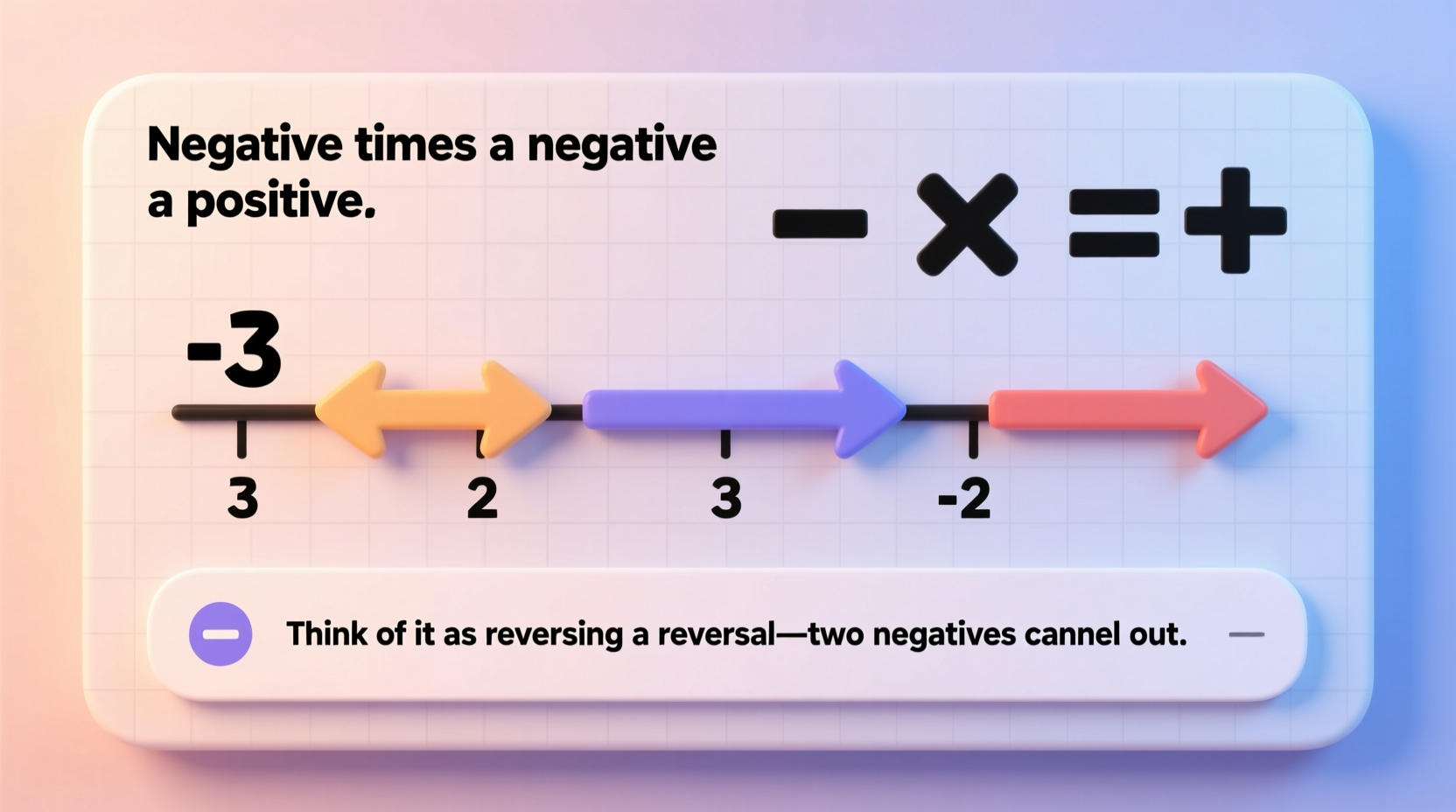
Negative numbers represent opposites: debts, temperatures below zero, or directions backward on a number line. When we multiply, we’re essentially scaling or repeating an action. So what happens when we scale an opposite of an opposite?
Think of negatives as “reversals.” One negative reverses direction. Two reversals bring you back to where you started. Just like saying “I don’t not want dessert” subtly means you *do* want dessert, two negatives cancel out.
In math terms:
- Positive × Positive = Positive (forward motion, scaled up)
- Positive × Negative = Negative (forward becomes backward)
- Negative × Positive = Negative (reverse applied to forward)
- Negative × Negative = Positive (reverse the reverse → forward again)
Pattern-Based Explanation: Watch the Sequence
One of the clearest ways to see why −×−=+ is by observing number patterns. Let’s look at what happens when we multiply 3, 2, 1, 0, −1, −2, and so on, by −4.
| Multiplication | Result |
|---|---|
| 3 × (−4) | −12 |
| 2 × (−4) | −8 |
| 1 × (−4) | −4 |
| 0 × (−4) | 0 |
| (−1) × (−4) | ? |
| (−2) × (−4) | ? |
Notice the pattern: each time the first number decreases by 1, the result increases by 4.
- From −12 to −8: +4
- From −8 to −4: +4
- From −4 to 0: +4
Continuing this pattern logically:
- (−1) × (−4) = 0 + 4 = 4
- (−2) × (−4) = 4 + 4 = 8
The sequence holds only if a negative times a negative yields a positive. Abandoning this would break arithmetic consistency.
Real-Life Analogy: Debt and Cancellation
Imagine you owe $5 to three people. Your total debt is 3 × (−5) = −15 dollars. You're down $15.
Now suppose someone says, “I’ll cancel your debt to three people.” That means removing a debt of $5, three times. Removing a negative is like adding a positive.
In math: −3 × (−5) means “remove a debt of $5, three times.”
So:
Removing −$5 three times = +$15
Therefore: (−3) × (−5) = +15
This reflects real-world logic: canceling a loss is a gain. Reversing a reversal leads to progress.
“Mathematics isn’t about memorizing rules—it’s about preserving consistency across operations. The negative-times-negative rule keeps arithmetic coherent.” — Dr. Alan Reyes, Mathematics Educator
Directional Model: The Number Line Flip
Think of multiplication as movement on a number line.
- Multiplying by a positive number scales your position without changing direction.
- Multiplying by a negative number flips your direction (like turning around) and then scales.
Example: Start at 1.
- 1 × 4 = 4 → move four times forward
- 1 × (−4) = −4 → flip direction, move four times backward
- Now start at −1 (already reversed):
- (−1) × 4 = −4 → stay in reverse, scale forward
- (−1) × (−4) = ?
You begin reversed (at −1), then apply another reversal (multiply by −4). Two reversals mean you face forward again. Scaling by 4 lands you at +4.
Hence: (−1) × (−4) = 4
This model shows that negatives act as directional switches. Two switches return you to the original orientation.
Algebraic Proof: Preserving Distributive Property
The most rigorous reason comes from algebra. Math must follow consistent rules. One key rule is the distributive property:
a × (b + c) = (a × b) + (a × c)
Let’s test this with negatives. Suppose we assume (−1) × (−1) = −1 (wrong, but let's see what happens).
Try distributing: (−1) × (1 + (−1))
= (−1) × 0 = 0
Now distribute:
(−1) × 1 + (−1) × (−1)
= −1 + (assumed −1) = −2
We get 0 = −2. Contradiction!
To preserve the distributive law, (−1) × (−1) must equal +1. Then:
−1 + 1 = 0 ✓
This isn’t just convenient—it’s necessary. Without this rule, basic algebra collapses.
Mini Case Study: Classroom Confusion Resolved
In a 7th-grade math class, students struggled with why −×−=+. One student, Maya, insisted it should be negative because “two bad things don’t make a good thing.” Her teacher responded with a video game analogy:
“Imagine your character loses 5 health points per minute in a trap. That’s −5 per minute.
If you go back 2 minutes in time (like rewinding), how much health did you have before entering the trap?”
The students realized: going backward in time while losing health means you had more health earlier.
Change in health = (rate) × (time)
= (−5) × (−2) = +10
So two minutes ago, you had 10 more health points. The double negative made a positive gain. Maya raised her hand and said, “Oh! It’s not about the signs—it’s about what they represent.”
Common Misconceptions and Pitfalls
Many people struggle because they treat negative multiplication like addition. But multiplication is scaling, not accumulation.
Here are common misunderstandings:
| Misconception | Reality |
|---|---|
| \"Two negatives should make a bigger negative.\" | Multiplication isn’t additive. Negatives here represent direction changes, not magnitude increases. |
| \"It’s just a rule to memorize.\" | No—it’s derived from consistency in math systems. It prevents contradictions. |
| \"This doesn’t happen in real life.\" | It does: reversing a loss, undoing a penalty, or moving backward in time while decreasing. |
Step-by-Step Guide to Understanding the Rule
- Start with known positives: Understand that 3 × 4 = 12 is repeated addition.
- Introduce negative multipliers: 3 × (−4) = −12 (adding −4 three times).
- Flip the sign: (−3) × 4 = −12 (removing 4 three times, or stepping backward).
- Observe the pattern: As the first number decreases by 1, results increase by the second number’s absolute value.
- Extend to double negatives: Following the pattern, (−3) × (−4) must be 12 to maintain consistency.
- Verify with models: Use debt cancellation, time reversal, or number line flipping to confirm.
- Test algebraically: Apply the distributive property to ensure no contradictions arise.
FAQ
Does this rule work for division too?
Yes. Division follows the same sign rules. For example, (−12) ÷ (−3) = 4. Dividing two negatives gives a positive for the same logical reasons—canceling reversals.
Can I visualize this on a graph?
Absolutely. On a coordinate plane, multiplying by −1 reflects a point across the origin. Doing it twice returns it to the original position—same as multiplying by +1.
Who decided this rule anyway?
No single person invented it. Mathematicians like Brahmagupta (7th century India) formalized rules for negative numbers. The modern rule emerged because alternatives broke arithmetic. It was discovered, not decreed.
Conclusion: Embrace the Logic, Not Just the Rule
The rule that a negative times a negative equals a positive isn’t a quirk of math—it’s a consequence of maintaining harmony across operations. Whether through patterns, real-world analogies, or algebraic necessity, the logic holds firm. Once you see negatives not as “bad numbers” but as directional or relational concepts, the mystery fades.
Understanding this principle strengthens your foundation for algebra, calculus, and beyond. More importantly, it teaches a deeper lesson: math isn’t about blind obedience to rules. It’s about coherence, consistency, and reasoning from first principles.




 浙公网安备
33010002000092号
浙公网安备
33010002000092号 浙B2-20120091-4
Comments
No comments yet. Why don't you start the discussion?