
The abbreviation \"lb\" for pound is so deeply embedded in everyday language that most people use it without questioning its origin. Whether reading nutrition labels, shopping for groceries, or tracking fitness goals, “lb” appears universally to represent pounds. But why not “pd” or “pnd”? The answer lies not in English, but in ancient Rome and the legacy of Latin terminology that has quietly shaped modern measurement systems.
This article explores the fascinating journey of the word \"pound\" and how its abbreviation \"lb\" emerged from historical trade practices, linguistic evolution, and standardization across centuries. From Roman weights to British commerce and global adoption, the story behind \"lb\" reveals how language and measurement are intertwined across cultures and time.
The Latin Roots: Libra and the Roman Weight System
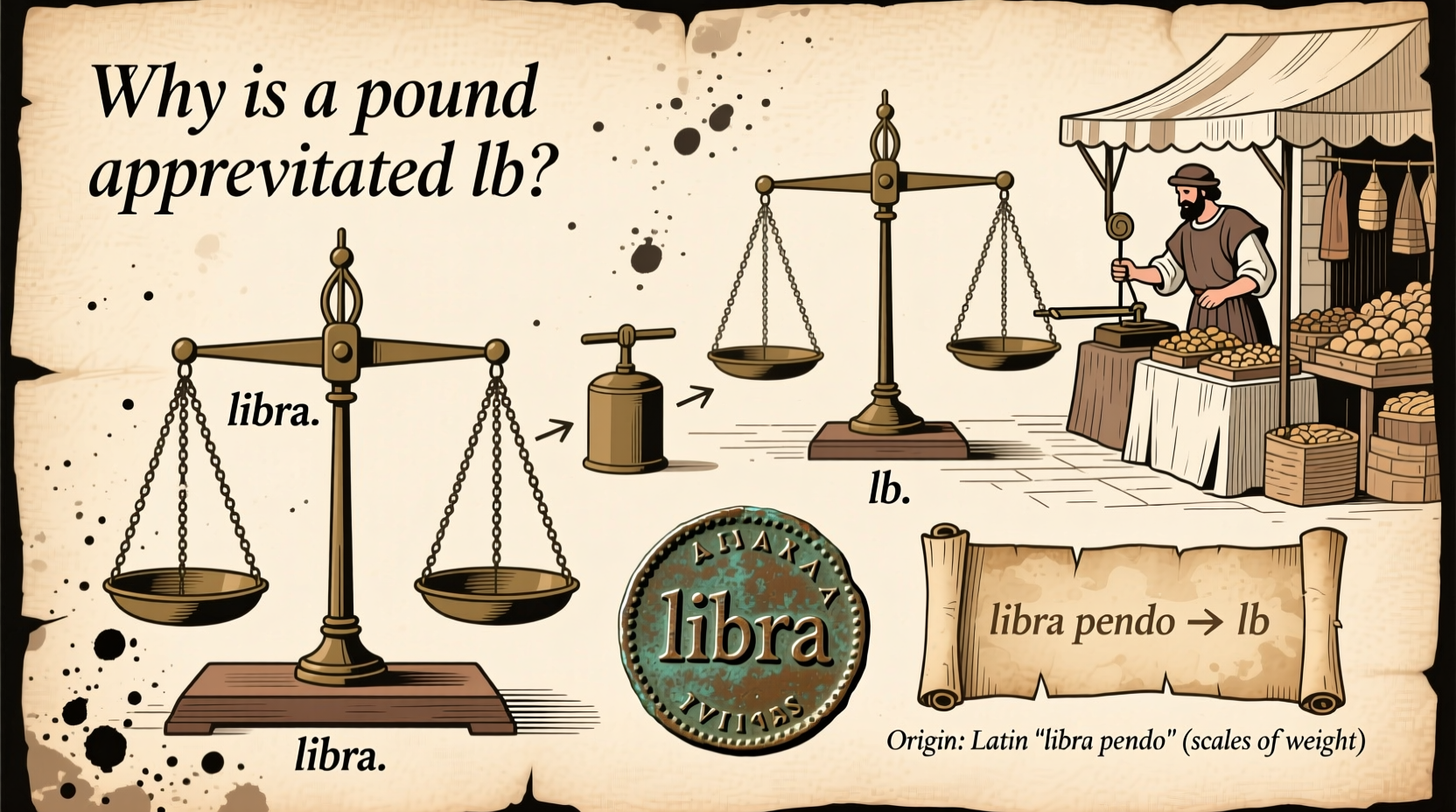
The abbreviation \"lb\" comes from the Latin word libra, which means \"balance\" or \"scales.\" In ancient Rome, libra was not only a term for balance but also the name of a unit of weight—roughly equivalent to 327 grams, or about three-quarters of a modern pound. This unit was one of the foundational measures in Roman commerce and daily life.
Roman society used standardized weights for trade, taxation, and military logistics. The libra was divided into 12 unciae—the origin of both the word \"ounce\" and the duodecimal (base-12) division system once common in European measurements. When scribes recorded transactions involving weight, they often abbreviated libra as \"lb,\" a practice that persisted long after the fall of Rome.
“Latin abbreviations like ‘lb’ survived because they were efficient and widely understood by scholars and merchants alike.” — Dr. Helena Moretti, Historian of Ancient Measurement Systems
From Libra to Pound: The Linguistic Evolution
Although \"pound\" sounds nothing like \"libra,\" the two terms are etymologically linked through Old English and French. The word \"pound\" derives from the Latin phrase pondus librae, meaning \"a weight of one libra.\" Over time, \"pondus\" (meaning \"weight\") evolved into the Old English \"pund,\" which eventually became \"pound.\"
Crucially, while the spoken word shifted from Latin to Germanic and Romance languages, written records—especially in legal, scientific, and commercial contexts—retained Latin abbreviations. Thus, even as \"pound\" replaced \"libra\" in speech, the abbreviation \"lb\" remained in use among clerks, apothecaries, and traders throughout medieval Europe.
In England, the avoirdupois pound—a system developed in the 13th century for general trade—became the standard. It weighed approximately 453.6 grams and was divided into 16 ounces. Despite these changes, the abbreviation \"lb\" carried forward due to continuity in documentation and recordkeeping traditions rooted in Latin.
A Timeline of Standardization: How 'lb' Became Global
The persistence of \"lb\" wasn’t automatic—it was reinforced through centuries of institutional use. Here’s a brief timeline showing key milestones in the abbreviation’s survival and spread:
- 1st Century BCE – 5th Century CE: Romans use libra as a unit of weight; abbreviation \"lb\" appears in inscriptions and manuscripts.
- 8th–12th Centuries: Carolingian reforms revive Roman measurement standards; monastic scribes preserve Latin abbreviations in Europe.
- 1303, England: The Weights and Measures Act formalizes the pound as a unit; Latin remains the language of law and trade, preserving \"lb.\"
- 16th–18th Centuries: British Empire expands; colonial trade adopts British units, spreading \"lb\" worldwide.
- 19th Century: International commerce demands consistency; \"lb\" becomes standard in shipping, medicine, and manufacturing.
- 20th Century – Present: Even as metrication spreads, \"lb\" endures in the U.S., UK, and other countries using imperial units.
Why Not 'pd'? A Look at Common Misconceptions
Many assume \"lb\" must be a typo or error, expecting \"pd\" as a more logical abbreviation. However, this overlooks the fact that \"pound\" wasn't the original source of the symbol. The abbreviation predates the English word itself in written form. Since \"lb\" originated from Latin, not English, there was no incentive to change it when pronunciation evolved.
Moreover, changing an established abbreviation risks confusion. Once \"lb\" became entrenched in legal codes, medical prescriptions, and engineering schematics, altering it would have disrupted communication across professions. Consistency in documentation outweighed phonetic logic.
| Aspect | Explanation |
|---|---|
| Origin Language | Latin (libra) |
| Meaning of 'Libra' | Balance, scales, or unit of weight |
| Modern Equivalent | Approx. 453.6 grams (avoirdupois pound) |
| Division | 16 ounces (modern), formerly 12 unciae (Roman) |
| Primary Regions Using 'lb' | United States, United Kingdom, Liberia, Myanmar |
Practical Implications Today: Where You’ll See 'lb'
Understanding the origin of \"lb\" isn’t just academic—it helps in real-world situations where precision matters. For example:
- Nutrition labels: In the U.S., food packaging lists weight in pounds and ounces using \"lb.\"
- Medical prescriptions: Dosages may still be recorded in pounds, especially for body weight affecting drug calculations.
- Shipping and logistics: Freight costs often depend on weight in pounds, with \"lb\" used in invoices and manifests.
- Fitness tracking: Gym equipment, workout plans, and health apps display resistance and body weight using \"lb.\"
Recognizing that \"lb\" is not arbitrary but historically grounded reinforces confidence in interpreting data correctly, especially in international or technical settings.
FAQ: Common Questions About 'lb' and the Pound
Does 'lb' stand for 'pound'?
No, 'lb' does not stand for 'pound.' It stands for the Latin word libra, which referred to a unit of weight. The English word \"pound\" evolved separately from the Latin phrase pondus librae.
Why do we still use 'lb' instead of switching to metric?
The continued use of 'lb' reflects cultural and economic inertia. Countries like the U.S. have deeply integrated imperial units into infrastructure, education, and industry. While the metric system is used in science and medicine, everyday life still relies on familiar terms like pounds and ounces.
Is 'lb' ever pluralized as 'lbs' correct?
Yes, \"lbs\" is commonly used as the plural form of \"lb,\" though technically \"lb\" is an abbreviation and doesn’t change in plural form. However, \"lbs\" is widely accepted in informal and commercial contexts (e.g., \"This package weighs 5 lbs\").
Conclusion: Embracing the Legacy Behind a Simple Symbol
The abbreviation \"lb\" is far more than a shorthand—it's a living relic of ancient Rome, preserved through centuries of trade, scholarship, and global exchange. Its endurance demonstrates how language, measurement, and culture evolve together, often retaining traces of forgotten origins.
Next time you see \"lb\" on a bag of flour or a gym weight, take a moment to appreciate the historical depth behind those two small letters. They connect us to a world of Roman engineers, medieval merchants, and international standardization efforts that shaped how we quantify our lives.




 浙公网安备
33010002000092号
浙公网安备
33010002000092号 浙B2-20120091-4
Comments
No comments yet. Why don't you start the discussion?