
Calculus is often seen as an abstract subject taught in high school and college math courses, but its influence extends far beyond the classroom. From designing safer cars to predicting stock market trends, calculus plays a foundational role in shaping modern life. It’s not just about solving equations—it’s a powerful tool for understanding change, motion, and optimization. Whether you realize it or not, calculus underpins many of the technologies and systems we rely on every day.
The Language of Change and Motion
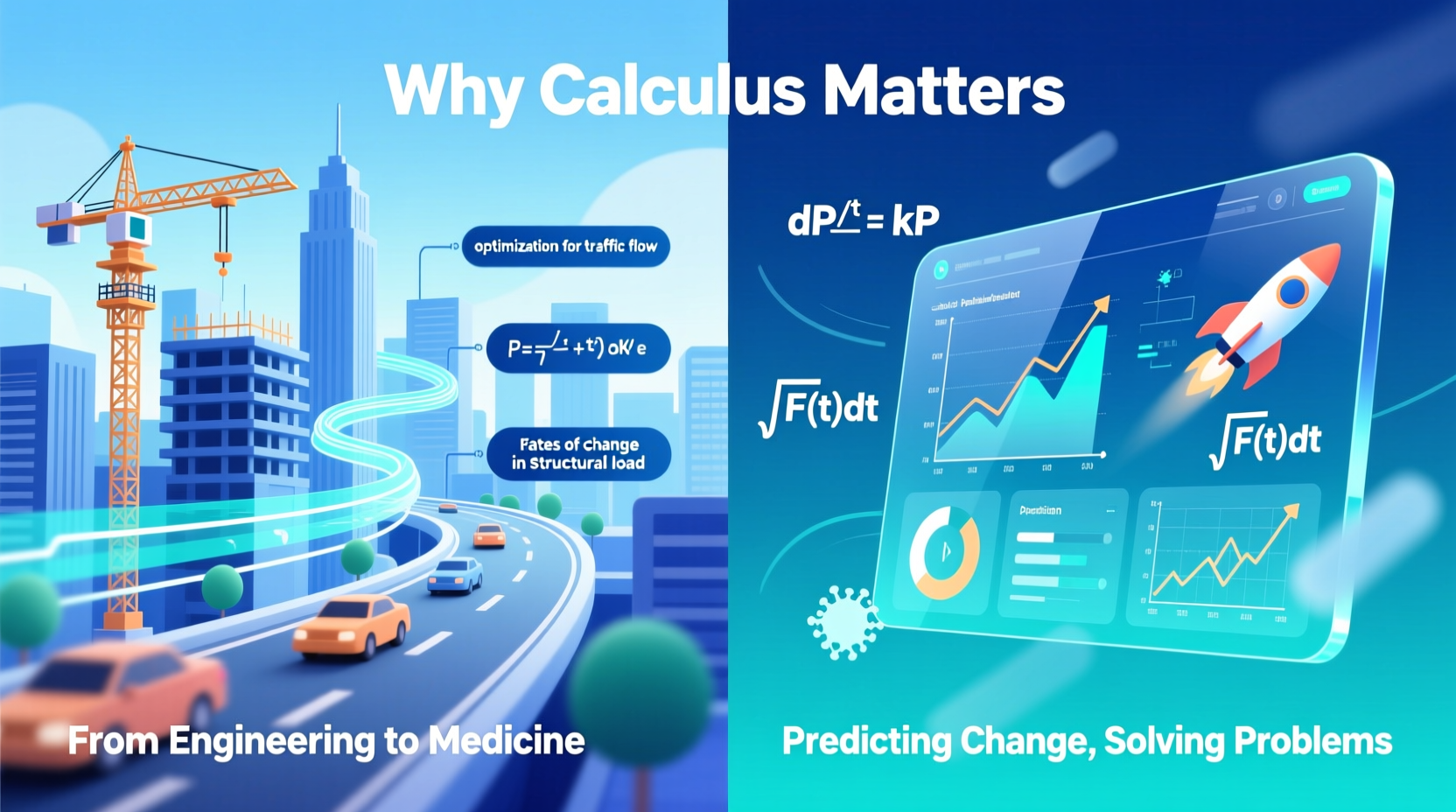
At its core, calculus is the mathematics of change. While algebra helps us understand static relationships, calculus allows us to analyze how things evolve over time. This makes it indispensable in fields where variables are constantly shifting—like physics, biology, and finance.
Differential calculus focuses on rates of change. For example, if you're driving a car, the speedometer shows your instantaneous rate of change—your velocity at that exact moment. Calculus enables engineers to model this precisely, which is critical when designing braking systems or optimizing fuel efficiency.
Integral calculus, on the other hand, deals with accumulation. It answers questions like: How much water flows through a pipe over time? What’s the total distance traveled given a changing speed? These concepts are vital in engineering, environmental science, and even public health planning.
“Calculus is the language God uses to describe the universe.” — Richard Feynman, Nobel Prize-winning physicist
Engineering and Technology Innovations
Modern infrastructure—from skyscrapers to smartphones—relies heavily on calculus. Structural engineers use differential equations to predict how buildings will respond to wind, earthquakes, and loads. Without these models, constructing safe, efficient structures would be nearly impossible.
In electrical engineering, calculus helps design circuits and signal processing systems. Fourier transforms—a concept rooted in integral calculus—are used to analyze sound waves, images, and data transmissions. Every time you make a phone call or stream music, calculus is working behind the scenes to ensure clarity and reliability.
Medicine and Biological Sciences
One of the most impactful real-world applications of calculus lies in healthcare. Doctors and researchers use it to model the spread of diseases, optimize drug dosages, and understand biological processes.
For instance, pharmacokinetics—the study of how drugs move through the body—uses differential equations to determine how quickly a medication is absorbed, distributed, metabolized, and excreted. This ensures patients receive effective doses without dangerous side effects.
Epidemiologists also depend on calculus-based models to forecast outbreaks. During the COVID-19 pandemic, governments relied on SIR (Susceptible-Infectious-Recovered) models derived from calculus to project infection rates and allocate medical resources efficiently.
Mini Case Study: Predicting Tumor Growth
A team of oncologists at a cancer research institute developed a mathematical model using differential equations to simulate tumor growth under various treatment regimens. By incorporating factors like cell division rate and response to chemotherapy, they could predict optimal timing and dosage for individual patients. This personalized approach improved outcomes and reduced unnecessary treatments, demonstrating how calculus directly contributes to saving lives.
Economics and Business Optimization
Businesses thrive on efficiency, and calculus provides the tools to maximize profits and minimize costs. Economists use marginal analysis—based on derivatives—to determine the ideal level of production, pricing, and resource allocation.
For example, a company might use calculus to find the point at which producing one more unit neither increases nor decreases profit—the “marginal cost equals marginal revenue” principle. This insight guides decisions in manufacturing, marketing, and supply chain management.
Financial analysts apply stochastic calculus to model stock prices and assess risk. The famous Black-Scholes equation, which earned a Nobel Prize in Economics, uses partial differential equations to price options and manage investment portfolios.
| Field | Calculus Application | Real-World Impact |
|---|---|---|
| Engineering | Stress analysis, fluid dynamics | Safer vehicles and buildings |
| Medicine | Drug dosage modeling, epidemiology | Improved patient outcomes |
| Economics | Marginal analysis, risk modeling | Better business strategies |
| Computer Science | Machine learning gradients | Smarter AI algorithms |
| Environmental Science | Pollution dispersion models | Effective climate policies |
Machine Learning and Artificial Intelligence
One of the fastest-growing areas where calculus is essential is artificial intelligence. Training a neural network involves minimizing error—a process known as gradient descent. This technique relies entirely on derivatives to adjust parameters and improve predictions.
Backpropagation, the algorithm that powers deep learning, uses the chain rule from differential calculus to compute gradients across complex networks. Every time a voice assistant understands your command or a recommendation engine suggests a product, calculus is part of the computational backbone.
“The power of machine learning comes from calculus. Without derivatives and optimization, AI wouldn’t exist in its current form.” — Dr. Sarah Lin, Data Scientist at MIT
Step-by-Step Guide: How Calculus Powers GPS Navigation
- Data Collection: GPS satellites transmit signals with timestamps to your device.
- Distance Calculation: Using the time delay of each signal, the receiver calculates distance via the formula: distance = speed × time.
- Position Triangulation: Multiple satellite distances create intersecting spheres; finding their intersection requires solving nonlinear equations.
- Error Correction: Atmospheric interference causes signal delays. Calculus models these changes dynamically to refine accuracy.
- Route Optimization: Navigation apps use calculus-based algorithms to compute the fastest route, factoring in traffic flow, road gradients, and speed limits.
This entire system depends on continuous functions, derivatives, and integrals—core components of calculus.
Frequently Asked Questions
Do I need to know calculus to work in tech or science?
While not every job requires direct application, understanding calculus gives you a deeper grasp of how systems behave. In fields like data science, robotics, or quantitative finance, it's often a prerequisite.
Can calculus help in everyday decision-making?
Indirectly, yes. The mindset of analyzing rates of change and optimizing outcomes applies to personal finance, fitness planning, and even time management. Recognizing patterns of increase or decrease helps make informed choices.
Is calculus only useful for STEM careers?
No. Its principles appear in social sciences, economics, and policy development. Anyone dealing with trends, forecasts, or dynamic systems benefits from a foundational understanding of calculus concepts.
Checklist: Applying Calculus Thinking in Real Life
- Identify situations involving change over time (e.g., savings growth, weight loss).
- Ask: What is the rate of change? Is it increasing or slowing down?
- Look for optimization opportunities (e.g., minimizing effort, maximizing output).
- Use graphs to visualize trends and estimate future behavior.
- Consider cumulative effects—small daily actions add up over time.
Conclusion
Calculus is more than a challenging math course—it’s a framework for understanding the dynamic nature of our world. Its applications span industries, drive innovation, and solve real human problems. Whether it’s improving medical treatments, building smarter cities, or advancing artificial intelligence, calculus remains a cornerstone of progress.
Even if you never solve a differential equation again, appreciating its role empowers you to think critically about change, growth, and efficiency. Embrace its logic, and you’ll see the world not just as it is, but as it evolves.




 浙公网安备
33010002000092号
浙公网安备
33010002000092号 浙B2-20120091-4
Comments
No comments yet. Why don't you start the discussion?