
Diddy Kong is more than just a fast-moving, jetpack-wearing primate in the Donkey Kong universe—he’s a symbol of evolution in video game character design and storytelling. But where does his unusual name come from? Why “Diddy”? And what does it mean in the context of Nintendo’s creative decisions? The answer lies in a blend of linguistic playfulness, cultural references, and deliberate branding choices made during the early 1990s when the Super Nintendo Entertainment System (SNES) was redefining platform gaming.
Understanding the origin of Diddy Kong’s name requires stepping back into the era of pixelated graphics, chiptune soundtracks, and the rise of character-driven franchises. It also reveals how Nintendo used language not just for identification, but to establish personality and relational dynamics within its games.
The Birth of Diddy Kong: A Sidekick with Personality
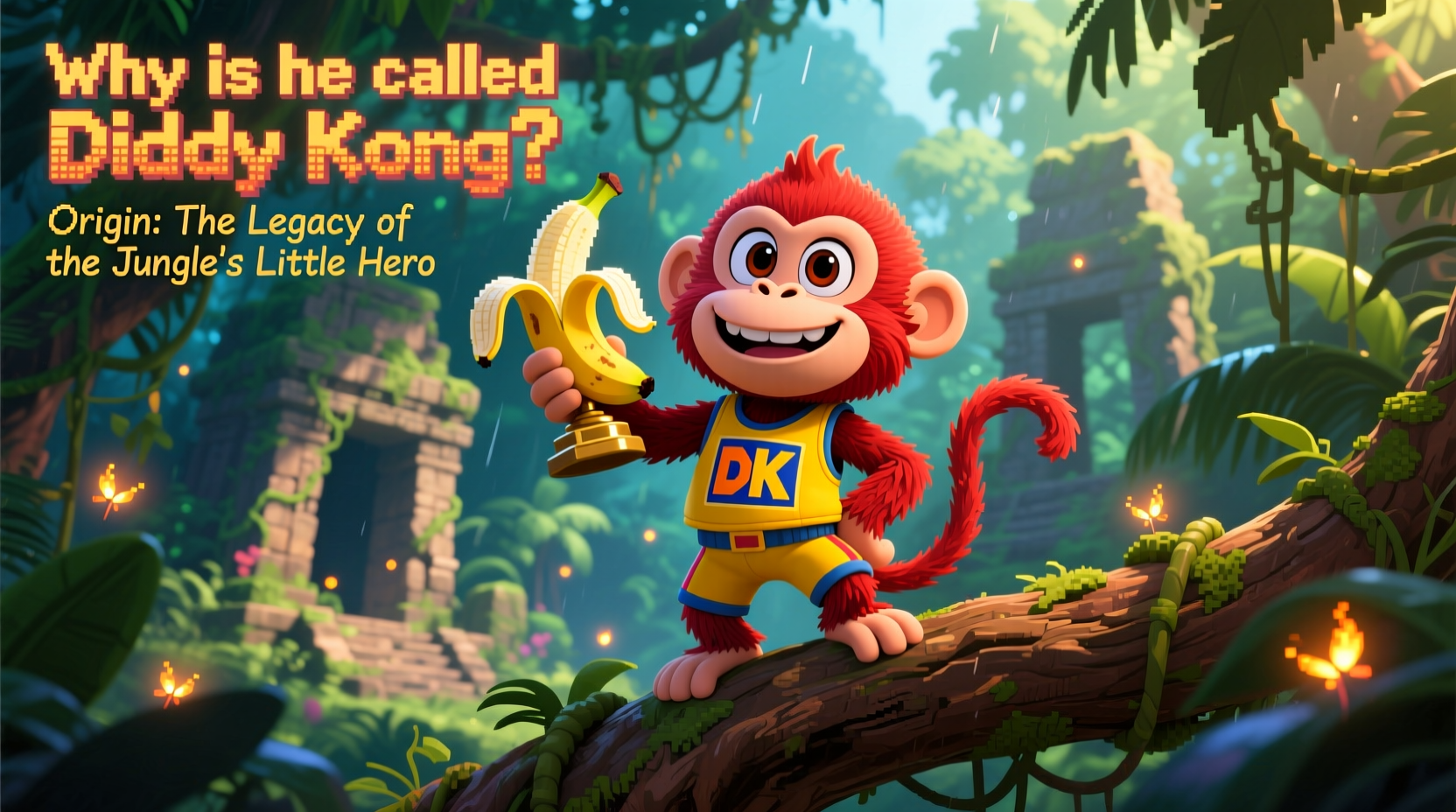
Diddy Kong first appeared in Donkey Kong Country, released in 1994 by Rare Ltd. under license from Nintendo. Developed by Tim and Chris Stamper, the game marked a turning point in visual fidelity for console games, utilizing pre-rendered 3D models to create lush, animated sprites. Alongside this technological leap came a fresh cast of characters designed to breathe life into the Kong family tree.
Diddy was introduced as Donkey Kong’s smaller, quicker companion—often described in-game materials as his \"nephew\" or \"best friend.\" Unlike earlier iterations of DK’s helpers, who were unnamed or generic, Diddy had a distinct look (red cap, blue overalls), attitude (mischievous yet loyal), and abilities (double jump, speed bursts). His name, however, stood out immediately—not because it sounded exotic, but because it seemed oddly informal, even playful.
In British English, “diddy” is a colloquial term meaning “small” or “little.” For example, a child might refer to a “diddy car” when talking about a toy vehicle. This regional usage wasn’t widely known in North America at the time, which made the name seem whimsical rather than descriptive to many players. Yet this was precisely the intent: to signal that Diddy was the younger, nimbler counterpart to the larger, stronger Donkey Kong.
Linguistic Roots: What “Diddy” Really Means
To fully appreciate the naming choice, it helps to examine the etymology. “Diddy” originates from Scottish and Northern English dialects, where it functions as an affectionate diminutive. It carries no negative connotation; instead, it implies endearment and youthfulness. In Scotland, “wee” and “diddy” are often interchangeable in casual speech.
Rare, the UK-based developer behind Donkey Kong Country, naturally leaned on familiar linguistic terrain when crafting character identities. Naming the small red-capped monkey “Diddy” was both intuitive and clever—it instantly communicated his role without needing exposition. Players understood he was junior in size and status, yet vital to the adventure.
This contrasts sharply with other potential names like “Mini Kong” or “Little Kong,” which would have felt clunky or overly literal. “Diddy” has rhythm, charm, and a hint of cheekiness—qualities that align perfectly with his in-game behavior.
“Names in platformers aren't just labels—they're part of the character’s identity. 'Diddy' tells you everything: he's small, quick, and full of energy.” — Sarah Thompson, Game Historian & Author of *Platform Legends*
Why Not “Baby Kong” or “Junior Kong”?
One might wonder why Nintendo and Rare didn’t opt for a more straightforward name. After all, later entries introduced characters like Baby Donkey Kong and Tiny Kong. However, those names emerged in different eras and contexts, often tied to specific gameplay mechanics (e.g., Tiny Kong’s ability to fit through small spaces in Donkey Kong 64).
In 1994, the goal wasn’t to create a literal familial hierarchy but to build a dynamic duo reminiscent of classic cartoon partnerships—think Mickey and Goofy, or Mario and Luigi. Diddy wasn’t meant to be seen as childish or immature; he was agile, brave, and capable. Calling him “Baby” would have undermined that image. “Diddy,” while indicating smallness, preserved his credibility as a hero.
Moreover, “Kong” already carried weight as a surname denoting strength and legacy. By pairing it with a soft-sounding prefix like “Diddy,” the developers created a contrast that emphasized balance: brute force meets speed, experience meets innovation.
Evolution of the Name Across Games
Over time, Diddy Kong evolved beyond his original role. He starred in his own titles such as Diddy Kong Racing (1997) and became a staple in spin-offs like the Super Smash Bros. series. As his prominence grew, so did questions about his background. Was he truly related to Donkey Kong? Did the name reflect biology or friendship?
Nintendo has never provided a definitive canonical answer, allowing fans to interpret the relationship flexibly. Some view Diddy as a blood relative; others see him as an honorary nephew, adopted into the family due to loyalty and courage. Regardless, the name “Diddy Kong” remained consistent—a rare constant in a franchise known for reinvention.
The persistence of the name speaks volumes about its effectiveness. Even as graphics advanced and gameplay diversified, “Diddy” endured because it encapsulated a clear archetype: the underdog sidekick who rises to the occasion.
Timeline of Key Appearances
- 1994: Debut in Donkey Kong Country as Donkey Kong’s partner.
- 1997: Leads Diddy Kong Racing, showcasing leadership and versatility.
- 2000: Appears in Donkey Kong 64 alongside other Kongs, each with unique abilities.
- 2008: Featured in Super Smash Bros. Brawl, introducing him to a broader audience.
- 2025: Continues as a playable character in Donkey Kong Country: Tropical Freeze and crossover titles.
Cultural Impact and Misinterpretations
Outside the UK, the meaning of “diddy” was largely unknown, leading to various fan theories. Some speculated it was short for “dynamite,” referencing his explosive attacks. Others believed it was a nod to hip-hop culture or a mishearing of “daddy.” These interpretations, while imaginative, miss the mark.
Still, the ambiguity contributed to Diddy’s mystique. In regions where the slang wasn’t recognized, the name simply became part of his brand—an identifier as distinctive as “Sonic” or “Crash.” This accidental universality may have helped him gain global appeal.
| Interpretation | Origin | Accuracy |
|---|---|---|
| \"Small\" or \"little\" | British English slang | ✅ Correct – intended meaning |
| Short for \"Dynamite\" | Fan theory based on gameplay | ❌ Incorrect – no official support |
| Reference to \"Diddy\" in music (e.g., Sean Combs) | Coincidental name overlap | ❌ Unrelated – predates music usage |
| Misheard version of \"Daddy Kong\" | Phonetic confusion | ❌ Myth – contradicts character roles |
FAQ
Is Diddy Kong related to Donkey Kong?
Official sources vary. He is most commonly referred to as Donkey Kong’s nephew or best friend. There is no confirmed biological link, leaving the relationship open to interpretation.
Was Diddy Kong named after Puff Daddy (Sean Combs)?
No. Diddy Kong debuted in 1994, two years before Sean Combs adopted the nickname “Puffy” or later “Diddy.” The similarity is coincidental and rooted in different cultural contexts.
Why do some people think “Diddy” means something else?
Because “diddy” is primarily a British slang term, non-UK audiences lacked context. This led to alternative explanations, especially as the word gained new associations in pop culture.
Conclusion: A Name That Stuck for All the Right Reasons
The name “Diddy Kong” is deceptively simple, yet rich with intention. Born from British vernacular and shaped by Rare’s creative vision, it communicates size, spirit, and synergy with Donkey Kong—all in two syllables. More than just a label, it reflects a thoughtful approach to character development: using language to convey role, tone, and emotional resonance.
As video game storytelling continues to mature, Diddy Kong remains a reminder that even the smallest details—like a name—can carry lasting significance. Whether you’re a longtime fan or new to the jungle, recognizing the depth behind “Diddy” adds a new layer of appreciation for one of gaming’s most enduring duos.




 浙公网安备
33010002000092号
浙公网安备
33010002000092号 浙B2-20120091-4
Comments
No comments yet. Why don't you start the discussion?