
English is spoken by over 1.5 billion people worldwide, serving as a global lingua franca in business, science, entertainment, and diplomacy. Yet beyond its reach lies something more intriguing: its structure, history, and idiosyncrasies make English unlike any other language. From chaotic spelling rules to a vocabulary drawn from dozens of linguistic sources, English defies easy categorization. Its evolution has been shaped by invasions, trade, colonization, and digital communication—creating a linguistic patchwork that continues to evolve at an unprecedented pace.
A Language of Contradictions and Borrowing
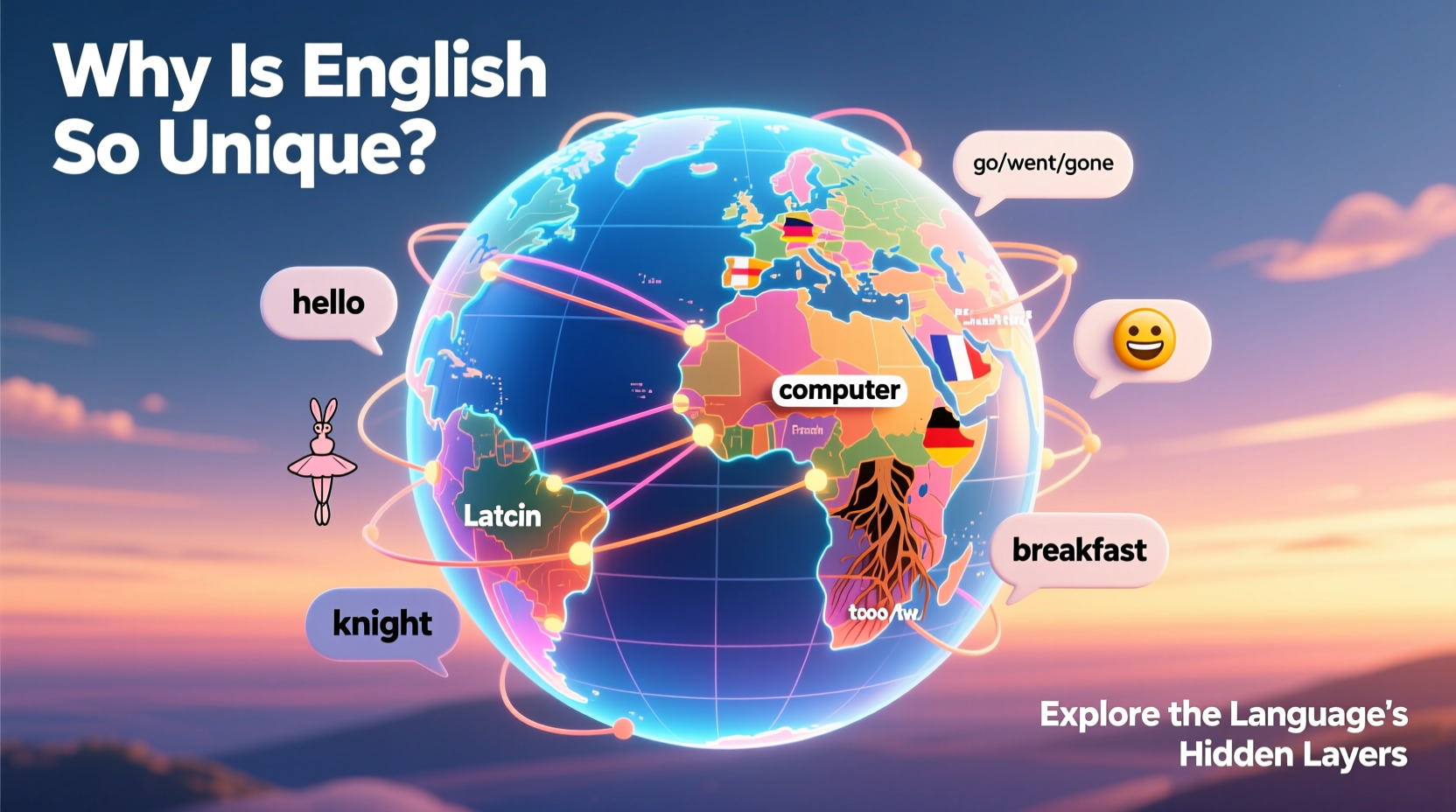
One of the most defining traits of English is its extraordinary openness to foreign words. Over 80% of English vocabulary is borrowed from other languages—a figure unmatched in linguistic history. Latin, French, Norse, Greek, Arabic, Hindi, and even Japanese have all left indelible marks on the lexicon.
The Norman Conquest of 1066 was a turning point. When William the Conqueror seized England, French became the language of the court, law, and aristocracy. For centuries, English absorbed thousands of French terms. This is why we have pairs like cow (Old English) and beef (from French *boeuf*), or sheep (Anglo-Saxon) and mutton (from French *mouton*). The animal kept by peasants had an English name; the meat served to nobles bore a French one.
| Native English Word | Borrowed Equivalent | Origin |
|---|---|---|
| ask | question | French/Latin |
| heaven | paradise | Persian via Greek |
| kingly | royal | French |
| freedom | liberty | Latin |
This layering of vocabulary allows for subtle distinctions in tone and register. A writer can choose between “begin” (Germanic), “commence” (French), and “initiate” (Latin), each carrying different connotations despite similar meanings.
The Spelling Nightmare: Why \"Through\" Isn't \"Thru\"
English spelling is notoriously inconsistent. There are more exceptions than rules: through, though, thought, thorough, and plough all end with \"-ough\" but are pronounced completely differently. Linguist Mario Pei once quipped, “Only in English do ‘writers’ write, but ‘fingers’ don’t ‘fing.’”
This chaos stems from the Great Vowel Shift (1350–1700), a massive change in pronunciation that occurred while spelling norms were becoming fixed due to the printing press. As vowel sounds evolved dramatically, spelling remained largely unchanged. Words like name and house shifted in pronunciation but kept medieval spellings.
Compounding the issue, early printers often favored etymological spellings—inserting silent letters to reflect Latin roots. Thus, “debt” gained a silent “b” (from Latin *debitum*), and “island” acquired an “s” (erroneously linked to Latin *insula*, though it originally came from Old English *īegland*).
“English spelling is not a system designed for efficiency—it’s a historical archive frozen in type.” — Dr. Sarah Johnson, Historical Linguist, University of Edinburgh
Syntax and Simplicity: Grammar Without Gender
Despite its lexical complexity, English grammar is relatively simple compared to many Indo-European languages. It lacks grammatical gender (unlike French, German, or Spanish), has minimal verb conjugation, and uses word order rather than inflection to convey meaning.
Consider the sentence: The dog bites the man. Change the word order to The man bites the dog, and the meaning flips entirely. In Latin or Russian, case endings would clarify who is doing what, regardless of order. But in English, syntax is king.
This analytic structure makes English highly adaptable. New phrases and constructions emerge constantly through usage, not prescription. Phrasal verbs like give up, put off, or run into combine simple verbs with prepositions to create nuanced meanings—a feature rare in other languages.
Why English Thrives in the Digital Age
The internet has accelerated English’s dominance, but also highlighted its flexibility. Online communication rewards brevity, clarity, and speed—all areas where English excels due to its modular vocabulary and straightforward syntax.
Hashtags, memes, and emojis integrate seamlessly with English because the language readily absorbs new forms. Abbreviations like “LOL,” “IMO,” and “TL;DR” enter mainstream use almost overnight. Even non-native speakers adopt English-based digital slang globally.
Global Variants: One Language, Many Identities
There is no single “correct” English. From Indian English to Nigerian Pidgin, Singaporean English to Jamaican Creole, regional varieties reflect local cultures while remaining mutually intelligible to varying degrees. These dialects aren’t deviations—they’re evolutions.
In Nigeria, for example, “I’m coming” often means “I’m about to leave,” reflecting context-based interpretation over literal translation. In India, expressions like “Do the needful” or “She is studying still” follow native syntactic patterns adapted into English grammar.
This adaptability is both a strength and a source of confusion. It enables inclusion but challenges standardization. Yet it underscores a key truth: English belongs to everyone who uses it, not just its native speakers.
Mini Case Study: The Rise of Singlish
Singapore’s hybrid English, known as Singlish, blends English base structure with Malay, Mandarin, and Tamil influences. Phrases like “Can or not?” or “He very blur one” may seem ungrammatical to outsiders, but they function efficiently within the community.
Despite government efforts to promote “Standard English” for international competitiveness, Singlish persists as a marker of national identity. It demonstrates how English can serve dual roles: a tool for global connection and a vessel for local expression.
Learning Challenges and Cognitive Advantages
For learners, English presents unique hurdles. Irregular verbs (go/went/gone), unpredictable stress patterns, and homophones (there/their/they’re) demand memorization over logic. Yet studies suggest that mastering such irregularity enhances cognitive flexibility.
Researchers at the Max Planck Institute found that multilinguals exposed to high-variability languages like English develop stronger pattern-recognition skills. The brain learns to expect exceptions, making adaptation to new linguistic environments easier.
📋 **Checklist: What Makes English Distinct?**- Massive borrowing from over 350 languages
- No grammatical gender system
- Fixed subject-verb-object word order
- High tolerance for neologisms and slang
- Pronunciation-spelling mismatch due to historical shifts
- Global diversity in regional dialects
- Phrasal verbs that create complex meanings from simple parts
Frequently Asked Questions
Why does English have so many synonyms?
Centuries of conquest and cultural exchange introduced overlapping vocabularies. Germanic, Romance, and Classical roots coexist, giving English multiple words for similar ideas—often with subtle differences in formality or context.
Is English harder to learn than other languages?
It depends. Basic communication can be acquired quickly due to simple grammar, but mastering fluency is challenging because of irregular spelling, idioms, and pronunciation inconsistencies.
Will English eventually stop changing?
No. All living languages evolve. With AI, globalization, and youth-driven digital culture, English is changing faster than ever. New words like “selfie,” “ghosting,” and “metaverse” show that innovation is built into the language’s DNA.
Conclusion: Embrace the Chaos
English isn’t unique because it’s logical or consistent—it’s unique because it survives and thrives on contradiction. It borrows without permission, simplifies complex grammar, and reinvents itself across continents. Its power lies not in purity, but in plasticity.
Whether you're a native speaker or learning it as a second language, understanding English’s peculiarities unlocks deeper appreciation—not just of words, but of history, culture, and human connection. Instead of fighting its quirks, embrace them. After all, if English played by the rules, it wouldn’t be English.




 浙公网安备
33010002000092号
浙公网安备
33010002000092号 浙B2-20120091-4
Comments
No comments yet. Why don't you start the discussion?