
For over two decades, Final Fantasy VII has remained one of the most influential role-playing games in history. Even among players who grew up with modern open-world epics and photorealistic graphics, FFVII continues to resonate—both as a nostalgic landmark and as a masterclass in storytelling, character development, and world-building. But if you're new to RPGs or have only recently heard the name Cloud Strife or Sephiroth, you might wonder: what makes this 1997 title still matter today? The answer isn't just nostalgia—it's a combination of groundbreaking design, emotional depth, and cultural impact that redefined what video games could be.
The Game That Changed RPGs Forever
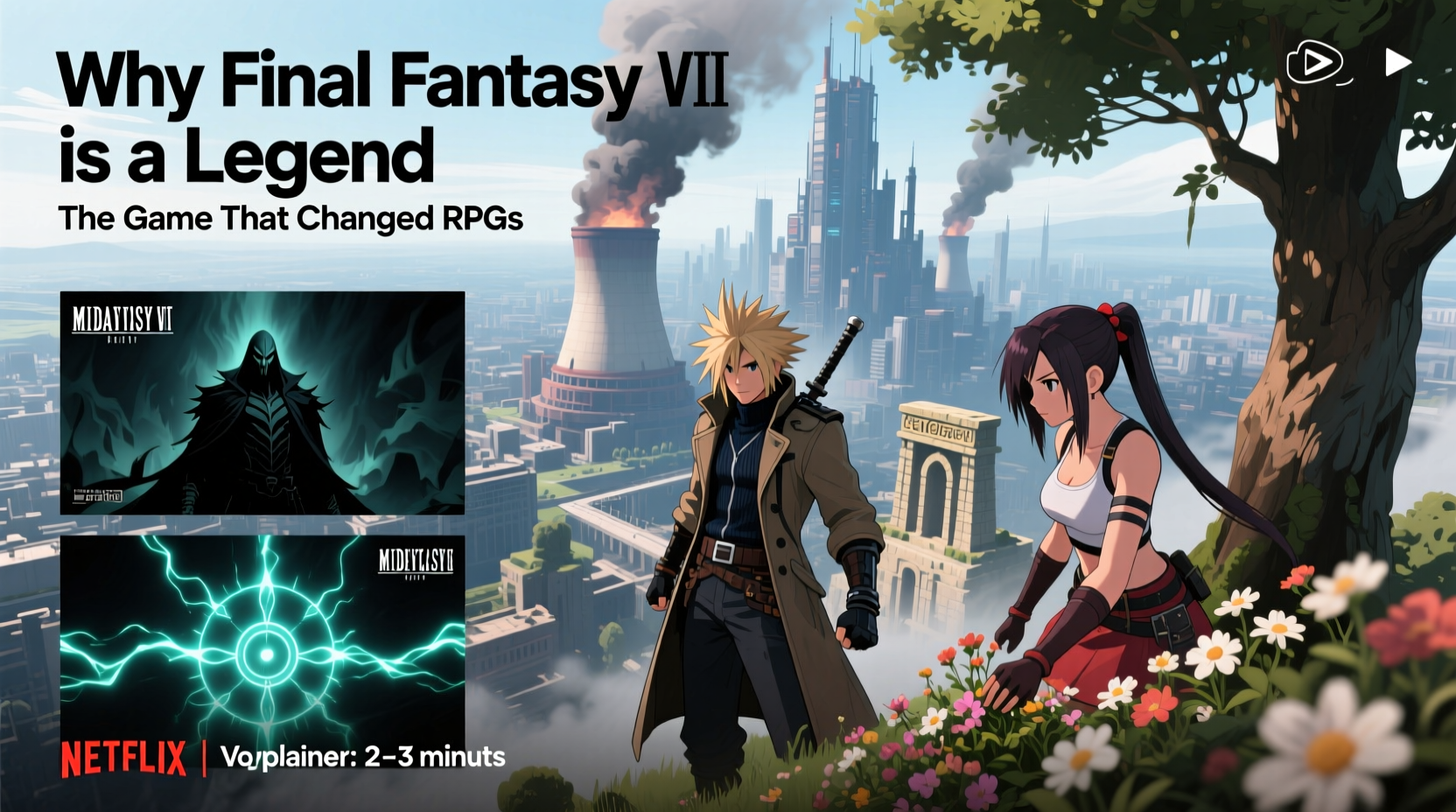
When Final Fantasy VII launched on the original PlayStation, it arrived at a pivotal moment in gaming history. RPGs were largely niche in the West, dominated by turn-based mechanics and pixelated sprites. FFVII didn’t just enter the mainstream—it exploded into it. By leveraging the power of CD-ROM technology, Square (now Square Enix) delivered full-motion cutscenes, orchestrated music, and voice acting during key moments, all of which gave the game a cinematic quality previously unseen in the genre.
But beyond technical achievements, FFVII made RPGs accessible. It introduced a streamlined menu system, an intuitive Active Time Battle (ATB) mechanic, and a world map that encouraged exploration without overwhelming newcomers. For many Western players, this was their first real experience with a deep, narrative-driven RPG—and it set a new standard.
A Story That Feels Human
At its core, Final Fantasy VII tells the story of Cloud Strife, a former soldier turned mercenary who joins an eco-terrorist group called AVALANCHE to fight against the Shinra Corporation—a megacorporation draining the planet’s life force for energy. What begins as a political conflict evolves into a deeply personal journey about identity, loss, and redemption.
Cloud’s internal struggle—his fragmented memories, suppressed trauma, and quest for self-understanding—was revolutionary for its time. Unlike traditional heroes who knew their purpose from the start, Cloud is unreliable, emotionally distant, and gradually pieced together by both the player and the narrative. This psychological complexity elevated the game beyond typical “save the world” tropes.
The supporting cast further deepens the emotional weight. Characters like Aerith, whose quiet strength and tragic fate shocked players worldwide; Tifa, balancing loyalty and unspoken feelings; and even antagonists like Sephiroth, whose god complex and twisted origin story make him one of gaming’s most iconic villains—all contribute to a narrative that feels operatic yet intimate.
“Final Fantasy VII proved that video games could carry emotional weight comparable to film or literature. It wasn’t just entertainment—it was art.” — Hironobu Sakaguchi, Creator of Final Fantasy
Innovation That Shaped the Industry
FFVII wasn’t just a hit—it was a blueprint. Its success demonstrated that Japanese RPGs could achieve global popularity, paving the way for franchises like Kingdom Hearts, Persona, and even Western titles such as Mass Effect and The Witcher. Let’s break down some of the innovations that made it so influential:
- Cinematic storytelling: Cutscenes weren’t just transitions—they advanced plot, revealed character motivations, and built tension.
- Materia system: A customizable progression system where players could mix and match abilities, magic, and stats, allowing for diverse playstyles.
- Environmental themes: The game tackled ecological collapse decades before climate change became a mainstream concern in media.
- Urban dystopia: Midgar, the game’s opening city, presented a steampunk-meets-cyberpunk metropolis divided between the wealthy elite and the oppressed undercity—a stark commentary on class disparity.
These elements weren’t just cool features—they created immersion. Players didn’t just control characters; they lived alongside them in a world that felt alive, flawed, and worth saving.
How FFVII’s Design Influenced Modern Games
| Innovation | Impact on FFVII | Influence on Later Games |
|---|---|---|
| Active Time Battle (ATB) | Bridged turn-based strategy with real-time urgency | Inspired systems in Tales series, Chrono Cross, and modern Final Fantasy titles |
| Materia System | Allowed deep customization without rigid classes | Precursor to skill trees in Skyrim, Diablo, and Dragon Age |
| Filmic Cutscenes | Elevated narrative delivery with dramatic pacing | Standardized in games like God of War, The Last of Us, and Red Dead Redemption |
| Character-Driven Plot | Emphasized personal arcs over pure heroism | Seen in games like Disco Elysium, Life is Strange, and Nier: Automata |
A Legacy That Keeps Evolving
What truly sets FFVII apart is how its legacy continues to grow. Unlike many classic games that fade into obscurity, FFVII has been reborn multiple times:
- Advent Children (2005): An animated film sequel exploring the aftermath of the original story.
- Compilation of Final Fantasy VII: A multimedia project including prequels (Crisis Core), side stories (Dirge of Cerberus), and spin-offs (Before Crisis).
- Final Fantasy VII Remake (2020): A full ground-up reimagining that expands the original narrative with modern gameplay, visuals, and deeper character development.
- Rebirth (2024): The second chapter in the remake trilogy, confirming that this story still has years of relevance ahead.
The remake, in particular, demonstrates why FFVII endures. It doesn’t just update graphics—it recontextualizes the story, adding layers to characters and themes that were only hinted at in 1997. For example, the expanded portrayal of Barret Wallace challenges early perceptions of him as a loud radical, instead revealing a passionate father fighting for his people’s survival. These updates make the world feel more nuanced and socially aware, resonating with modern audiences.
Mini Case Study: How One Player Discovered FFVII at 22
Diego Martinez, a college student majoring in digital media, had never played an RPG before picking up the FFVII Remake on a friend’s recommendation. “I thought it would be slow and full of text,” he said. “But within an hour, I was hooked. The way the camera lingered on Cloud’s face during quiet moments, the music swelling during boss fights—I felt like I was in a movie, but I was making the choices.”
After finishing the game, Diego researched the original version and joined online forums discussing lore theories. “It’s wild that a game from the ’90s still has fans debating whether Aerith’s death was avoidable or if Sephiroth was born evil. That kind of lasting discussion? That’s not just a game. That’s culture.”
Why New RPG Players Should Experience FFVII
If you’re new to RPGs, starting with FFVII might seem daunting—especially given its age. But the essence of its appeal transcends technical limitations. Here’s a practical checklist to help you engage with the game meaningfully:
Checklist: Getting the Most Out of FFVII (Original or Remake)
- Play the Remake first if you’re new: It modernizes combat and pacing while preserving the soul of the original.
- Pay attention to dialogue: Key plot points and character insights are often buried in optional conversations.
- Experiment with Materia: Don’t just stick to basic attacks. Try pairing Magic Materia with Support Materia (e.g., Fire + All to hit all enemies).
- Explore every area: Hidden items, side quests, and lore entries enrich the experience.
- Take breaks between chapters: The story is dense. Let key moments sink in before moving forward.
- Listen to the soundtrack: Nobuo Uematsu’s score is integral to the mood. Try playing with headphones.
Frequently Asked Questions
Is Final Fantasy VII hard for beginners?
The original can feel slow and menu-heavy by today’s standards, but it’s designed to ease players in. The Remake modernizes combat into a dynamic action-RPG hybrid, making it much more approachable. Difficulty settings also allow newcomers to focus on story without constant frustration.
Do I need to play the other Final Fantasy games to understand VII?
No. Each mainline Final Fantasy game is standalone. FFVII has no direct connection to others in the series, though it shares common themes like magic, airships, and summons (like Ifrit or Bahamut).
Why is Aerith’s death such a big deal?
She was one of the first major RPG characters to die permanently during the story, and her death occurs suddenly, mid-quest, with no chance to prevent it. At the time, this subverted expectations completely—players assumed main party members were safe. Her loss reshapes the tone of the entire game, emphasizing that stakes are real.
Conclusion: More Than a Game—A Cultural Touchstone
Final Fantasy VII remains popular because it did something rare: it made players care. Not just about winning battles or leveling up, but about a broken planet, a haunted protagonist, and friends who stood together against impossible odds. It proved that games could be emotionally complex, visually ambitious, and culturally significant.
For new RPG players, experiencing FFVII—whether through the original, the Remake, or both—isn’t just about playing a classic. It’s about understanding where modern storytelling in games began. It’s about seeing how themes of environmental decay, corporate greed, and personal healing can be woven into an epic adventure. And it’s about joining a global community that has kept this story alive for over 25 years.




 浙公网安备
33010002000092号
浙公网安备
33010002000092号 浙B2-20120091-4
Comments
No comments yet. Why don't you start the discussion?