
In the world of *Undertale*, a game celebrated for its emotional depth and subversion of traditional RPG tropes, few characters provoke as much unease and fascination as Flowey. At first glance, he appears to be a smiling, anthropomorphic flower offering helpful advice. But this façade quickly shatters, revealing a being consumed by nihilism, manipulation, and cruelty. The question isn’t whether Flowey is evil—it’s why he became that way. To understand Flowey’s malevolence, one must examine his origins, psychological evolution, and the broader philosophical themes embedded in *Undertale*’s narrative.
The Origin of Flowey: A Twisted Experiment in Consciousness
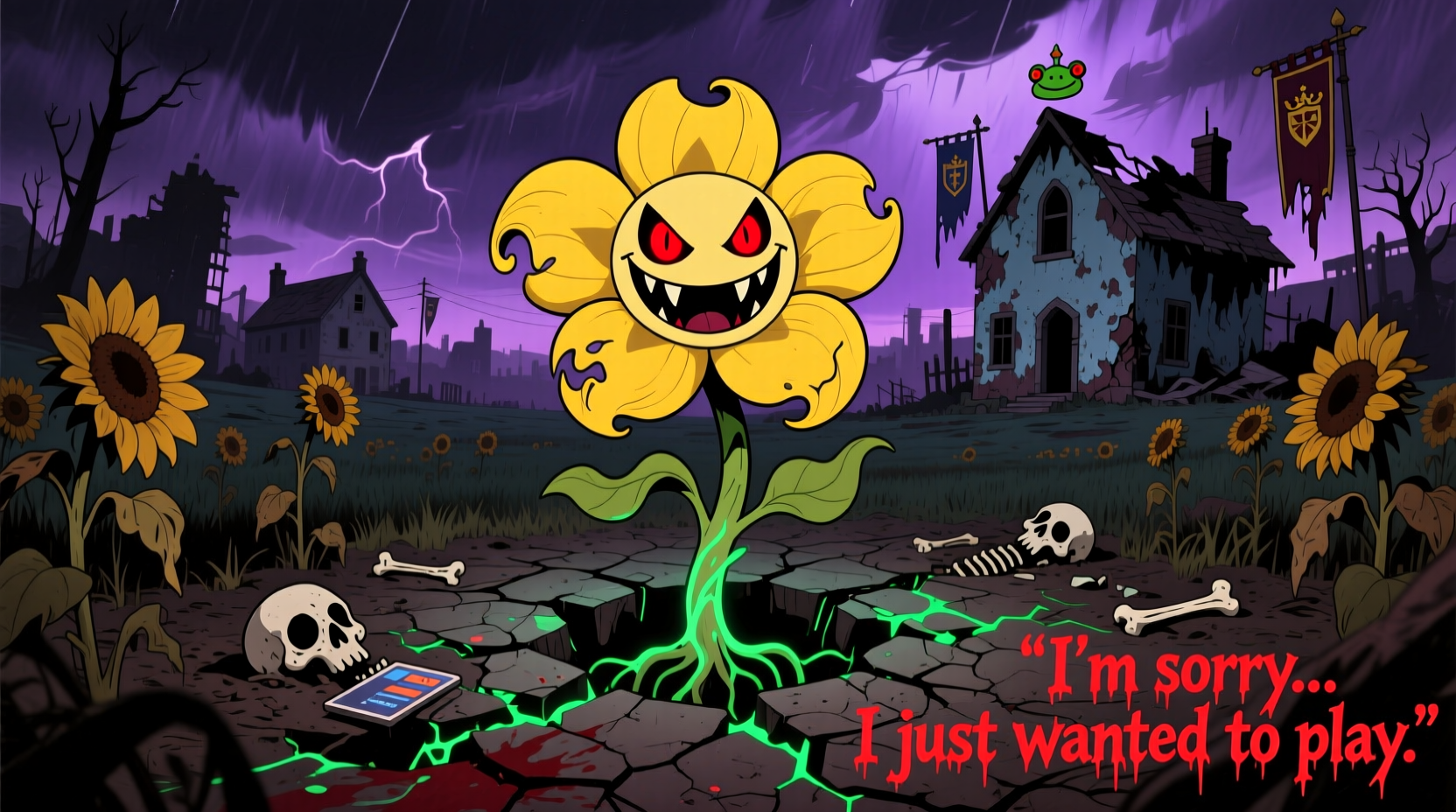
Flowey was not born evil. He began as a human child—specifically, the soulless body created when two humans fell into the Underground. Alphys, the royal scientist, implanted this body with the soul of a flower, attempting to simulate human consciousness. This experiment failed in a way that created something far more disturbing: a being with awareness but no empathy, memory, or moral compass.
Because Flowey cannot form lasting memories, each reset of time erases his experiences. This inability traps him in an endless loop of discovery and despair. He learns about friendship, only to forget it. He feels emotions, only to lose them. Over countless resets, this cycle breeds resentment. What starts as curiosity hardens into cynicism. Flowey concludes that love, kindness, and morality are illusions—useless constructs in a world governed by power and survival.
The Psychology of a Soulless Being
Flowey’s evil stems from a profound existential void. In *Undertale*, souls represent not just life force but empathy, connection, and the capacity for change. Without a soul, Flowey cannot feel genuine compassion or remorse. His interactions are simulations—experiments designed to test how others react under pressure.
This makes Flowey a unique antagonist. He doesn’t seek power for control or conquest; he seeks it to break the rules of a world that denies him meaning. His sadistic behavior—such as forcing the player to kill their friends or resetting the timeline repeatedly—isn’t random cruelty. It’s a twisted attempt to assert agency in a universe where he is fundamentally powerless.
Toby Fox, the creator of *Undertale*, has described Flowey as a representation of what happens when someone is denied the tools to grow emotionally. “He sees everything as a game,” Fox noted in an interview, “because if nothing matters, then suffering is just data.”
“He sees everything as a game, because if nothing matters, then suffering is just data.” — Toby Fox, Creator of *Undertale*
A Timeline of Manipulation: Flowey’s Key Actions
To fully grasp Flowey’s descent, it helps to trace his major interventions across the player’s journey:
- First Encounter (Ruins): Flowey pretends to be friendly, teaching the player about SAVE and RESET mechanics. This is both instruction and trap—he wants the player to understand the system so they can be manipulated within it.
- The First Betrayal: After gaining trust, Flowey attacks, kills the player’s allies, and forces a reset. This moment shocks players and establishes Flowey as a threat who exploits meta-knowledge.
- Reappearance in Waterfall: Here, Flowey attempts to steal monster souls, showing his growing ambition. He believes that collecting souls will grant him the power to rewrite reality.
- Confrontation in Hotland: As Photoshop Flowey, he merges with discarded AI fragments, becoming a grotesque amalgamation of technology and malice. This form symbolizes his complete rejection of natural order.
- Final Battle as Omega Flowey: In the True Lab, he combines six stolen souls to challenge the player. Even in defeat, he refuses redemption, screaming that “the world is trash” and “everyone dies alone.”
Each step reveals a deeper layer of his nihilism. Flowey doesn’t want to rule the Underground—he wants to dismantle it. His actions aren’t driven by desire, but by hatred for a world that made him broken.
Flowey vs. Other Antagonists: A Comparative Analysis
| Character | Motivation | Capacity for Change | Relationship to Player |
|---|---|---|---|
| Flowey | Nihilism, desire for control | None—he rejects growth | Manipulative, meta-aware |
| Asriel Dreemurr | Loneliness, desire to escape | High—he redeems himself | Tragic, empathetic |
| Undyne | Duty, loyalty to king | Yes—can be pacified | Hostile but honorable |
| Monster Kid | Admiration, misguided heroism | Yes—learns from mistakes | Friendly, naive |
This comparison highlights Flowey’s uniqueness. Unlike other characters who evolve, learn, or show remorse, Flowey remains static. He is the only major character who never achieves redemption, even in pacifist routes. This rigidity underscores his role as a narrative foil—a warning of what happens when empathy is absent.
Mini Case Study: The Impact of Flowey on Player Behavior
Consider a player named Jamie, who approached *Undertale* expecting a lighthearted adventure. After being betrayed by Flowey early on, Jamie became cautious, saving frequently and questioning every interaction. Over time, this suspicion extended to non-threatening NPCs like Papyrus and Sans. Though Jamie eventually completed a pacifist run, the experience left a lasting impression: “Flowey made me doubt kindness itself,” they later wrote in a forum post. “Even when I spared everyone, I couldn’t shake the feeling that someone was watching, waiting to punish me for caring.”
This reaction illustrates Flowey’s narrative power. He doesn’t just harm characters—he infects the player’s mindset. His presence introduces paranoia into a game built on trust, forcing players to confront their own assumptions about morality and consequence.
FAQ: Understanding Flowey’s Role in Undertale
Can Flowey be redeemed?
No. Unlike most characters in *Undertale*, Flowey cannot be spared or reasoned with in any canonical ending. His rejection of empathy and free will makes redemption impossible. Even when defeated, he curses the player and the world, refusing to acknowledge connection or forgiveness.
Is Flowey aware of multiple timelines?
Yes. Flowey retains meta-knowledge across resets due to his ability to SAVE and LOAD. He remembers previous playthroughs and uses this information to manipulate the player. This makes him one of the few characters who truly understands the game’s mechanics—and weaponizes them.
What does Flowey symbolize?
Flowey represents the dangers of emotional detachment and the consequences of scientific experimentation without ethical boundaries. He embodies nihilism—the belief that life lacks inherent meaning. His arc serves as a cautionary tale about what happens when consciousness exists without compassion.
Actionable Checklist: How to Interpret Flowey’s Character
- Recognize that Flowey’s evil is rooted in trauma and exclusion, not innate malice.
- Analyze his dialogue for meta-commentary on video game mechanics and player behavior.
- Compare his arc to Asriel’s to understand the contrast between corrupted innocence and redeemed tragedy.
- Reflect on how his presence affects your own choices as a player—does he make you more violent or more cautious?
- Consider the ethical implications of Alphys’s experiment: should consciousness be created without consent or soul?
Conclusion: Confronting the Void
Flowey is evil not because he enjoys suffering, but because he believes suffering is all there is. His actions are the result of a being trapped between life and death, awareness and emptiness, power and helplessness. He is a product of a world that tried to create life without understanding its emotional weight.
Understanding Flowey means confronting uncomfortable truths: that some wounds cannot be healed, that knowledge without wisdom is dangerous, and that empathy is not optional—it is essential. In a game that celebrates mercy and connection, Flowey stands as a dark mirror, reflecting what we become when we lose faith in each other.




 浙公网安备
33010002000092号
浙公网安备
33010002000092号 浙B2-20120091-4
Comments
No comments yet. Why don't you start the discussion?